Postcard from Cadiz, Spain: Jueves Santo processions stretch toward dawn

As Saint John (I think?) headed down the street, we were returning to our apartment about 7:30 last night. During our meandering hour or two walk we encountered this float bearing the evangelist, Mary the wife of Cleopus, Mary Magdalene, the Virgin Mary and Jesus with the cross a multitude of times.

Their swaying journey on the golden paso was not close to over for the night. Perhaps they were still Cathedral-bound because costaleros in purple t-shirts slipped into the procession to replace the team underneath porting the heavy load within the next block. The back of this float has a small emblem of Hercules on it, which seems appropriate when you watch a team hoist it back up after lowering it.

The Mister spotted the putto with a nail-puller, perhaps indicative of the historical trade engaged in by some members of the velvet capirote-ed cofradia sponsoring the procession. (I have noticed the role of hard-working putti in the church often is overlooked. Yes, sometimes they appear fluttering around in fluffy clouds, but more often petite putti spend eternity supporting enormous statues, altars, organs, columns and even soaring domes.)

I am unsure how many processions were weaving their way around our neighborhood last night, but they do march for hours. Floats pass through the Cathedral, but do not encamp overnight. They must make the return trip to their home churches and squeeze back through the doors.

Our street might not quite be a paso-possible width, but processions were crossing at both ends less than a block away in addition to a square a block away. This crossroads location meant the procession-watchers on foot would come down our little rarely trafficked street in large, chattering groups before and after each passing.

They awakened me in time to hear the brass bands and thudding drums about 12:30 and 2:30. The 4:30 crowd sounded much smaller. At 6:30 this morning it seemed a second more refreshed and sedate shift of faithful followers was filtering out to view the final float trying to reach home before dawn.

How will they all recover in time to participate in Viernes Santo?
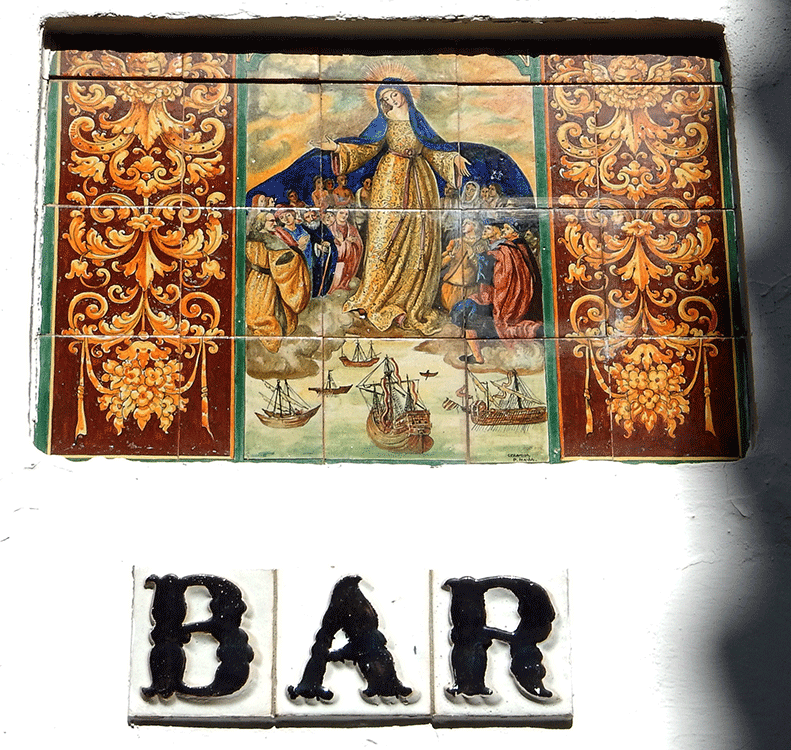
Postcard from Sevilla, Spain: The patron saint of nerds doesn’t stand a chance against the mighty tile Mary

The patron saint of Sevilla is San Isidro, Saint Isidore of Seville (560-636), Archbishop of Sevilla. I failed to find what miracles were credited to him to attain sainthood, and I think he died a natural death. His major accomplishment was his encyclopedic Etymologiae, collecting and preserving numerous early written works of antiquity.

But, wandering the streets of Sevilla, it is obvious La Virgen reigns. She lords over everything everywhere. Upon arriving, I decided to snap a photo of every tile mural of her I encountered.

It quickly became apparent that was absurd. Although the Mister is patient, we would have to stop at almost every corner to accomplish that. Plus, how many photos are allowed in one blog post?

But today might be the time for San Isidro’s popularity to soar. Au courant, he is the patron saint of the Internet, computers and nerds.

From now on, I will try to utter San Isidro’s name when I encounter computer frustration instead of my usual over-employed four-letter words.

The poor saint does not stand much of a chance in Sevilla though. Internet powers pale next to the beauty of the abundant tile tributes to the Virgin Mary found along her streets.

Many more azulejo postcards, not all La Virgen, will be posted in the coming weeks….

Postcard from Andalucia, Spain: Marching toward Semana Santa

It takes a certain build to be able to port an immense paso, or float, through the streets for the numerous processions that will be held during Semana Santa, or Holy Week. Teams of costaleros, the bearers of the floats, must all be of about the same height and have strong necks.

Costaleros are often encountered at practice, as above, with a training base topped with cinder blocks. Rewarding beer breaks appear part of the team-building practice. As the floats are assembled by members of the church confradias, or brotherhoods, what the porters carry becomes increasingly more elaborate.

In the early evening leading up to Holy Week in Sevilla, almost every church throws open their doors for the faithful to file through to view the heavily gilded pasos.

Ornately crowned Virgens appear front and center in displays in numerous shops, but the most tantalizing windows are those of La Campana, a confectionary store operating in Sevilla since 1885. Chocolate and bon bon Nazarenos parade side by side next to elaborately crafted candied pasos. Could not help wondering about the proper etiquette for eating a chocolate Nazareno. Feet first? The way I used to nibble at chocolate rabbits when Mother wasn’t looking, thinking she would assume the bunnies merely were sinking deeper in the shiny green grass of the basket?

Last evening found us in Cadiz for processions of penitentes slowly, dirge-like slowly, marching to mark Viernes de Pasion, or Viernes de Dolores, the final Friday of Lent commemorating the suffering of the grieving Virgin Mary. Wearing their signature capirotes, hoods with tall points revealing only their eyes, the figures appeared quite grim.

Guilty confession: dinner summoned us before any actual pasos appeared heading our way along the crowded narrow streets. There were a lot of penitentes in the advance guard.