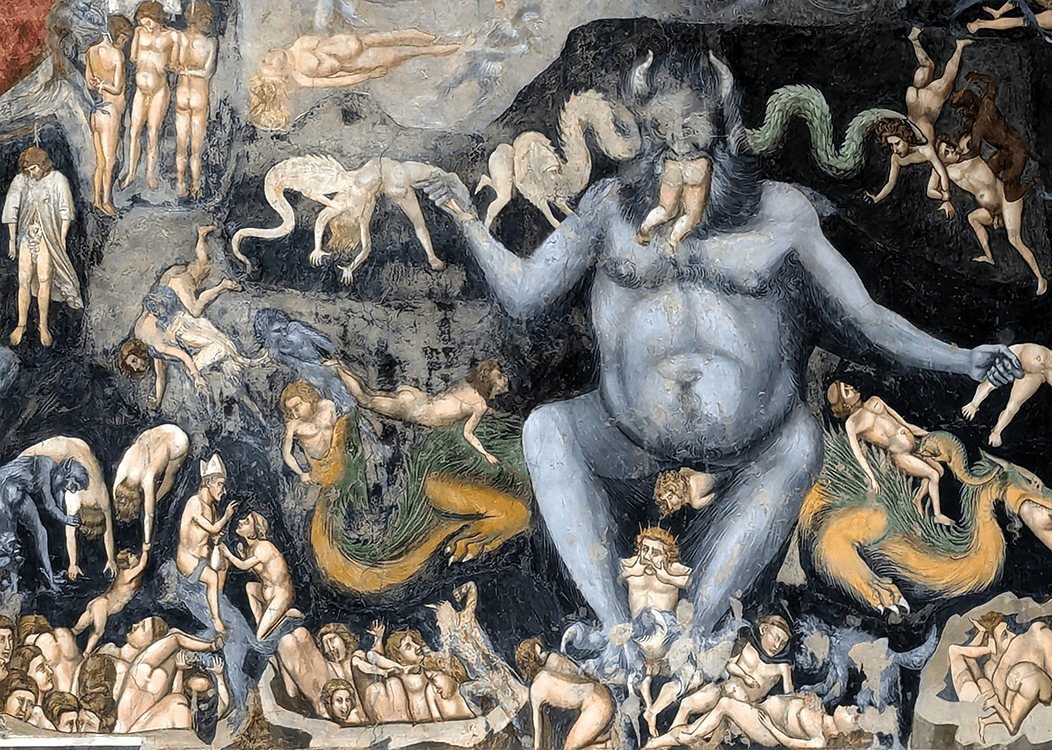
Postcard from Padua, Italy: How could I forget Giotto’s Hell?

A postage stamp depicting a scene from the Scrovegni Chapel, showing the Nativity with the Virgin Mary, Joseph, and angels, artistically rendered.

Above: The devil lording over Hell as depicted in “The Last Judgment” by Giotto (Ambrogiotto di Bondone, 1266-1337) in the Scrovegni Chapel

But as for the cowardly, the faithless, the detestable, as for murderers, the sexually immoral, sorcerers, idolaters, and all liars, their portion will be in the lake that burns with fire and sulfur, which is the second death.”

Book of Revelation, Chapter 21, Verse 8

Slides in Professor Bill White’s Renaissance art course at Hollins University groomed me into a Giotto groupie prior to standing in awe before Giotto’s actual frescoes in the Scrovegni Chapel. And Professor Henning surely pointed out Giotto’s horrific visions of Hell when I was on summer tour about a half-century ago, but I had sharper memories of gazing upward toward his Heaven.

Continue reading “Postcard from Padua, Italy: How could I forget Giotto’s Hell?”

Postcard from Catania, Sicily: Path to sainthood painful, but it’s Santuzza’s day

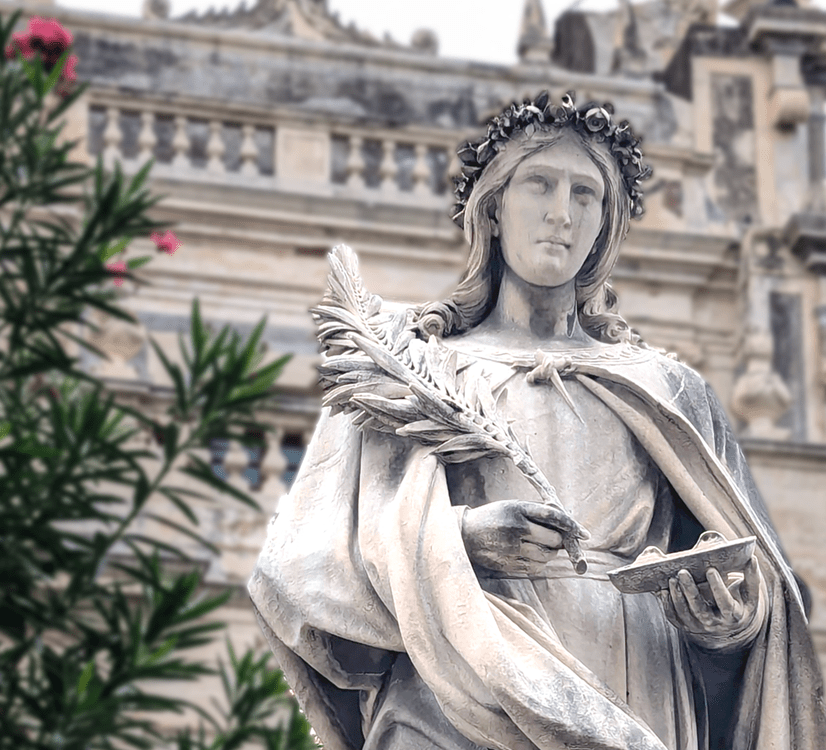
Above: Statue of Saint Agatha, affectionately known as Santuzza, in front of the Basilica di Sant’Agata in Catania

I wanted to do a “birthday” post for Saint Agatha (231?-251?), but recent world news knocked the wind out of my sails to the point I felt unable to complete it last night. But that’s not fair to Santuzza on her feast day, February 5.

Saint Agatha can’t be expected to solve all the world’s problems. The faithful turn to her for intercession so often; she already has a lot on her hands. The Sicilian martyr serves as the patron saint of victims of breast cancer or rape, and of wet nurses, firefighters, workers in bell foundries and bakers. Plus, Sicilians offer prayers to the Catania native for safety from earthquakes and volcanic eruptions of Mount Etna. The virgin martyr also is the patron saint of both Palermo and Catania in Sicily.

Continue reading “Postcard from Catania, Sicily: Path to sainthood painful, but it’s Santuzza’s day”

Postcard from Palermo, Sicily: Modern art in Sant’Anna haunt

Above: Richard Avedon’s 1981 photograph, “Natassja Kinski and the Serpent,” is superimposed over one of a cage protecting a cluster of bones in the crypt below Sant’Anna la Misericordia, home to Palermo’s Galleria d’Arte Moderna.

Granted this Richard Avedon photo of “Natassja Kinski” in the nude was not displayed in such close proximity to bones in the crypt of the church of Sant’Anna alla Misericordia, but, after all, nothing is more naked than bones. And churches in Italy have always been home to art, religious art that in the time of its creation was considered contemporary.

When citizens in Palermo determined they needed to have a Modern Art Museum in 1906, they boldly ventured forth to Venice in 1907 to acquire avant-garde works to supplement their Sicilian collection. Launched in 1895, the Venice Biennale quickly garnered international prestige. Ongoing buying trips through the years enabled the museum to trace the evolution of symbolism and modernism in art.

Continue reading “Postcard from Palermo, Sicily: Modern art in Sant’Anna haunt”