More than 300 workers lost their livelihoods when the giant mechanical looms quit spinning cotton at Fabrica la Aurora in 1991. After 90 years, the massive mill stood silent.
Twenty years later, artists began to breathe new life into the abandoned structures as developers reopened one after another to create a vibrant center of art and design. The studios of working artists, art galleries, antique stores, restaurants and cafes now number more than 40, meaning meandering through the campus can take several hours.
This slideshow requires JavaScript.
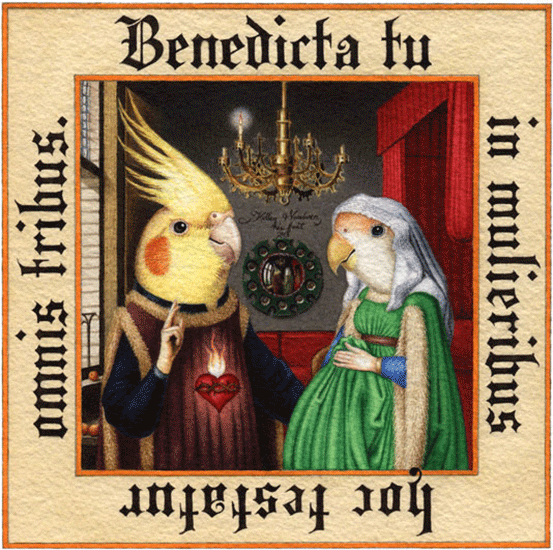
Naturally, my favorite space belongs to artist Kelley Vandiver because every painting tells a story – the kind I call “saintly stories nuns never told me.” And Vandiver splices wonderful iconography into the tales he weaves.
Why live in Mexico? Vandiver’s answer:
This is a beautiful country that embraces the insane and the artistic with open arms.
I was not a real Mexican, and I was not a real American.
Benjamin Alire Saenz
That’s how author Benjamin Alire Saenz recalled his feelings as a young boy growing up in Mesilla, New Mexico, and crossing weekly into Ciudad Juarez for flat-top haircuts. Staring at the giant flags fluttering over the bridge:
I wondered if the American eagle was that much different than the Mexican one.
Saenz is the author of Everything Begins and Ends at the Kentucky Club, a collection of short stories winning a PEN Faulkner Award for Fiction. A former Wallace Stegner Fellow at Stanford University, Saenz chairs the Creative Writing Department at the University of Texas at El Paso.
“Juarez Doesn’t Stop at the Border” was the title of the powerful keynote address he delivered two nights ago at the San Miguel Writers’ Conference. The visibly affected crowd quickly rose as one the second he finished the final sentence of the emotionally charged presentation. It was the topic on everyone’s lips the next morning as attendees flocked to the bookstore to purchase recordings to share with others.
Saenz’s talk was preceded by an introduction to Duncan Tonatiuh, the artist/author who designed the conference posters. Although Tonatiuh is young – he graduated from college in 2008 – he already has several award-winning books to his credit.
In an article in USA Today, Mark Krikorian, executive director of the Center for Immigration Studies,labels Tonatiuh’s Pancho Rabbit and the Coyote: A Migrant’s Tale “propaganda.” But the author of the fable, in which the coyote stands in for those who smuggle immigrants into the United States from Mexico, believes he has created a bedtime story to which many children in North America can relate.
At the Writers’ Conference, Tonatiuh screened a short video made for him by a fourth-grade class in Austin, Texas.
Many a Kleenix was lifted up to dab away a tear.
It appears Tonatiuh’s book provides a key for teachers to encourage children of immigrants to open up and discuss their experiences.
Perhaps Pancho Rabbit serves as an even more valuable tool for helping children of American-born parents understand and empathize with the issues confronting some of their classmates.
Oh, I’m sorry Mr. Krikorian. Is that “propaganda?”
Update posted on March 19, 2014: Duncan Tonatiuh will be appearing from 11 to 11:30 a.m. in the Children’s Book Tent at the San Antonio Book Festival on Saturday, April 5.




 Postcards from Barton Springs