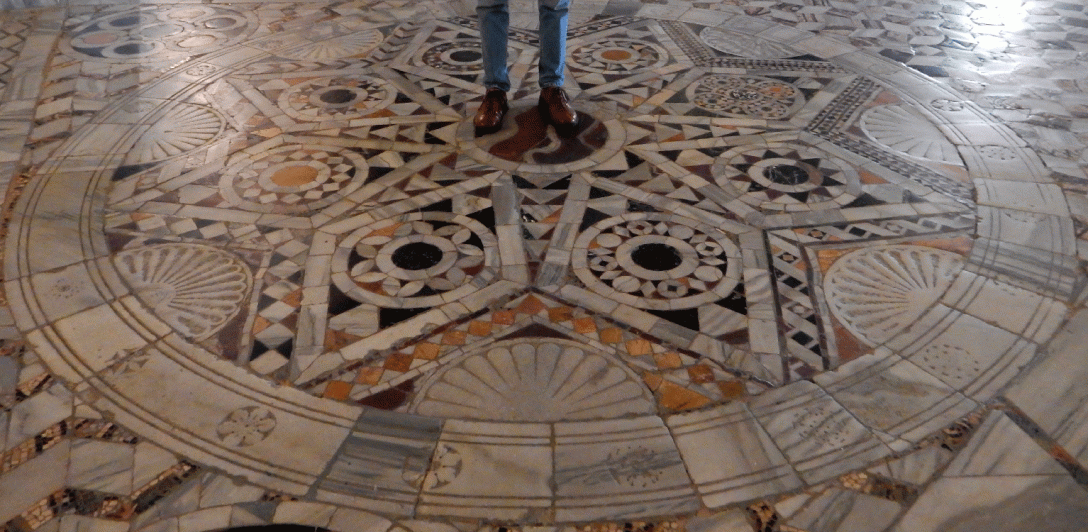
Before we look up at the walls and the ceilings covered in mosaics, we are going to look underfoot. The shimmering mosaics above make it almost easy to overlook the amazing mosaic and marble floors found in landmarks in Ravenna dating from the first millennium.
Honorius (384-423) was only ten years old when his father died. Sad fact on its own, but his father was Theodosius the Great (347-395), Emperor of the Roman Empire. With big shoes to fill, he needed to grow up quickly. The rule of the empire was divided, with his older brother reigning over the eastern half and Honorius presiding over the western half.
Pesky barbarians kept trying to wrest control of his empire, and Honorius decided to move his capital to Ravenna in 402. The new capital was viewed as easy to defend, surrounded by fortifications built by earlier emperors and marshland. While the capital could be defended, its location left much of the rest of Italy vulnerable.
In 408, the Roman Senate bought their way out of danger by paying the Visigoths 4,000 pounds of gold to leave Italy alone. But having run through that the Goths returned to sack Rome itself in 410. Britain and much of the rest of the Roman Empire were left without Roman protection. And, although Rome was regained in 414, Honorius is remembered for the defeats suffered and the unraveling of the empire during his reign.
Perhaps tired of being cold, the Goths returned with a vengeance under the leadership of the King of the Ostrogoths, Theodoric the Great (454-526). Theodoric made Ravenna the base for his new Arian kingdom, welcoming more than 200,000 of his followers to settle in Italy. While this was bad for much of Italy, Ravenna flourished under the attention.
Two decades after Theodoric’s death, Justinian I (483-565), the Byzantine Emperor, was able to wrest control of Ravenna and much of Italy from the Ostrogoths. Ravenna continued to benefit from royal attention.
After the 8th century, Ravenna was no longer a star. This lack of attention and imperialistic investment turned her into somewhat of a sleeping beauty, extremely beneficial for preserving the city’s early Christian monuments. Eight of its 5th and 6th century buildings are recognized on UNESCO’s World Heritage List as demonstrating “great artistic skill, including a wonderful blend of Graeco-Roman tradition, Christian iconography and oriental and Western styles.”
The mosaics inside these monuments are Ravenna’s main attractions, but we are going to ease into those. This first postcard from Ravenna is simply a random combination of photos of the city to whet your appetite.
La Gardela grilled raddicchio
La Gardela spedino
La Gardela fried zucchini
La Gardela tortelloni
Threw in a little bit of food from lunch to make you hungrier for Ravenna. We stumbled across a nice restaurant with street-side seating, La Gardela. As ridiculous as this sounds, the zucchini fries alone were worth the train ride from Bologna.
Okay, it’s not fair to totally hold out on the mosaics. Peek if you must at this UNESCO preview.
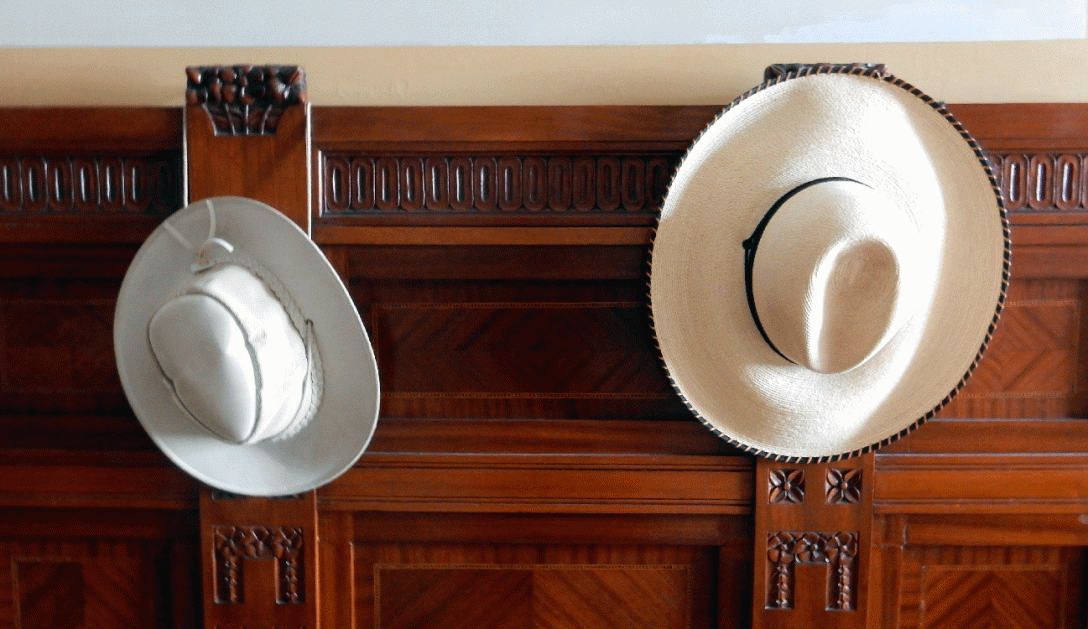
Bologna proved a great place to hang our hats for a month – both figuratively and literally.
We always travel with our sombreros. Although they fail to make a positive fashion statement, they are dermatologist prescribed.
But in Bologna there was scarcely a need to lift them off their hooks in our apartment. Close to 25 miles of arcades shade the sidewalks in Bologna. Rain or sunshine have little impact on your wanderings except when you cross streets.
Few porticos are alike, distinguished by varied treatments of columns, ceilings and sidewalks, which often are finished in artful patterns of terrazzo tile. Arcades were incorporated into the handsome architectural schemes of palaces and allowed landowners to maximize square footage on the upper floors above the public right-of-way.
San Antonio certainly would have benefitted from a program granting air rights in exchange for sheltering pedestrians from that strong Texas sun. Instead of gracefully incorporating porticos into their designs, many of our landmark structures originally had awkward awnings tacked onto their facades. Most of these did not age well and have been removed.





 Postcards from Barton Springs