Must History Repeat Itself? Story Today Leads to Reposting of the Mystery of the Missing State Park

“Plenty of land for new parks but not money” is the headline of a story by Cindy Horwell in today’s San Antonio Express-News.

Two years ago, the Kronkosky Charitable Foundation donated 3,700 acres of undeveloped Texas Hill Country land 30 minutes northwest of Boerne for use as a state park.

Great news, except it is closed to the public. And the state has no plans on board to open it because state park funds are stretched thinly already.

Dear Texas State Legislature: Hopefully, the State of Texas will not let this gift slip away from its residents, as happened with a smaller donation of parkland almost 90 years ago with a Kronkosky connection.

In 2010, I stumbled across, what to me, was the mysterious disappearance of a public park:

Whatever happened to your park, Hallie Maude Neff?

The newspapers of the day used such glowing terms to describe the new state park off the Boerne-Blanco Road (474) on the banks of the Guadalupe River.

Curiosity about the business partnerships existing between Albert Kronkosky (1868-1944), Charles Graebner (Albert Kronkosky’s brother-in-law) and my husband’s step-great-grandfather, John Nooe (1871-1944), a doctor in Boerne, led me to the first clues of the existence of the park:

A beautiful park site at Boerne, eight miles from the Guadalupe river, donated to the State by Charles Graebner, Albert Kronkosky and Dr. J. F. Nooe, has been christened Hallie Maude Neff State park, In honor of the governor’s daughter.

The Brookshire Times, July 25, 1924

Following, is a list of parks given the State on the recent trip… Boerne, 50 acres, Charles Graebner, Dr. J. F. Nooe, Albert Kronkosky, on Guadalupe River, fine shade-and water. (Hallie Maude Neff State Park.)

San Antonio Express, August 19, 1924

The Hallie Maude Neff State Park at Boerne. which was donated by Messrs Albert Kronkosky, Dr. J. F. Nooe and Col. Chas. Graebner, will be one of the most attractive spots in Texas for the coming season, because it has the Guadalupe River for the north line and the Sabinas River running through it with a concrete dam across it, making a fine swimming pool or lake. We should say, that will accommodate 7,000 people.  This Park will attract thousands of people from San Antonio during the summer season.  The Chamber of Commerce at Boerne has raised funds by public subscription to build a better road to the Park and it is about completed now, it isn’t only a better road but a good one.  Thanks to Mr. Holekamp for his business methods in spending money.

Big Spring Herald, January 16, 1925

Had I stumbled across these clues in the mystery of the missing state park a number of years ago, perhaps Bessie Mae Kronkosky might have been able to shed light.  But she passed away on the first of this month at the age of 103.

Sarah Reveley shared a much larger clue with me, a full-page story praising the park as a “new fairyland” in the March 22, 1925, edition of the San Antonio Express:

For not only has one of the most alluring and naturally beautiful scenic spots of all Texas, or anywhere else for that matter, been given in fee simple to the State Park Board acting in behalf of the State of Texas, but now the same interest that gave the 70-acre tract eight and a half miles out the Blanco highway from Boerne are spending $15,000 from their private funds in order that the park will be ready to receive visitors early this summer.  Other citizens of Boerne recently subscribed $1,100 to provide funds for putting the highway from Boerne to the park in the best possible shape to accommodate the tremendously heavy traffic anticipated.

The article describes a lodge capable of accommodating 100 people next to the caretakers’ cottage and facilities for campers.  Among the distinctive features were a “babbling brook,” a “bell-ringing rock” and “the Flapper’s Roost, which is reached by a winding stair on a tree that leads from a cliff down to the water’s edge.”  Recreational opportunities included the swimming area in the Guadalupe, canoeing and a concrete dam being built over the Sabinas River for fishing.  The natural cave on Bear Creek in the park contained:

…the Venus hair fern, a species of Maidenhair fern scientifically known as Adiantum Cappillis-Veneris.  This is the only place in Texas that this specimen of fern is known to thrive.

Does this rare fern still thrive today?

This slideshow requires JavaScript.

I dragged one of my sisters out to look for the park that promised to attract San Antonians by the thousands.  The spot at the creek at what would have been the closest edge of Hallie Maude State Park to 474 is indeed still beautiful.  Although there is river access, no evidence of a state park exists.

But how did Hallie’s namesake park disappear from the Texas state map?  Please send more clues….

Note Added on September 13, 2010:  And how could it disappear so quickly? It does not appear to be included on a 1936 map of state parks published by the Texas Planning Board.

Note Added on September 15, 2010:  As this story wandered around the internet, it fell into the hands of Bill Ward, a retired geologist and member of the Native Plant Society.  Not sure why, but, according to his research, the “fairyland” was returned to its donors before 1933:

Most of the improvements at Hallie Neff State Park at Boerne came during 1926 through convict labor.  Footnote:  The seventy acre Hallie Neff Park was donated to the state in 1925. It reverted back to the donors before 1933. Charles S. Potts, The Convict Labor System of Texas. (Publications of the American Academy of Political and Social Sciences, No. 383, 1903), p. 429, U.T. Vertical File, Box 332, SHRLRC; “Eight Convicts and Truck to Help Neff Build State Parks,” Austin American. 1924, Box 3L426, CAH; Lawson, “The Texas State Parks System,” pp. 1-3; Jackson, “State Parks for Texas,” p. 71; Texas Legislative Council, Texas State Parks, p. 2.  page 41 of dissertation on Texas state parks

Note added on October 27, 2010:  Another update from Bill Ward –

Sabinas River refers to the little Sabinas Creek that enters the Guadalupe River just west of the 474 bridge.  That species of maidenhair fern is the most common fern in the Hill Country.  Even in 1925, no one should have said it only was known from that site.

Processing Art through Public Filters, Part Two

whitewashedOn the left side of the photo on the right is a wall.

The wall, prepped for painting, is not architecturally stunning.

In fact, one could say it is architecturally challenged.

Perhaps that is why the artist wanted to make a monkey out of it.

monkeyBut this building is located in the King William Historic District, and, according to the San Antonio Express-News, some of its residents evidently felt Robert Tatum’s Chi Chi Monkey made a mockery of the neighborhood.

tame-birdSo the artist came up with a rendering for a tame bird sporting a Tyrolean hat perched outside a gingerbready bird house, all nods to the characteristics of the neighborhood.

Some of the residents were happy.

But, upon further reflection, the artist was not.

He must have felt as though he had his wings clipped.

This tame bird is not representative of his art, and this bird house is on the outside wall of his office.

cuckoo-birdSo he transformed the bird into something more reflective of his style, more of a wild-eyed cuckoo bird too big-headed to fit into his house.

This bird looks much more like Tatum’s style, but some of the neighbors balked at the new one.

The frustrated artist told reporter Scott Huddleston it will be his prized bird or no bird at all.

The poor members of the Historic Design and Review Commission are left in the middle, stuck walking the tightrope between artistic integrity and the strict enforcement of guidelines of the historic district.

I’m rooting for the cuckoo.

Sometimes we take ourselves so seriously, we kill the spirit of things. “We” includes me. Sometimes.

I draw a rigid line in the sand when it comes to protecting sensitive areas, such as the Alamo Plaza Historic District. I’ve even gone so far as to label myself Alamobsessive about it.

But South Alamo in Southtown is not across from the Alamo. And this building is not nestled among stately residences.

It’s in more of the entertainment part of the neighborhood. People walking by the back side of this building are most likely on their way to art galleries or restaurants.

And this wall is not exactly in pedestrians’ faces. It is set way back from the sidewalk and street.

But what about its across-the-street neighbor? Well, that’s got to be about the most laid-back, relaxed place around – The Friendly Spot. The cartoonish cuckoo bird will fit right in and should delight the kids scampering over the Spot’s playscape while their parents gather with friends.

The photo below shows the current wall when viewed from the entrance of The Friendly Spot.

friendly-spot

You probably are thinking I posted the wrong photo. But no. That’s the proposed canvas, way back behind the red SUV, tucked unobtrusively between two buildings. If the bird’s features are not exaggerated, they won’t show up at all.

The tame version of the mural is like the Mission Drive-In, where the spirit of the original art was put in a straitjacket.

Art should reflect its creator. In this location, there seems no need to over-process it in the name of King William’s integrity.

Let that cuckoo bird fly free.

Update on March 7, 2013: Alas, Mr. Tatum, if you had only showed up at the HDRC meeting to plead your case and get a fair hearing, the cuckoo might be perched on your wall instead of caged in my blog.

That Crabby Old Colonel Cribby Condemned the River Walk to Years of Lowlife Nightlife

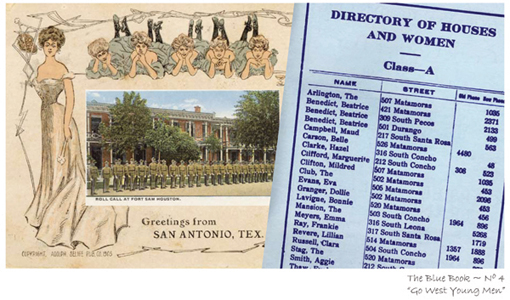
Blue Book No. 4, "Go West Young Men," Digital Collage by Gayle Brennan Spencer. Early 1900s' postcard of some of San Antonio's blue ladies is combined with a period mini-postcard image of "Roll Call at Fort Sam Houston" and a page from "The Blue Book."  The page is headlined "Directory of Houses and Women - Class-A" and lists the names and addresses of some of San Antonio's welcoming women in 1911.  Visit www.postcardsfromsanantonio.com.
Blue Book No. 4, “Go West Young Men,” digital collage by Gayle Brennan Spencer. Early 1900s’ postcard of some of San Antonio’s blue ladies is combined with a period mini-postcard image of “Roll Call at Fort Sam Houston” and a page from “The Blue Book.” The page is headlined “Directory of Houses and Women – Class-A” and lists the names and addresses of some of San Antonio’s welcoming women in 1911. Visit http://postcardssanantonio.com.

I had always heard the banks of the San Antonio River Walk were declared off-limits after dark for members of the military in San Antonio for many years, but I had never seen proof:

The area known as the “River Walk” is “Off Limits” during the periods 2400 hours to 0600 hours daily. It begins at Lexington Street, near the Auditorium, and extends about three hundred yards west of St. Mary’s Street, near the Plaza Hotel.

Office of the Provost Marshal, Fort Sam Houston, December 20, 1945

Melissa Gohlke, blogging for the Special Collections at the UTSA Libraries this morning, posted a 1945 list enumerating San Antonio’s lewd spots, so declared by order of Colonel Cribby.

off-limits-list

Although designed to serve as a warning to soldiers, this list was almost as efficient a guide for “those seeking a good time while in San Antonio, Texas,” as the 1911-1912 guide, The Blue Book. Col. Cribby’s list not only identified which places around town were “off-limits,” but why – whether because of immorality, prostitution, danger of venereal disease or gambling.

Gohlke’s post pertained to “San Antonio’s queer community,” but the list aided those in search of bisexual entertainment as well:

All a GI or WAC need do is read the list, understand the codes, and head out for a night of same-sex recreation. Ironically, the military imperative to regulate deviance facilitated the very behaviors such regulations were designed to stamp out.

Some of the same neighborhoods identified in The Blue Book were still hot spots flourishing under the eyes of lax local law enforcement three decades later.

The Blue Book No. 1, "See Sallie after the Alamo," digital collage by Gayle Brennan Spencer. The back cover of the 1911-1912 edition of "The Blue Book" reads "For Information of the Red Light District Ask Me. Meet me at the Beauty Saloon."  This image is combined with advertisements, including Sallie Brewer's, from an inside page of the guide to San Antonio's "Sporting District," a red light and an early 1900s' postcard of The Alamo. Visit   http://www.postcardsfromsanantonio.com/blue_book.htm.
The Blue Book No. 1, “See Sallie after the Alamo,” digital collage by Gayle Brennan Spencer. The back cover of the 1911-1912 edition of “The Blue Book” reads “For Information of the Red Light District Ask Me. Meet me at the Beauty Saloon.” This image is combined with advertisements, including Sallie Brewer’s, from an inside page of the guide to San Antonio’s “Sporting District,” a red light and an early 1900s’ postcard of The Alamo. Visit http://postcardssanantonio.com.

But what about today? This is from the fact sheet for visitors of participants in Lackland Air Force Base’s Basic Training Program:

Off Limits Areas and Establishments

The San Antonio Armed Forces Disciplinary Control Board has placed establishments off-limits to help maintain the health, morale, and welfare of Armed Forces personnel. Your Airman may not visit these  establishments and will know which ones they will not be able to service prior to town pass.

The River Walk has been family-friendly for decades, but now I am curious about what places in San Antonio are deemed too or lascivious or dangerous for today’s military. This list, not nearly as clear and complete a guide to local entertainment as the 1941 blacklist, is from a 2009 edition of the Lackland Talespinner:

The following locations are off-limits:

• Cracker Box Palace – 622 W. Hildebrand • Planet K – all locations in the following counties: Bexar, Atascosa, Wilson, Guadalupe, Comal, Kendall, Medina and Bandera • Voodoo Tattoo Parlor – 202 Aransas • Players Club (PC) of San Antonio – 8235 Vicar • Boys Town – Acuna, Mexico • Widows Web Bar and Night Club – Acuna, Mexico • The Up and Down Club – Acuna, Mexico

With no Blue Book or more detailed list available on base, what’s a newcomer in search of a little lascivious behavior to do?

It’s so simple nowadays. Just follow those huge “come-hither” billboards around north Loop 410 or grab a free issue of San Antonio Current for pages and pages of full-color “service” ads.