Postcard from France: Saint Phalle battled outside wrongs and monsters within

A colorful 1992 French stamp featuring a stylized figure by Niki de Saint Phalle, surrounded by stars and a crescent moon.

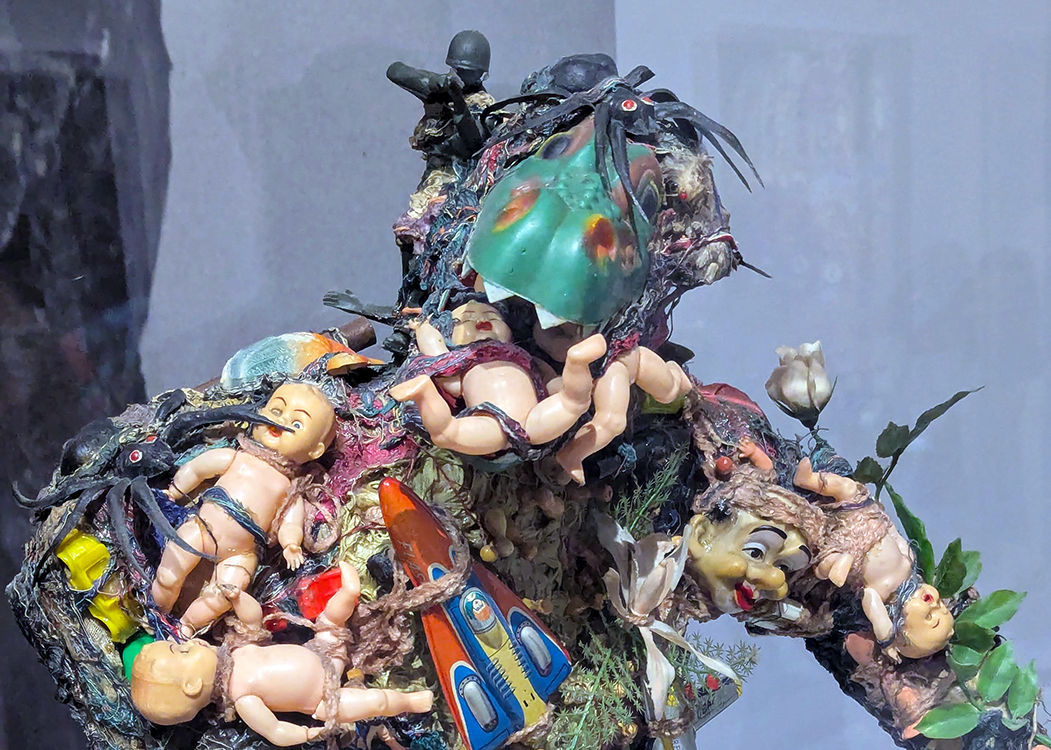
Above: Detail of “Monster Crocodile,” a 1964 assemblage by Niki de Saint Phalle.

I wanted [the fountain] to have charm, with the colors of Niki…. I wanted sculptures like street performers, a little bit like a circus, which was at the heart of Stravinsky’s style itself when in 1914 he had his first encounter with jazz….”

Jean Tinguely (1925-1991)

With bright primary colors twirling around squirting water in all different directions, the 1983 “Stravinsky Fountain” by Niki de Saint Phalle and husband Jean Tinguely ignited a public space between the Pompidou Center, housing the National Museum of Modern Art, and the Gothic-style Church of Saint-Merri. Viewing the flamboyant fountain evokes a childlike joyful feeling in even the most jaded adults.

Above: “Stravinsky Fountain,” Niki de Saint Phalle and Jean Tinguely, Paris, France, 1983.

That whimsical, playful exuberance bubbling up in the fountain and her jubilant plump “Nanas,” with figures resembling my own, meant I failed to take a serious look at her art. I must have been in a teenage trance to miss the media coverage when she exhibited a giant Nana “Hon” with an entryway for attendees between her widespread legs.

Underestimating Saint Phalle’s talents for decades was a mistake. An exhibition this spring at the Caumont Center for Art in Aix-en-Provence altered my misconceptions.

A quotation by Niki de Saint Phalle in French and English, expressing her love for monsters, displayed in a colorful and artistic font.
Continue reading “Postcard from France: Saint Phalle battled outside wrongs and monsters within”

Postcard from Provence, France: Monumental cemeteries where Impressionists rest

Blue postage stamp featuring a scenic view of Nice, France, with trees and hills, inscribed with 'République Française' and 'CFA'.

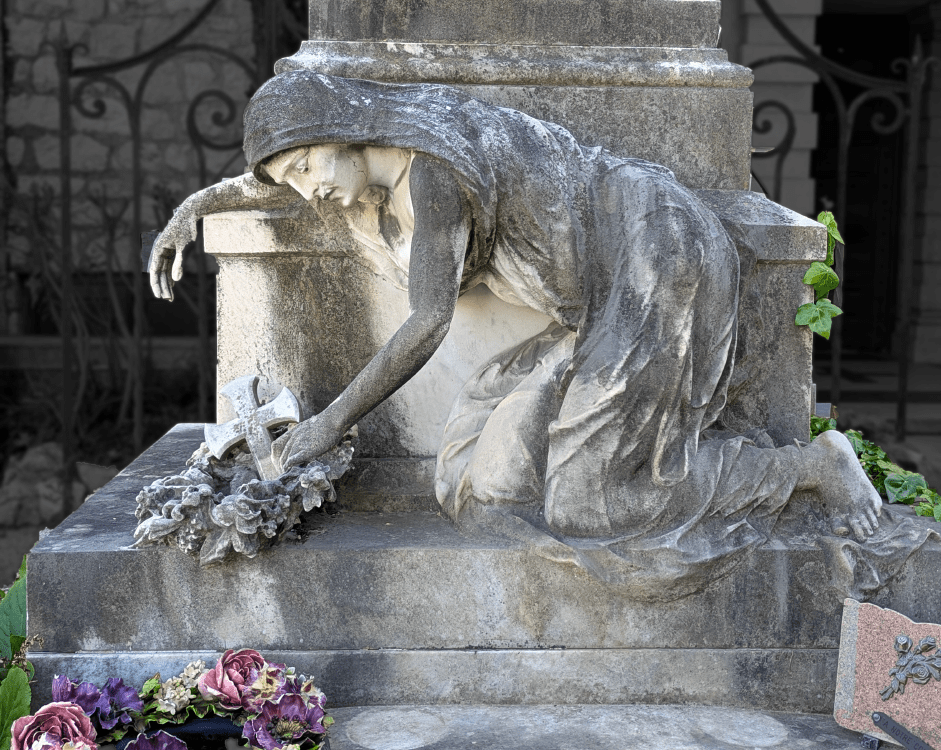
Above: Monument in Cimitiere du Chateau, Nice, France

A military citadel once crowned a hill overlooking the Bay of Nice. Bearing in mind that Nice did not become a permanent part of France until 1860, as part of one of the many wars fought during his reign, King Louis XIV (1638-1715) of France ordered the castle-fortress destroyed in 1706.

A portion of the grounds of the old citadel were opened as Cimetiere du Chateau in 1783. Instead of sentinels, monuments in the cemetery now occupy the most prominent vantage points for viewing the bay and surrounding countryside.

The cemetery* is an open space among the ruins, covered in winter with violets and daisies. It might make one in love with death, to think that one should be buried in so sweet a place.”

Preface to Adonais, Percy Bysshe Shelley, 1821

Continue reading “Postcard from Provence, France: Monumental cemeteries where Impressionists rest”

Postcard from Palermo, Sicily: Modern art in Sant’Anna haunt

Above: Richard Avedon’s 1981 photograph, “Natassja Kinski and the Serpent,” is superimposed over one of a cage protecting a cluster of bones in the crypt below Sant’Anna la Misericordia, home to Palermo’s Galleria d’Arte Moderna.

Granted this Richard Avedon photo of “Natassja Kinski” in the nude was not displayed in such close proximity to bones in the crypt of the church of Sant’Anna alla Misericordia, but, after all, nothing is more naked than bones. And churches in Italy have always been home to art, religious art that in the time of its creation was considered contemporary.

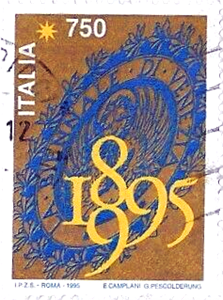
When citizens in Palermo determined they needed to have a Modern Art Museum in 1906, they boldly ventured forth to Venice in 1907 to acquire avant-garde works to supplement their Sicilian collection. Launched in 1895, the Venice Biennale quickly garnered international prestige. Ongoing buying trips through the years enabled the museum to trace the evolution of symbolism and modernism in art.

Continue reading “Postcard from Palermo, Sicily: Modern art in Sant’Anna haunt”