Happy birthday, oh fan most loyal…

As I am trying to stay focused on other writing projects, my blog posts are few and far between.

Not that anyone has been complaining.

Not surprisingly, readership has tapered off dramatically.

Except for my fan most loyal.

No matter how stale the posts are, this follower returns again and again. So frequent are those visits, WordPress tries to block them to keep its internet arteries unclogged.

But he is persistent, slipping through the second WordPress lets its guard down.

I knew little about him, so today I decided to learn more.

He turned 75 this year. And he must be well-educated.

Well, not that well-educated. Admittedly, his grammar is poor. In fact, his favorite post appears to be a photo with a spelling error in its title: “sandwish board.” This also means he has poor taste, as the photo is of an illegal, tacky sign plopped in the middle of a sidewalk on Alamo Plaza.

He speaks some Japanese, I think. And he appears fluent in Russian, at least as far as I can tell from trying to read his comments. Even though I rudely never respond to his comments – one of my numerous excuses being my ignorance of the Russian language – he never wavers in his loyalty.

With only a little research, I found out why he speaks Russian:

“Without Spam, we wouldn’t have been able to feed our army.”

Nikita Khrushchev, ‘Khrushchev Remembers’ (1970)

According to www.spam.com, more than 100 million cans of Spam were shipped out to feed the Allied troops during World War II, which, under the lend-lease program, included those of the USSR.

Yes, Spam the man is my number one fan (Sorry, Hormel, I just don’t get the all-caps thing.).

So, here’s Spammy, as Hormel affectionately calls him >

The one-billionth can of Spam was produced in 1959.

I thought Spam disappeared from the shelves as soon as babyboomers entered adolescence.

Until today, I assumed a can of Spam was like the tin of fruitcake described by Johnny Carson:

There is only one fruitcake in the world, and people keep sending it to each other.

But I was so mistaken. I underestimated Spam’s resiliency. According to this frightening statistic on foodreference.com, 3.6 cans of Spam are consumed every second.

I also underestimated his versatility. Spam is oh so much more than something served simply sliced straight out of the can.

According to the official website, Spam has taken on an international flair to suit our changing palates. The combinations are beyond your wildest dreams (or worst nightmares?). Do you like green eggs and Spam?

I will spare you the glossy photos of the outcomes, but a few recipes Hormel proudly shares are polenta topped with Spam and black bean salsa, Spam wontons, Spam musubi and huevos Spamcheros. But come November, you probably just want to rely on that all-American favorite, “Spamsgiving Day Delight.”
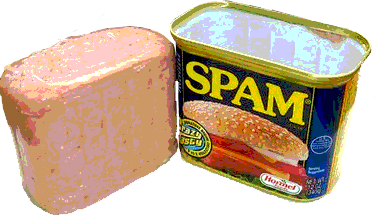
Oh, please, spare us, Sam. Put that Spam back in the can.

The most amazing thing I found out about my fan Spam today is why he has a layer of jiggly jelly. I assumed it was for long-term preservation so he could be stored in bomb shelters. But the preservative in Spam is simply sodium nitrate, about which Hormel strives to make you feel good:

Small amounts of sodium nitrate are found in delicious meats like hot dogs…. It helps preserve the pink color of meat. And no one likes gray meat.

No, the real reason is Spam actually is cooked directly in the can. So naturally his fat rises to the top. Cooking and cooling a can of Spam is as time-consuming as cooking a turkey; it takes Hormel three hours.

So, Spam, my fan. It was good to get to know more about you today. I think it’s wise wordpress.com screens out thousands of your clicks on my blog. The sheer numbers might go to my head, encouraging me to post more often.

And happy birthday, you old-75-year-old you. You don’t look a day older than the day you were first canned.

Just please, don’t wear your birthday suit around me. Keep your can about you. I want to have something to pass down to my grandchildren.
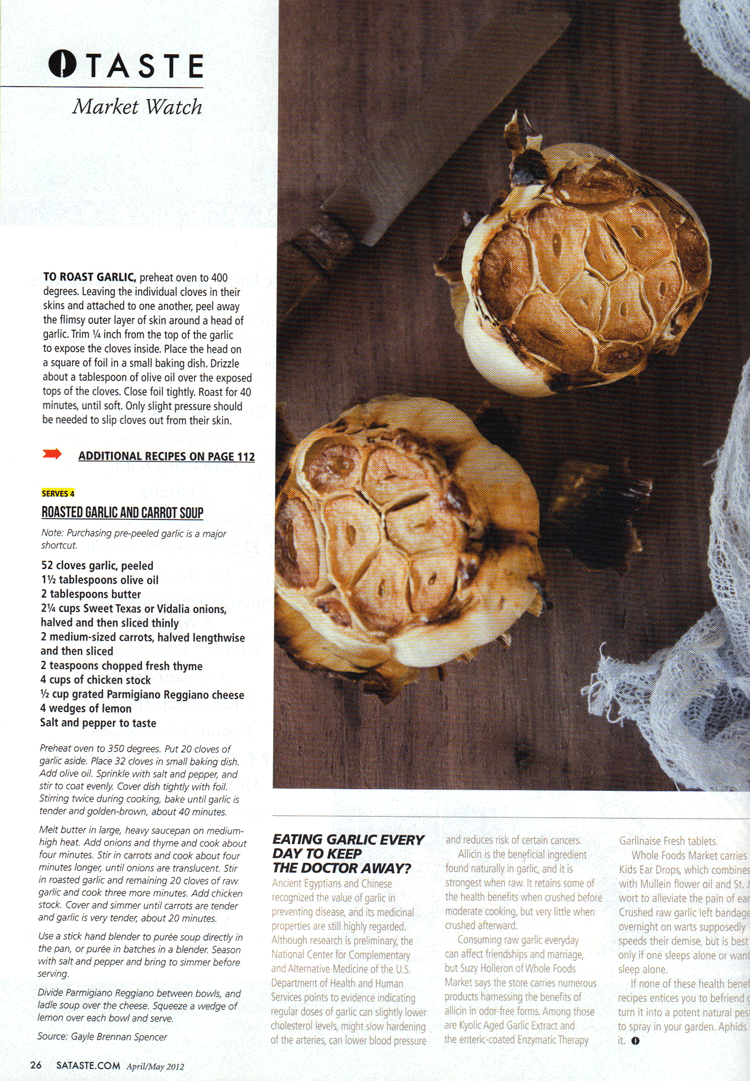
 

The sex life of garlic

Face it. We’ve been eating clones. And not just recent clones, but clones of clones of clones. Generations of us have been eating generation upon generation of clones for possibly thousands of years.

Bob Anderson, Texas’ “garlicmeister,” dropped hints about the importance of the sex life of garlic in a phone interview I had with him for the April-May issue of San Antonio Taste Magazine.

Little did I know that great garlic requires some sex in the wild, or at least some wild sex in the last few decades. But finding proper propagating partners for garlic was impossible in this part of the world until Gorbachev and GW Bush officially thawed the Cold War at Malta in 1989.

Once the two leaders decided to finally melt the ice, the door opened to Kyrgyzstan, Tajikistan, Turkmenistan and Uzbekistan, the only places where garlic still grew wild, freely engaging in unbridled cross-pollination.

I gleaned this from reading Phillip Simon’s research for the USDA. Simon went on the 1989 expedition to what I call the “Four Stans” (because I clumsily stumble over their full names) to collect all kinds of new hardneck garlics capable of producing “true garlic seed,” unlike the Dolly-like clones we have been consuming.

Anderson passionately gushes about some of the distinctive flavors of the resulting children of these newly available types of garlic on page after page of his website.

The above information represents only a few of the titillating facts I learned about garlic for San Antonio Taste.

garlic goes topless

I’m sure my feature on garlic would have been the magazine’s cover story if the garlic had not posed topless. The editors probably feared highlighting such a steamy topic would mean some outlets would require a brown paper outer wrapper or only be willing to sell the magazine from under the counter.

Note added on April 10, 2012: Totally missed that April is National Garlic Month.

Grandma’s rusks refuse to be rushed…

This description of a treasured recipe handed down to husband Lamar was published in the 2012 February-March issue of San Antonio Taste Magazine as part of a feature article I wrote on artisan breads:

This slideshow requires JavaScript.

Grandma – my husband Lamar’s grandmother, Virginia Lamar Hornor (1895-1988) – always claimed the secret to her rusks was her ancient gas Chamberlain stove. The recipe she used was handed down through the Lamar family as they migrated from Georgia to Mexico to try to earn a living in the decades after the Civil War.

The best guess for the origins of this rustic bread is that shortages of white flour during the war led to a more creative use of graham flour, a version of whole wheat. While born out of necessity, the recipe remains a family favorite for its taste, probably boosted by a heavy dash of sentimentality.

To me, and perhaps to Lamar’s mother as well who declined to tackle it, the recipe is hardly one at all. What is “enough” graham flour? Four cups? Six cups? What kind of “sponge?” How much white flour is “sufficient?”

But Lamar gamely picked up the tradition where Grandma left off. Through the years, he has developed some rather picky (my word) rules about preparation and ingredients; although I admit they enhance the flavor.

A yeast cake yields better results than dry yeast, and we finally have been able to find the cakes in the refrigerator section of Central Market. We have switched to King Arthur Premium 100% Whole Wheat Flour because its texture and flavor more closely mimics the harder, if not impossible, to find graham than standard, more finely ground whole wheat flours. And it must be freshly purchased; no matter if the canister is already full.

The nutmeg must be freshly grated, again for texture and taste. Early efforts to grate the hard kernel almost always resulted in blood, but I recently purchased a new one at Melissa Guerra’s at Pearl that offers ample protection for the fingers.

All mixing and kneading is done by hand because the only way to determine when the proportions are correct is by feel.

Warning: Rusks refuse to rise when rushed. Even when preparing for an evening meal, they should be covered and set out the night before for the first rise.

How this banker by day, baker by night knows how much flour or water to add when defies my understanding. I’ve decided it is an inbred bread sense, similar to the way he plays the guitar by ear. I don’t have it, but should you, this recipe could become a treasured one for your family as well.