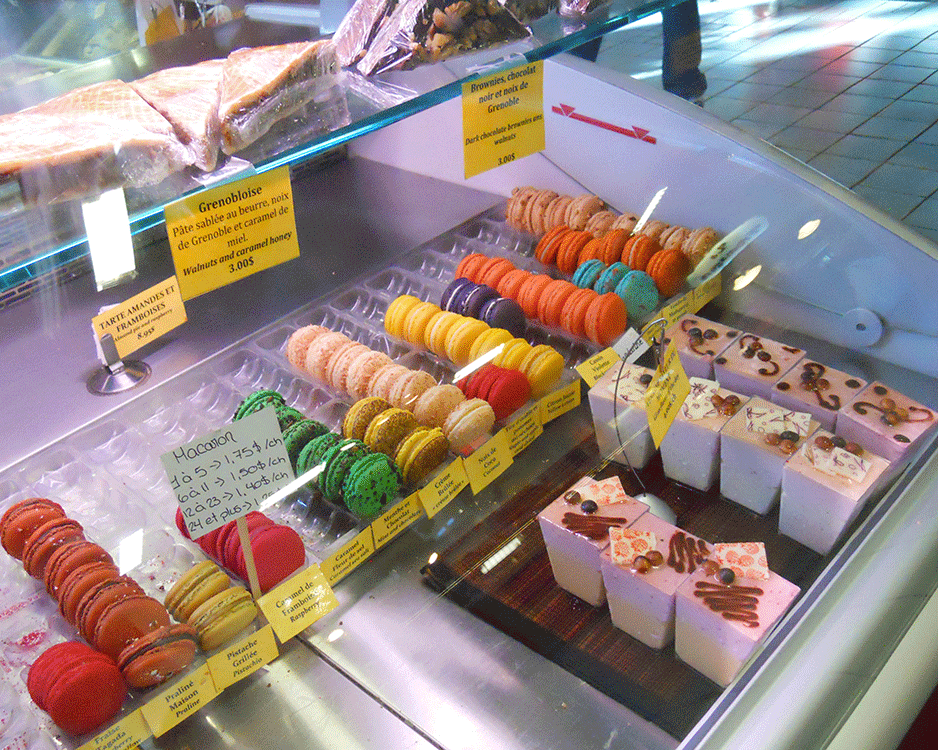
Grazing our way through Quebec City…

macarons

This represents our final fulfillment of our pledge to record some of our restaurant experiences from our recent trip to assist other travelers who obsessively turn to the internet before mealtime. (Well, semi-recent. And only a partial fulfillment. This has been a slow process, and the memories of restaurants and meals are fading a bit.)

Our apartment was in the Vieux-Port area of Quebec City, and foot was always our mode of transportation during our stay.

This slideshow requires JavaScript.

On the night of our arrival we lucked into seats at L’Échaude, a tony spot where reservations normally are a necessity. Service was extremely polished, and we enjoyed the rich flavors of a mussel and seafood soup in lobster broth and grilled seafood risotto.

Somehow we ended up in the neighborhood of Le Pain Béni in the old city twice at lunch time. The multi-course table d’hote menu represents quite a bargain and inside was relaxing after our long morning explorations. A crispy duck appetizer flavored with maple was wonderful. Maple seems to slip into the ingredients of numerous dishes in Quebec City. Among the dishes we sampled were a lobster-based risotto with fish and a flank steak with purple potatoes and carrots. The fruit salad was not a good dessert option, but the blueberry cake soaked with maple is highly recommended.

SSS, formally named Simple Snack Sympathique, is a popular, trendy spot in the port area and is a sister restaurant of Restaurant Toast. Weekday lunch seems to attract professionals rather than tourists. For lunch, I had salmon tartar with sesame seed and avocado, and the Mister ordered roasted lamb shank with gremolata and roasted vegetables. Both came with French fries, which you can exchange for salad or vegetables. But don’t. These are great fries.

A visit to the impressive National Assembly building was on our agenda, but, rather than go on the total tour, we checked out the restaurant, Le Parliamentaire. We had no reservations, but they are recommended. The Beaux Arts dining room with soaring ceiling is elegant, and service is formal. The table d’hote is not as expensive as one would expect in such surroundings, and the setting is worth experiencing.

We flunked planning ahead, and so often could not get in at the last minute for dinner at some of the popular restaurants in the old quarter. Part of the failure to make reservations was due to lack of hunger. Our long table d’hote lunches left no room for major dinners. We actually slipped into – true confession – a chain, not once, but twice, for lighter evening fare. The Piazzetta in the Old Port area is quite pleasant. The pizza is fine, but what surprised us was how good the restaurant’s main course salads are. We split a warm asparagus and prosciutto salad, which included grape tomatoes, olive and onions with balsamic vinaigrette; and a warm apple and camembert salad with croutons and pecans topped with a three-pepper maple syrup dressing.

As we neared the end of the two-week trip to Canada, I was beginning to yearn for a non-restaurant meal. The century-old farmer’s market, Marché du Vieux Port, was only about a block or two from our apartment and was filled with fresh fruits, vegetables, cheeses, meats and fish just waiting to be relocated to our kitchen.

One more night, and I’m sure I would have cooked.

Maybe.

Post-Thanksgiving thought: Why 1963 was a very good year

This represents another re-post from two years ago. Since I re-recognized the genius of Dorcas Reilly (Hey, is that actually even a green bean casserole sitting in this oven?), it only seems fair to re-mention my favorite Thanksgiving-related invention:

1963: Innovations in the kitchen, while even more helpful, begin to grow more complex. The P-7 self-cleaning oven is introduced. In developing the oven, which uses a pyrolytic system to remove food soil, GE engineers are granted some 100 patents.

While it took about another two decades for a self-cleaning oven to enter any of the houses in which we have lived, what a great invention GE brought to life.

Last night I pressed a button, and this morning I woke up to find all traces of Thanksgiving had vanished from my oven.

The genius of Dorcas Reilly: More than 100 million Americans will have her dish on the table this Thanksgiving.

This is my first re-post, but it is so seasonally appropriate.

It also came to mind because some relatives I love dearly asked if I could make “the” green bean casserole.

Wait. I don’t do that.

Fortunately, I have wriggled my way into other responsibilities, but I know I am clearly in the minority:

Stock Tips:  Buy Luby’s.  Buy Campbell’s. (from May 2010)

If Luby’s stockholders read the Taste section of the San Antonio Express-News, I thought, NYSE: LUB will tumble dramatically on Monday.

A reader wrote in to the San Antonio Express-News requesting an “old” Luby’s recipe for eggplant casserole.  To the credit of the “new” Luby’s, which is promoting “healthy sensations,” the manager of an area Luby’s said she could not find the recipe.

The Express’ Karen Haram dug up the recipe from a 1994 column.  The ingredients seem more vintage than that.  In addition to eggplant, the casserole includes diced onion, peppers and celery.  Fine so far.  But the add-ins and add-ons include a can of cream-style corn, a can of cream of mushroom soup, bacon bits, two cups of crumbled cornbread and a cup of, believe it or not, shredded American cheese.  Results:  Extremely well-disguised eggplant with the capability of single-handedly supplying more than half of your sodium intake for the day.

Having not purchased a can of mushroom soup for at least 25 years, I thought nobody was cooking this way any longer.  But I am dead wrong.  My cooking evidently is out of step with the majority of America.

Dorcas Reilly gets a lot of the credit (blame?).  According to Rod Taylor in a 2003 article for Promo Magazine:

Reilly was the midwife, as it were, who gave birth 48 years ago to the mother of all comfort foods: “Campbell Soup’s Green Bean Casserole.”

The now 77-year-old Reilly was in charge of the Campbell Soup Co. test kitchen in 1955 when the recipe was created.  “My initial inspiration for the Green Bean Casserole was really quite simple,” Reilly notes.  “I wanted to create a quick and easy recipe around two things most Americans always had on hand in the 1950s: green beans and Campbell’s Cream of Mushroom soup….”

Campbell estimates that 40% of its annual sales of Cream of Mushroom Soup end up in this recipe, which isn’t too surprising when you consider the company also estimates that 1.5 million cans of Campbell’s soup are used as an ingredient to prepare dinner every day….  Although consumers use the recipe year-round in their cooking, Thanksgiving represents the pinnacle of usage with an estimated 20% to 30% of all US households making the casserole for their holiday feast.

Run the numbers on that one and you’ll discover we’re talking 17.6 million homes on the low end.  Figure that one casserole feeds six, and you’re reaching an estimated 105.6 million Americans in one meal, well over a third of the total population, and that’s on the low side as an estimate….  Consider this:  their Cream of Mushroom soup ranks as one of the six fastest moving items in the entire dry grocery category.

And think about all the additional people who purchased other brands of mushroom soup?

Taylor claims:

Last year Reilly appeared at the National Inventor’s Hall of Fame to donate her original copy of the recipe to the museum.  Her now-yellowed 8 x 11 recipe card takes its place alongside Enrico Fermi’s invention of the first controlled nuclear reactor and Thomas Alva Edison’s two greatest hits:  the lightbulb and the phonograph.

That seems like a big stretch for combining cans of soup and green beans, and I could not verify the story.  The National Inventors Hall of Fame Museum in Alexandria, Virginia, is closed right now as it prepares for the opening of a major exhibition, “Inventive Eats: Incredible Food Innovations,” which does, however, sound like a logical time to spotlight Reilly’s contribution to American cuisine.

But wait, is this the same country in which Julia & Julia grossed $95 million at the box office?  Paraphrasing Julia Child’s husband Paul in the film, I thought her book changed the world.

Campbell Soup Company’s stock continues to rise.

Hey, five recipes on the label of every can, all much easier than any of those through which Julie Powell plowed and blogged her way.

Forget my initial market prediction.  Buy Luby’s stock.  Buy Campbell Soup Company’s stock.