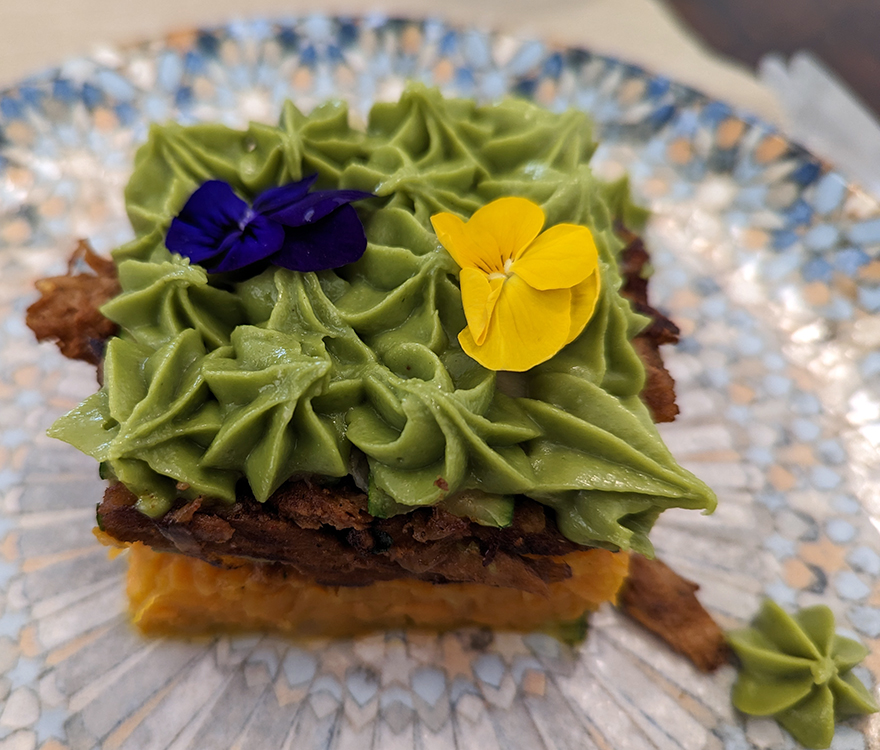
Postcard from Siracusa, Sicily: Bellomo Palace and, for saint’s sake, always eat two of this dessert

Above: A representation of the story of Adam and Eve eating the forbidden apples, Museo Regionale di Palazzzo Bellomo

A stark façade conveys the 12th-century origin of the Bellomo Palace. The interior spaces, however, reflect several centuries of architectural alterations, much like the centuries of regional Sicilian art housed within. Benedictine monks occupied the palace in the 18th century, merging it and an adjacent palazzo into one compound.

The Risorgimento, the ongoing unification of the Kingdom of Italy, represented a disaster for many Catholic religious orders. In Sicily, the government seized property and buildings, including this monastery in 1866. In 1940, the government repurposed the compound as a museum, with the 1866 confiscated religious art forming a major portion of its collection. The Bellomo underwent substantial renovation in 2004.

Continue reading “Postcard from Siracusa, Sicily: Bellomo Palace and, for saint’s sake, always eat two of this dessert”

Postcard from Noto, Sicily: Palazzi with regal airs

Above: The ballroom of Palazzo di Nicolaci di Villadorata

Tuna fish, and evidently a lot of it. Riches earned in the lucrative fishing industry of the 17th-century enabled the upper-middle-class Nicolaci family to buy their way into nobility in Noto. After the 1693 earthquake wiped out the fortunes of much of Noto’s high society, Corradino Nicolaci purchased land and the accompanying title of Baron of Bonfala in 1701.

Corradino’s son, Baron Giacomo (1711-1760), supervised the 1720 design of a four-story palace with more than 90 rooms, which took 40 years to complete. While the ground floor was relegated to food storage and stables, the second-floor piano nobile was decorated lavishly for entertaining guests – a necessity later as another member of the family succeeded in acquiring the title of Prince of Villadorata in 1774.

Continue reading “Postcard from Noto, Sicily: Palazzi with regal airs”

Postcard from Noto, Sicily: Ever-Ready for ‘Lights. Camera. Action.’

Above: Stairway climbing up to Chiesa di San Francesco d’Assisi in Noto

The earthquake of 1693 virtually wiped medieval Antica Noto off the map, along with eliminating roughly half of its population. Undeterred by the widespread devastation, Sicilians started anew. The fresh start resulted in a city basically built in one style over a 50-year period – Sicilian Baroque. Gorgeous. Stunningly picturesque, yet….

Supposedly 25,000 people inhabit Noto, but, wandering in the historic center, it feels as though there is nobody home but us tourists – a lot of them. Which is a flaw. Noto looks so perfect that is seems artificial, more like a movie set, which it has been numerous times.

Continue reading “Postcard from Noto, Sicily: Ever-Ready for ‘Lights. Camera. Action.’”