
This blog’s most recent post left you touring palaces in Genoa but now is flying you back to San Antonio for the King William Home Tour.
The King William Association has arranged for a peek inside six private homes, two museums and its own offices on Saturday, December 1, in the historic neighborhood just south of downtown. The residential streets were surveyed by the City of San Antonio in 1859, and the historic district’s namesake King William Street honored Kaiser Wilhelm I (1797-1888), King of Prussia and the first German Emperor.
This blog tour begins at the southern end of King William Street at house number 524, the Albert Moye House, because it is one of two places you can purchase a ticket, $25 per person, on the route. Mathilda Louise von Bartheld (1821-1896) and Albert Carl Moye (1820-1899) arrived at Indianola, Texas, with their two oldest sons in tow in 1845. The Moye family were part of a wave of immigrants attracted by the overblown promises of the German Emigration Company. By 1850, the saddler and his family had made their way to San Antonio. The Moyes built their symmetrical wood-sided house with Doric columns across the front porch in 1881, with Albert residing there until after Mathilda’s death.
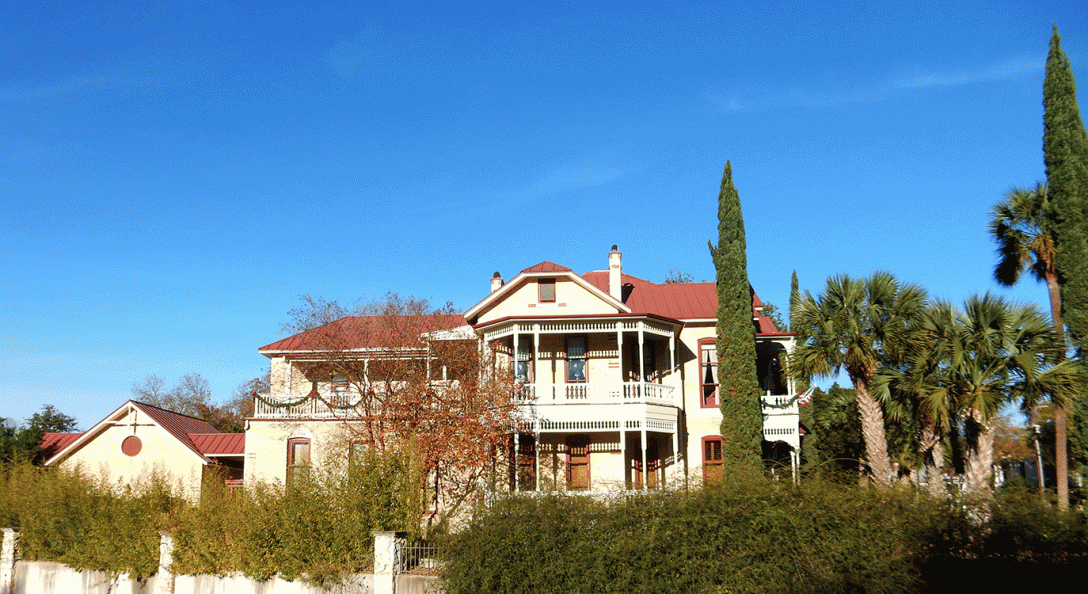
The featured photo above is the riverside view of the Harnisch House, 523 King William. Prussian-born Carl Harnisch (1833-1920) entered into a partnership in San Antonio with a pair of immigrants who married in 1853, shortly after their arrival in Texas – Josephine Brentano (1823-1917) and Christian Baer (1824-1882). Harnisch and Baer elegantly displayed its cakes, pastries, and ice cream in glass cases and provided upscale full restaurant service in its palm-filled location at 109 West Commerce Street.
“Harnisch and Baer Restaurant,” Reflections on Texas Video Collection, KMOL-TV, UTSA Special Collections
The successful business partnership was cemented more closely by the marriage of Carl to the Baers’ Texas-born daughter, Louisa (1853-1917), in 1876. The yellow brick home with red accents the Harnish family built on three lots was designed by architect Albert Felix Beckmann (1855-1900). Although Beckmann was born in San Antonio, he studied architecture in Germany before returning to Texas in the early 1880s. Completed before 1892, the residence was listed with an address on Pershing Street at the time of Carl’s death. During World War I, the street name temporarily was changed from honoring the Kaiser to an American hero, General John Pershing (1860-1948).
The Victorian-style house was occupied by Harnisch descendants until 1963. More than a century after its construction, Debra and Steve Walker purchased and began to renovate it. Just prior to completion of the major undertaking, a fire swept through the structure. The Walkers persuaded the city not to proceed with condemnation of the heavily damaged house and managed to oversee a second, more massive renovation project transforming the burned-out shell into their home.


The next palatial structure on the tour, 401 King William, has a humble four-room limestone house at its core. Born in Texas while it still was a republic, hardware merchant Russell Cogswell Norton (1844-1928) and his wife Ellen Hayes Whiteley (1846-1899) had their home erected there in 1876. A Missouri-born stockman, Edwin Polk (1849-1918), purchased the home in 1881 and added a two-story brick wing and a porch.
But it would be cattleman Isaac (Ike) Thomas Pryor (1852-1937) who added the architectural flourishes enlarging the home in 1896 to accommodate his family and that of his second wife, a widow, Myra E. Stafford Early (1863-1943). The addition of the three-story tower and adjacent two-story porch reflect the immense success his Texas and Colorado Land and Cattle Company enjoyed leasing land and running cattle in Indian Territory.
Numerous owners lived there through the years as the neighborhood suffered ups ad downs, with perhaps one of the most colorful being Billy Keilman (1875-1925). Keilman owned the seedy Beauty Saloon, developed a hangover cure billed as “patent plugs for pifflicated people” and published The Blue Book, a 1911-1912 guide for visitors to San Antonio’s “sporting district.”
When Walter Nold Mathis (1919-2005) purchased the house in 1967, it had fallen upon hard times and was subdivided into a boarding house. Mathis restored it as his home, Villa Finale, and went on to restore numerous other houses in the neighborhood. Mathis bequeathed his home with furnishings and collections to the National Trust for Historic Preservation as a museum, and Villa Finale retains the interior furnishings and art exactly as he had them arranged during his lifetime.
Vergie Gibbs (1875-1912) and her new husband Dr. Alfred Clifton McDaniel (1866-1944) moved into a grand Victorian Richardsonian Romanesque brick home courtesy of her father in 1896. The next stop is 130 King William Street, the original, much altered, carriage house for the McDaniel House behind it on Madison. The doctor converted the former carriage house into a duplex in 1926.
Kaye and Charles Scheer harvested hardware, windows and banisters from Victorian-era tear-downs in an attempt to make the house measure up to others lining the street. The property was purchased by the San Antonio Art League and Museum in 1987. Founded in 1912, the Art League has more than 600 works in its collection. The current exhibition features paintings by Sylvia Benitez and Vikki Fields.
Thirsty? Time to take a cookie and wine break at the offices of the King William Association, 122 Madison Street, the second location where tour tickets can be purchased beginning at 10 a.m. During tour hours, the Stray Grape Urban Winery will be offering a wine-tasting.
Plus, by now you will want to know about every house you have walked past so you are ready to invest in the updated, expanded and now in color version of Mary V. Burkholder’s 1973 The King William Area: A History and Guide to the Houses. Resident Jessie N.M. Simpson updated and expanded Burkholder’s original narrative, and photographer Al Rendon added contemporary photographs of the neighborhood. The price of the guide, published by the King William Association, is discounted to $20 for ticket holders on tour day.
After wining, step across the street to 202 Madison. A married couple from Iowa, Pauline Witting (1864-1949) and attorney Isaac Bradford Henyan (1856-1922), agreed to pay Ed. Steves and Sons $3,500 to build the brick home designed by architect Beverly Welford Spillman (1885-1977). With its raised porch and upper door to nowhere, eclectic architectural details lend the property an unusual Swiss chalet appearance. Several subsequent owners of the now-renovated home repeat stories that it served as a house of ill repute during the 1940s.
George Alexander Chabot (1864-1941) was born in San Luis, Potosi, Mexico, while his English-born father was employed with the British foreign service. In 1885, he purchased lots across the street from his parents, Mary Taft Vanderlip (1842-1929) and George Stooks Chabot (1821-1902).
It is unclear when George Alexander Chabot built upon the property at 402 Madison, but he and his wife, Lucile Stapp (1875-1962), moved in after their 1893 marriage. The crockery merchant, according to the 1900 census, and his wife relocated to California before 1910, where he was employed as an accountant with the Southern Pacific Railroad. The career move led the couple to rent out their Victorian Queen Anne style home, distinguished by its hexagonal porch.
The final tour stop is a contemporary townhome, modern infill located on a lot formerly occupied by a wing of the defunct St. Benedict’s Hospital. The single-family residence was designed by architect Jim Poteet and then modified to fit the clients’ needs by Darryl Ohlenbusch.
Phew. Maybe you will be lucky enough to snag some more wine at the King William office before 5. Or maybe plan to adjourn to one of Southtown’s numerous watering holes within walking distance.


 Postcards from Barton Springs