Processing Art through Public Filters, Part Two

whitewashedOn the left side of the photo on the right is a wall.

The wall, prepped for painting, is not architecturally stunning.

In fact, one could say it is architecturally challenged.

Perhaps that is why the artist wanted to make a monkey out of it.

monkeyBut this building is located in the King William Historic District, and, according to the San Antonio Express-News, some of its residents evidently felt Robert Tatum’s Chi Chi Monkey made a mockery of the neighborhood.

tame-birdSo the artist came up with a rendering for a tame bird sporting a Tyrolean hat perched outside a gingerbready bird house, all nods to the characteristics of the neighborhood.

Some of the residents were happy.

But, upon further reflection, the artist was not.

He must have felt as though he had his wings clipped.

This tame bird is not representative of his art, and this bird house is on the outside wall of his office.

cuckoo-birdSo he transformed the bird into something more reflective of his style, more of a wild-eyed cuckoo bird too big-headed to fit into his house.

This bird looks much more like Tatum’s style, but some of the neighbors balked at the new one.

The frustrated artist told reporter Scott Huddleston it will be his prized bird or no bird at all.

The poor members of the Historic Design and Review Commission are left in the middle, stuck walking the tightrope between artistic integrity and the strict enforcement of guidelines of the historic district.

I’m rooting for the cuckoo.

Sometimes we take ourselves so seriously, we kill the spirit of things. “We” includes me. Sometimes.

I draw a rigid line in the sand when it comes to protecting sensitive areas, such as the Alamo Plaza Historic District. I’ve even gone so far as to label myself Alamobsessive about it.

But South Alamo in Southtown is not across from the Alamo. And this building is not nestled among stately residences.

It’s in more of the entertainment part of the neighborhood. People walking by the back side of this building are most likely on their way to art galleries or restaurants.

And this wall is not exactly in pedestrians’ faces. It is set way back from the sidewalk and street.

But what about its across-the-street neighbor? Well, that’s got to be about the most laid-back, relaxed place around – The Friendly Spot. The cartoonish cuckoo bird will fit right in and should delight the kids scampering over the Spot’s playscape while their parents gather with friends.

The photo below shows the current wall when viewed from the entrance of The Friendly Spot.

friendly-spot

You probably are thinking I posted the wrong photo. But no. That’s the proposed canvas, way back behind the red SUV, tucked unobtrusively between two buildings. If the bird’s features are not exaggerated, they won’t show up at all.

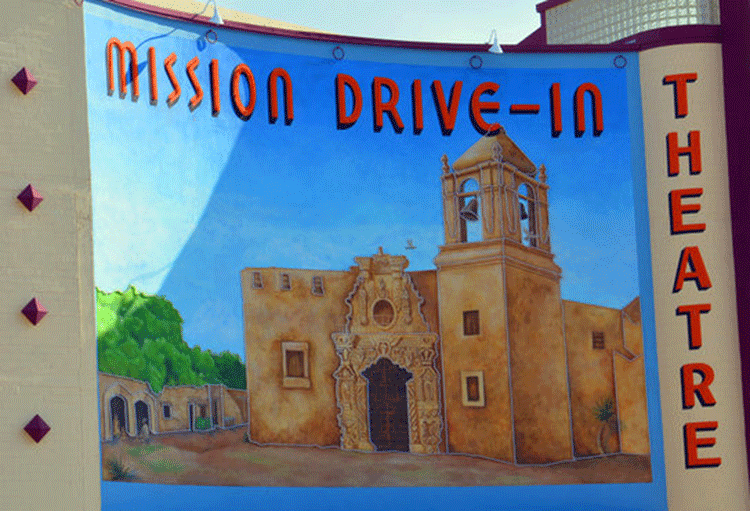
The tame version of the mural is like the Mission Drive-In, where the spirit of the original art was put in a straitjacket.

Art should reflect its creator. In this location, there seems no need to over-process it in the name of King William’s integrity.

Let that cuckoo bird fly free.

Update on March 7, 2013: Alas, Mr. Tatum, if you had only showed up at the HDRC meeting to plead your case and get a fair hearing, the cuckoo might be perched on your wall instead of caged in my blog.
That Crabby Old Colonel Cribby Condemned the River Walk to Years of Lowlife Nightlife

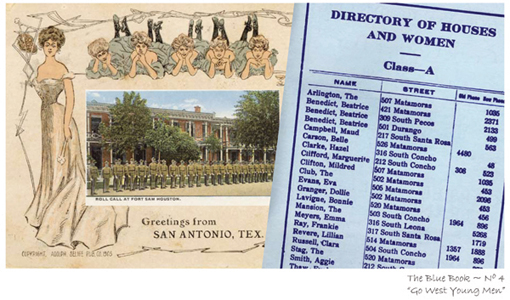
Blue Book No. 4, "Go West Young Men," Digital Collage by Gayle Brennan Spencer. Early 1900s' postcard of some of San Antonio's blue ladies is combined with a period mini-postcard image of "Roll Call at Fort Sam Houston" and a page from "The Blue Book."  The page is headlined "Directory of Houses and Women - Class-A" and lists the names and addresses of some of San Antonio's welcoming women in 1911.  Visit www.postcardsfromsanantonio.com.
Blue Book No. 4, “Go West Young Men,” digital collage by Gayle Brennan Spencer. Early 1900s’ postcard of some of San Antonio’s blue ladies is combined with a period mini-postcard image of “Roll Call at Fort Sam Houston” and a page from “The Blue Book.” The page is headlined “Directory of Houses and Women – Class-A” and lists the names and addresses of some of San Antonio’s welcoming women in 1911. Visit http://postcardssanantonio.com.

I had always heard the banks of the San Antonio River Walk were declared off-limits after dark for members of the military in San Antonio for many years, but I had never seen proof:

The area known as the “River Walk” is “Off Limits” during the periods 2400 hours to 0600 hours daily. It begins at Lexington Street, near the Auditorium, and extends about three hundred yards west of St. Mary’s Street, near the Plaza Hotel.

Office of the Provost Marshal, Fort Sam Houston, December 20, 1945

Melissa Gohlke, blogging for the Special Collections at the UTSA Libraries this morning, posted a 1945 list enumerating San Antonio’s lewd spots, so declared by order of Colonel Cribby.

off-limits-list

Although designed to serve as a warning to soldiers, this list was almost as efficient a guide for “those seeking a good time while in San Antonio, Texas,” as the 1911-1912 guide, The Blue Book. Col. Cribby’s list not only identified which places around town were “off-limits,” but why – whether because of immorality, prostitution, danger of venereal disease or gambling.

Gohlke’s post pertained to “San Antonio’s queer community,” but the list aided those in search of bisexual entertainment as well:

All a GI or WAC need do is read the list, understand the codes, and head out for a night of same-sex recreation. Ironically, the military imperative to regulate deviance facilitated the very behaviors such regulations were designed to stamp out.

Some of the same neighborhoods identified in The Blue Book were still hot spots flourishing under the eyes of lax local law enforcement three decades later.

The Blue Book No. 1, "See Sallie after the Alamo," digital collage by Gayle Brennan Spencer. The back cover of the 1911-1912 edition of "The Blue Book" reads "For Information of the Red Light District Ask Me. Meet me at the Beauty Saloon."  This image is combined with advertisements, including Sallie Brewer's, from an inside page of the guide to San Antonio's "Sporting District," a red light and an early 1900s' postcard of The Alamo. Visit   http://www.postcardsfromsanantonio.com/blue_book.htm.
The Blue Book No. 1, “See Sallie after the Alamo,” digital collage by Gayle Brennan Spencer. The back cover of the 1911-1912 edition of “The Blue Book” reads “For Information of the Red Light District Ask Me. Meet me at the Beauty Saloon.” This image is combined with advertisements, including Sallie Brewer’s, from an inside page of the guide to San Antonio’s “Sporting District,” a red light and an early 1900s’ postcard of The Alamo. Visit http://postcardssanantonio.com.

But what about today? This is from the fact sheet for visitors of participants in Lackland Air Force Base’s Basic Training Program:

Off Limits Areas and Establishments

The San Antonio Armed Forces Disciplinary Control Board has placed establishments off-limits to help maintain the health, morale, and welfare of Armed Forces personnel. Your Airman may not visit these  establishments and will know which ones they will not be able to service prior to town pass.

The River Walk has been family-friendly for decades, but now I am curious about what places in San Antonio are deemed too or lascivious or dangerous for today’s military. This list, not nearly as clear and complete a guide to local entertainment as the 1941 blacklist, is from a 2009 edition of the Lackland Talespinner:

The following locations are off-limits:

• Cracker Box Palace – 622 W. Hildebrand • Planet K – all locations in the following counties: Bexar, Atascosa, Wilson, Guadalupe, Comal, Kendall, Medina and Bandera • Voodoo Tattoo Parlor – 202 Aransas • Players Club (PC) of San Antonio – 8235 Vicar • Boys Town – Acuna, Mexico • Widows Web Bar and Night Club – Acuna, Mexico • The Up and Down Club – Acuna, Mexico

With no Blue Book or more detailed list available on base, what’s a newcomer in search of a little lascivious behavior to do?

It’s so simple nowadays. Just follow those huge “come-hither” billboards around north Loop 410 or grab a free issue of San Antonio Current for pages and pages of full-color “service” ads.

Processing Art through Public Filters, Part One

UTSA Libraries Special Collections

When completed the Mission Drive‐in Theatre will serve as an icon for preservation and neighborhood re‐development….

The project goal is to complete the approved mural components of the Historic Mission Drive‐In Marquee in a way that follows recommendations of the Secretary of the Interior’s Standards for the Treatment of Historic Buildings, and stays consistent with the historic period….

…all viable methods of re‐creating the mural, sign lettering and lighting feature will be considered, provided that the completed work re‐creates the style, color and graphic quality of the original mural and components as closely as possible.

Public Art San Antonio, 2012 RFP

Historic Mission Drive-In Marquee Re-Creation

The resulting illumination of the marquee mural instantly makes the old Mission Drive-In Theatre a striking night-time landmark on the south side.

Public Art San Antonio

But there is something missing.

KENS-5 TV
KENS-5 TV

The new mural is soul-less, devoid of the human presence that characterized the original.

Instead of a re-creation, the design was sanitized following public protests in several contentious meetings.

A sombrero-porting Latino leading a donkey, a beast of burden sparing many a worker from debilitating back injuries, and one napping under a sombrero are both regarded as racial stereotyping.

I concede there was a time when many Anglos viewed such images and uttered the racial slur “lazy Mexicans.” Call me naïve, but I like to think we have moved beyond that point.

Sombrerería in Mexico City, Late 1800s, Underwood & Underwood stereoview card: "The ordinary sombreros are made of palm-leaves and straw, but those of the wealthier classes are of expensive felt, and may be white, gray, or maroon in color. They are often very ornate, being embroidered with the wearer's monogram, or designs of flowers, and faced with gold or silver lace. In Mexico, only the men wear hats, and they are a very valued  possession. Sometimes a man will invest his entire fortune of thirty or forty dollars in his sombrero. They are frequently of vast dimensions. The larger the sombrero, in fact, the greater its aesthetic value in the eye of the average Mexican. The flourish with which he doffs it in salute is something never to be forgotten by the unaccustomed foreigner."
Sombrerería in Mexico City, late 1800s, Underwood & Underwood stereoview card: “The ordinary sombreros are made of palm-leaves and straw, but those of the wealthier classes are of expensive felt, and may be white, gray, or maroon in color. They are often very ornate, being embroidered with the wearer’s monogram, or designs of flowers, and faced with gold or silver lace. In Mexico, only the men wear hats, and they are a very valued possession. Sometimes a man will invest his entire fortune of thirty or forty dollars in his sombrero. They are frequently of vast dimensions. The larger the sombrero, in fact, the greater its aesthetic value in the eye of the average Mexican. The flourish with which he doffs it in salute is something never to be forgotten by the unaccustomed foreigner.”

My hope is, rather than erase the existence of sombreros from our collective memory, we honorably embrace them as part of our heritage in San Antonio.

Here is why:

  • San Antonio was part of Mexico for longer than it has been part of the United States.
  • Mexicans who worked outside in the hot sun wore sombreros. They were smart.
  • The crown of a sombrero can be angled to follow the sun like a sunflower, shading both the face and the neck.
  • Hardworking people who rose long before the sun and worked until after it went down could use their sombreros for shelter while taking well-deserved naps.
  • People who sport gimme caps get red necks. No additional comment necessary.
mi sombrero guapo
mi sombrero guapo

I’m all for a sombrero resurgence. I’m doing my part.

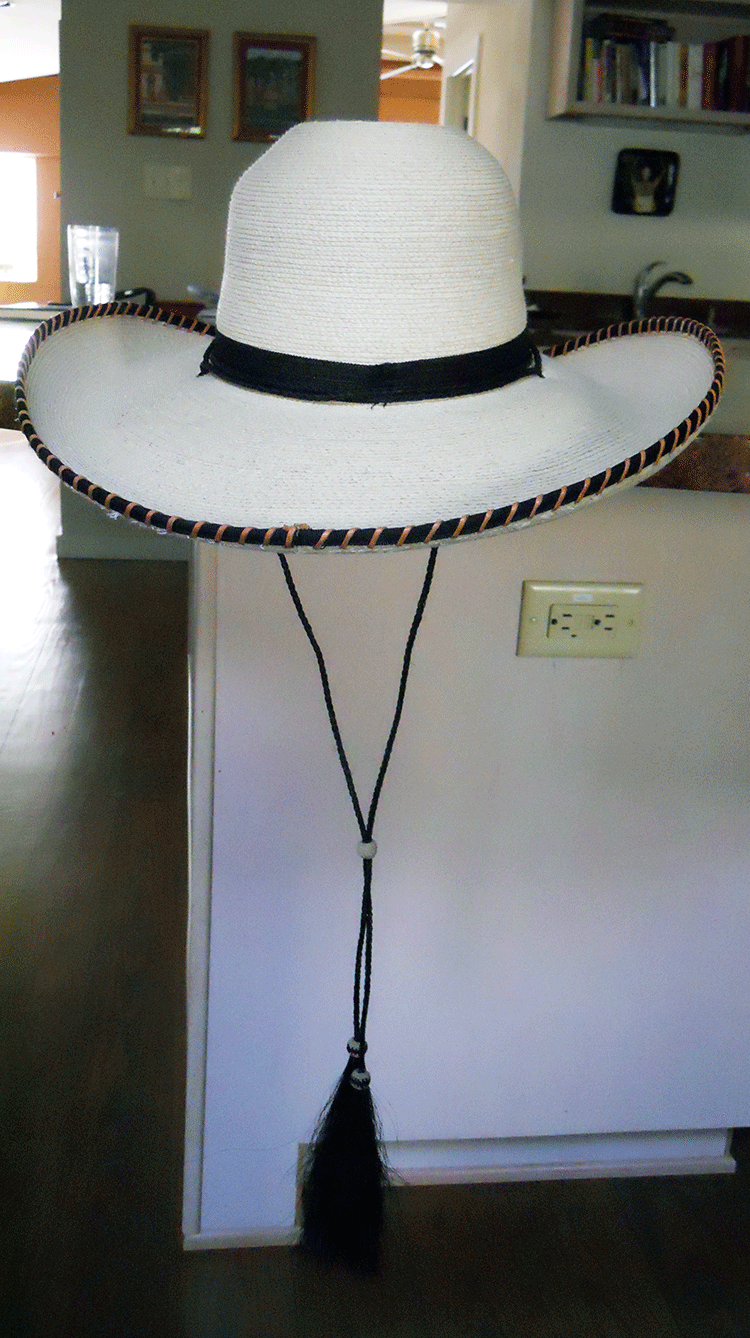
Yes, I know this aging gringa looks foolish wearing her broad-brimmed caballera hat, complete with a horsetail-hair stampede string to hold it in place when the wind threatens to send it swirling.

But time has taught me a few things. I grew up on a beach trying to keep up with tan people. I merely burned and freckled. A slow learner, I repeated the process over and over, summer after summer.

I’m part of a freckled race that old Dr. Pipkin said had no business south of Ireland. But I hate cold and love hot sauce.

Because I was not wise enough to learn from experience, I had, what I told the Mister was in his honor, an upside-down, backwards “L” carved in my chest. But that “L” actually represents the third letter of melanoma.

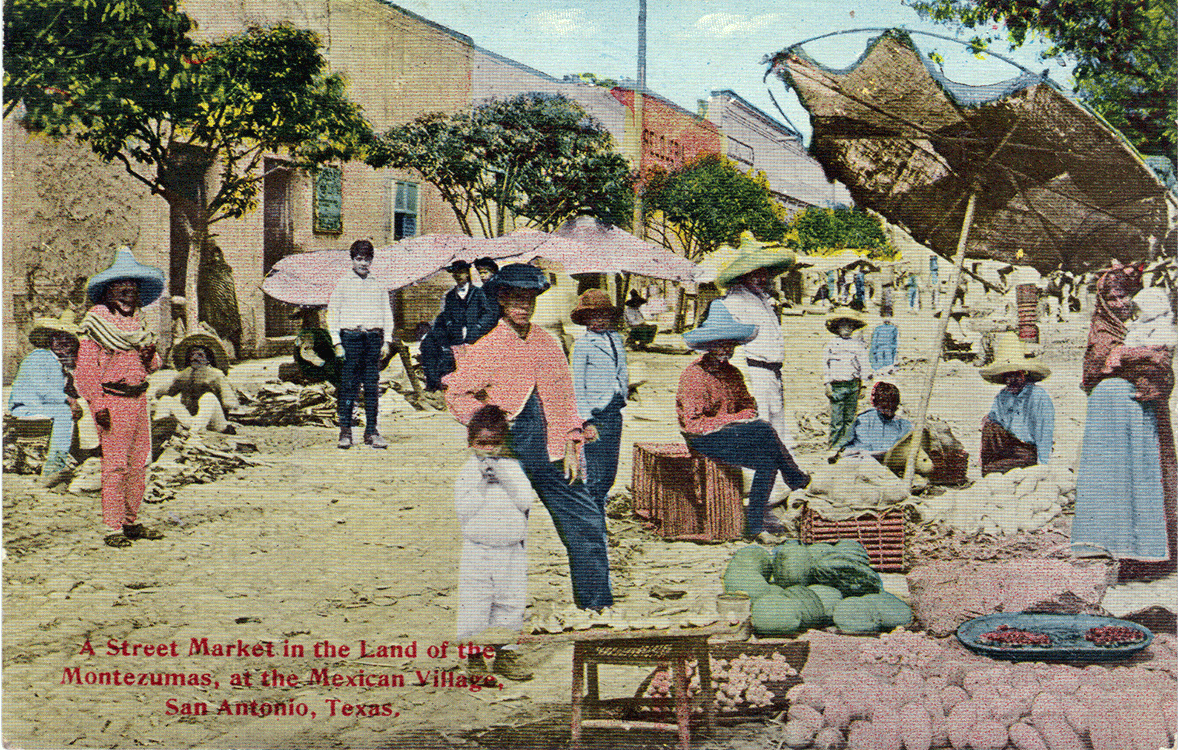
I’m only telling you this so, when you see me wearing my caballera hat walking along the Mission Reach, you won’t make fun of me in front of me. My sombrero represents a self-preservation technique I learned from old postcards, from photos of men like those who used to grace the Mission Drive-In marquee.

san-antonio-market

And, yes, some of the postcards were condescending in tone. But the photos were of real people, real people living in San Antonio who wore sensible hats when going about their daily business.

At this latitude, the sombrero-toting figure appears the smart one. Having a red neck is no sign of intelligence; it’s just asking to be branded with one of those “L’s.”

If only I had one of those back-saving burros to port that case of two-buck Chuck up to the kitchen….