Postcard from Rome, Italy: ‘Innocent’ intrigue surrounding summer soirees at papal retreat

The following all should relate to the collection of ancient B.C. art housed in the National Etruscan Museum. Although many of the photos focus on the artifacts, I find myself totally distracted by the origin of their home, Villa Giulia.

Papal politics were a mess in 1550 when the crossed keys were handed over to Pope Julius III (1487-1555). He had served as governor of Rome twice and barely escaped execution when Clement VII (1478-1534) turned him over to imperialists as a hostage following the sack of Rome in 1527.

But the cardinals were not impressed by his credentials. Three factions emerged: those in favor of continuing the Council of Trent and its response to the rise of Protestantism; the French who were against it; and the powerful Farneses pushing one of their relatives. Pope Julius III represented a compromise accepted with reluctance.

While benefitting from the ascension of the Catholic Queen Mary (1516-1558) to the throne of England, the pope’s efforts to reconvene the Council of Trent proved controversial. And the papacy became entangled in the war of Parma. The international intrigue proved overwhelming. The frustrated pope retreated to focus on creating a pleasurable escape from the turmoil.

Villa Giulia is the result. A vacation home. A palace for entertaining. A palace for the arts. And a papal playground.

Vineyards, no longer in existence, cascaded down to the Tiber, and the host and guests could travel back and forth by boat from the Vatican. Loggias surrounding and overlooking reclining “gods” in the Nympheum provided al fresco opportunities for summer parties.

All leading to gossip. Rumors. Jealousy. Fake news, perhaps, about nepotism.

Innocenzo (1532-1577) was the pope’s major Achilles’ heel. While still a cardinal, Julius found the poor 17-year-old lad on the streets of Parma; had his brother adopt the unfortunate boy; and employed him as a caretaker for his pet monkey. When elevated to Pope, Julius immediately elevated the teenager to Cardinal. We are reserving judgment about the qualifications of Innocenzo for this post; although the wags of Rome did not.

After Pope Julius III’s death, Pope Paul IV (1476-1559) confiscated the villa. His predecessor’s incredible collection of sculpture assembled there was transported through the vineyards and floated by barges down the Tiber to the Vatican.

The government of Italy confiscated Villa Giulia from the Vatican in 1870, and, in 1889, dedicated it as the National Museum of Etruscan Art. A copy of a small Etruscan temple was inserted in the middle of a courtyard in 1891.

Finally, the art. But I’m not going to blog about that much because I know very little about the period (No snide remarks necessary about how little I know about the papacy or the history of Italy overall). You (assuming you follow this blog religiously) already have been introduced to the most famous couple in the museum reclining on their sarcophagus.

As you view the tender pair from Cerveteri enjoying a banquet atop their remains, squint. Try to visualize them in color. And try not to get distracted by imagining the sumptuous parties that occurred there during the palace’s early days.

Postcard from Ferrara, Italy: Rambling the ramparts

Ercole d’Este (1431-1505), Duke of Ferrara, had an expansive vision for his fiefdom when he built a new fortress circling its outskirts – a circumference of approximately six miles. Protection certainly was needed to keep enemies out, as the duke had many, including Venice and powerful papal authorities of the Vatican.

But Ferrara did not emerge as a cramped medieval city confined by claustrophobic walls but as a spacious city of the Renaissance.

The remnants of the ramparts today serve as an invitation to stroll, jog and bike on upper and lower pathways, many shaded by an alley of towering trees.

The walls do discourage one invader from entering the city – the automobile. Parking is so limited inside the ramparts that most drivers choose to abandon their cars outside. The result is an entire city of residents who travel mainly afoot and on bikes, a friendly town where neighbors purposefully meet or randomly encounter friends on its welcoming plazas.

If only those founding friars had built the walls surrounding Mission San Antonio de Valero a mile or two out from the chapel, downtown San Antonio might have been forced to go carless.


Holy card from Oaxaca, Mexico: Zapotecans in line for sainthood

DSCN2359

A long list is found on one of the walls of La Compania de Jesus Church in Oaxaca. A list of those waiting. Those whose lives in Mexico were so full of sacrifice Rome surely will notice and promote them on the road to sainthood.

I’m pulling for the child martyrs of Tlaxcala, the land of corn tortillas. Poor Christobalito, Antonio and Juan were, after all, children. Antonio and Juan were clubbed to death, but Christobalito’s own father, a confirmed pagan, condemned him to be beaten with clubs and then set ablaze for his faith. The trio was beatified by Pope John Paul II in 1990, but they hardly seem on the fast-track. They have been waiting in line a really, really, really long time. Ever since the late 1520s.

But in Oaxaca, a pair of Zapotecs stand out, although newcomers to the waiting list by comparison to the ninos above.

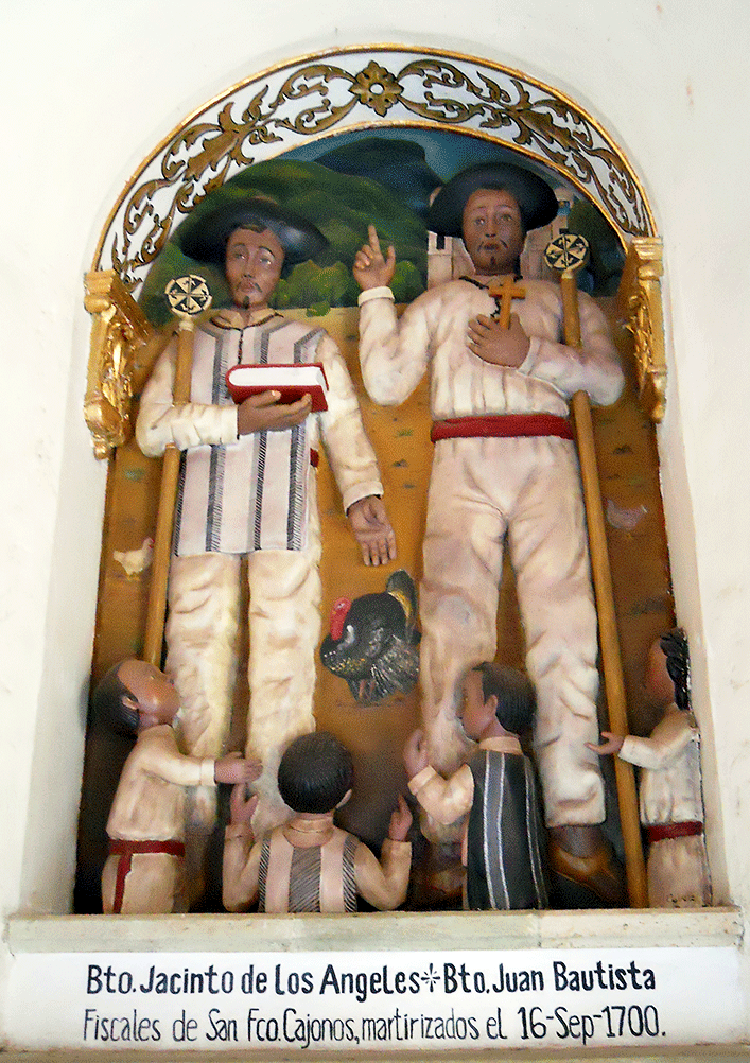
Back in 1700, Dominican priests in Oaxaca would commission converts to serve as “attorneys general,” assigned to police the purity and practices of those living in rural areas. Jacinto de los Angeles and Juan Bautista of San Francisco Cajonos, “the town in the clouds,” were so honored. Overhearing those worshipping the harvest god, Huitzilopochtli, talking about a clandestine evening gathering in his honor, the attorneys reported back to the Dominican friars. Intervention was planned, and Jacinto and Juan led a group to break up the idolatrous meet, seizing the men’s musical instruments.

Unfortunately for Jacinto and Juan, their Zapotec brethren did not take kindly to what they viewed as tattle-tale turncoat interference. A mob seized the two from the sheltering confines of the convent. The pair refused to recant their faith, even under torture.

They survived being thrown off Tanga Hill in the village of San Pedro, but clubs still were viewed as a popular way to deal with Christians anyway. The mob clubbed them and cut them with knives before cutting open their chests and feeding their hearts to the dogs. (I don’t make these things up. Read the Vatican’s version here.)

Whatever parts were left were gathered later by the faithful, who put them in the church of Villa Alta until 1889. The remains were moved to a chapel in the Cathedral of Oaxaca, a chapel almost always locked for their protection.

DSCN1067

A bad thing happened to what should be set aside as their day. Jacinto and Juan attained martyrdom on September 16, but, unfortunately, 110 years later Father Hidalgo absconded with their day on the calendar. His cry for independence from Spain changed what would be their feast day to Mexican Independence Day, a celebration far overshadowing their sacrifices.

But an exhausted-looking but determined Pope John Paul II rescued them from obscurity, beatifying them in 2002 as examples “of how, without regarding one’s ancestral customs as myths, one can reach God without renouncing one’s own culture but letting oneself be enlightened by the light of Christ, which renews the religious spirit of the best popular traditions.”

While their hearts probably wouldn’t be fed to the dogs, one wonders what kind of reception church spies would receive in someplace like San Juan Chamula today. “Hey, they are sacrificing chickens in your church.” “Hey, do you know that elder over there has four wives?” They would be so expelled from town.

But, the good part of this story is how Jacinto and Juan are revered in their hometown. Their stories didn’t rise up on the Vatican radar without help. A trio of maize and chickpea farmers championed their cause at the grassroots level. According to a story by Stephen Henderson in the Los Angeles Times, they researched the story at City Hall and then chronicled the testimonies of more than 30 locals who claimed prayers to Jacinto and Juan were answered with miracles. This represents 1/10 of the entire town.

The task took decades of dedication, but it paid off. A group of Cajonos proudly accompanied the glass-encased heartless remains of Jacinto and Juan to Mexico City for the papal ceremonies taking them one step closer to sainthood. Plus, the pair was given a new feast day of their own – September 18.


The Pope-blessed glass-encased relics can still be glimpsed sitting on the altar in that side chapel in the Cathedral of Oaxaca, a destination for Zapotecan pilgrims.