
The imaginative contributions of blacksmiths are among the embellishments that make wandering the streets of Budapest as pleasurable as exploring the galleries of an enormous museum.


Gayle Brennan Spencer – sending random thoughts to and from South Austin
The imaginative contributions of blacksmiths are among the embellishments that make wandering the streets of Budapest as pleasurable as exploring the galleries of an enormous museum.
The odalisque-type figures lolling about on the pastel mosaic friezes of the Budapest Hall of Art appear idle, but the creative Hungarians whose minds envisioned items featured in the 2017 National Salon obviously have been working overtime during the past decade.
The salon we viewed in May, “All Around Us,” was organized around eight applied art and design areas. According to Erno Sara and Joszef Sherer, curators of the exhibition:
“The Art of Everyday Life, Inevitable Design” – we could add as an explanation, and as a subtitle in some cases. Both the title and the subtitle are accurate, since the displayed materials comprise artworks we live with, artworks that are part of our everyday life, objects that we use and that contribute to our everyday comfort….
Our material culture is characterized by explosive attitudinal and technological development…. Archaic techniques and futuristic concepts meet in a warm embrace here…. The futile opposition of Craft and Design are replaced in this exhibition by the nature and possibilities of their mutual interaction.
The architectural designs lining the streets of Budapest reflect a culture reverent of the importance of adding appealing embellishments. But Gyorgy Szego, the artistic director of the hall formally named Mucsarnok – Kunsthalle Budapest, sounds an alarm for the future:
Somewhat more than 150 years ago, the relation between objects and people became a key civilizational issue. Since then, with the exception of “periods of grace…,” creative masters making and using their own tools have been forced on the defensive. The vectors of the curve describing this trend point in the direction of robotisation in an ever-widening scope of products. Resolving the conflict that exists between machine and man, technology and nature has to this day been a recurring, heroic and convulsive challenge faced by architecture and the applied arts….
How can we continue if artificial intelligence overwrites everything? Will the thousands-of-years-old practice of creating with thumb, hand, head and heart versus robotics eventually bring about the end of human existence?


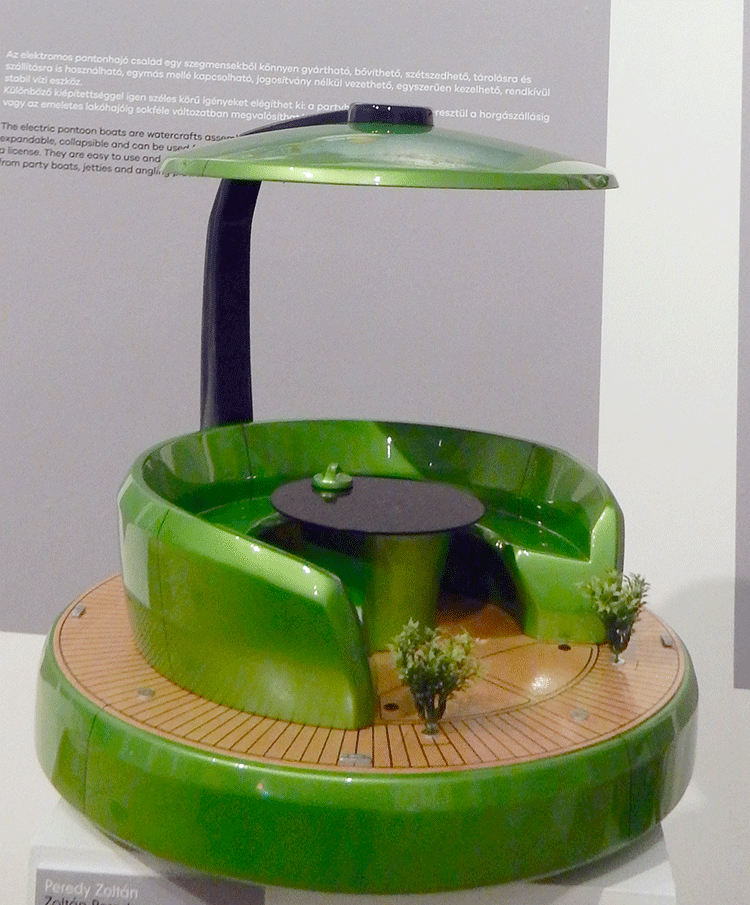
We both had our favorites. I so can picture this cheerful green cocktail pontoon lazily cruising in the Museum Reach of the San Antonio River. Or a spa or little sunbathing pontoon smoothly sailing out of a landing by Hotel Emma. The pontoon boats are electric, so they would be extremely quiet on their relaxing journeys. The collection was designed by Zoltan Peredy.
The Mister, on the other hand, was drawn to Peter Uveges’ metal and glass guitars. The slide and fretless guitars are designed to be particularly appropriate for playing the Delta blues.
Unfortunately, the explanations of his designs are in Hungarian, but the instruments speak for themselves:
During our wanderings throughout our stay in Budapest, the human element in design and invention seems well engrained in and safeguarded for the future by Hungarian culture.

Let the photo below of the former “Bazar” serve as an example from a time when signage was approached as artistic embellishment.
From a distance, the banners on the Opera House above appear a major detriment to its majestic architectural integrity. But at least they are removable. And, when you examine the second tier banner in the close-up shot, the comic strip-like advertising might just be a brilliant way to market opera to a new generation. The other series of seven posters with stars in more traditional poses appears downright stuffy by comparison.
The double-d-cupped model for Intimissimi mars another architectural gem, from a woman’s point of view, but it does have the excuse of promoting lingerie. On the other hand, Coca-Cola’s “Taste the Feeling” is offensive to women on so many levels.
The advertisement depicting Hungarian-American billionaire George Soros as a puppeteer reflects current political contests in Hungary. This spring, thousands of students marched to Parliament to protest laws targeting Soros’ Central European University, and, this week, Andras Gergely reported for Bloomberg News:
Hungarian Prime Minister Viktor Orban told lawmakers from his Fidesz party that fighting against what he sees as the agenda of billionaire financier George Soros will be the key campaign theme ahead of next year’s general elections, a news website reported.
Orban has already been facing charges from Jewish groups that he stoked anti-Semitism with a billboard campaign that targeted the investor and philanthropist this year. While the government has repeatedly denied that charge, it has kept up its rhetoric, saying Soros was undermining Hungary’s security by inducing migration toward Europe.
The government plans to hold a “national consultation” with voters to survey their views on what it calls the “Soros plan” on migration, Orban told lawmakers in a closed-door meeting, Origo news website said late on Wednesday. The premier said his chances for reelection to a third consecutive term in the spring hinge on whether the “Soros plan” fails, the publication close to the ruling party reported.
Orban’s government has also clashed with the U.S. and the European Commission over legislation targeting non-governmental organizations and a university funded by Soros. The laws were steps in Orban’s push to prevent what he calls foreign meddling in political matters by civil groups and institutions, in line with his model of the “illiberal state.”


The random signs brandishing exclamation points to indicate the importance of their warnings went unheeded by us. We were clueless. After a month, we still remained completely ignorant of the meaning of virtually any Hungarian word. Fortunately, the Kakastoke Porkolt sign was much friendlier about translating its warning that the stand’s star product was rooster testicles stew. No exclamation point needed to send us on our way.
Emperor Franz Josef is thrown in here purely because every time we saw the posters of him we felt as though we were staring at Jim LaVilla-Havelin. As I could find no email address for the San Antonio poet online, maybe someone who stumbles across this blog can forward it to him.
 Postcards from Barton Springs