Postcard from San Agustin Etla, Oaxaca, Mexico: Former factory rehabilitated as center for the arts

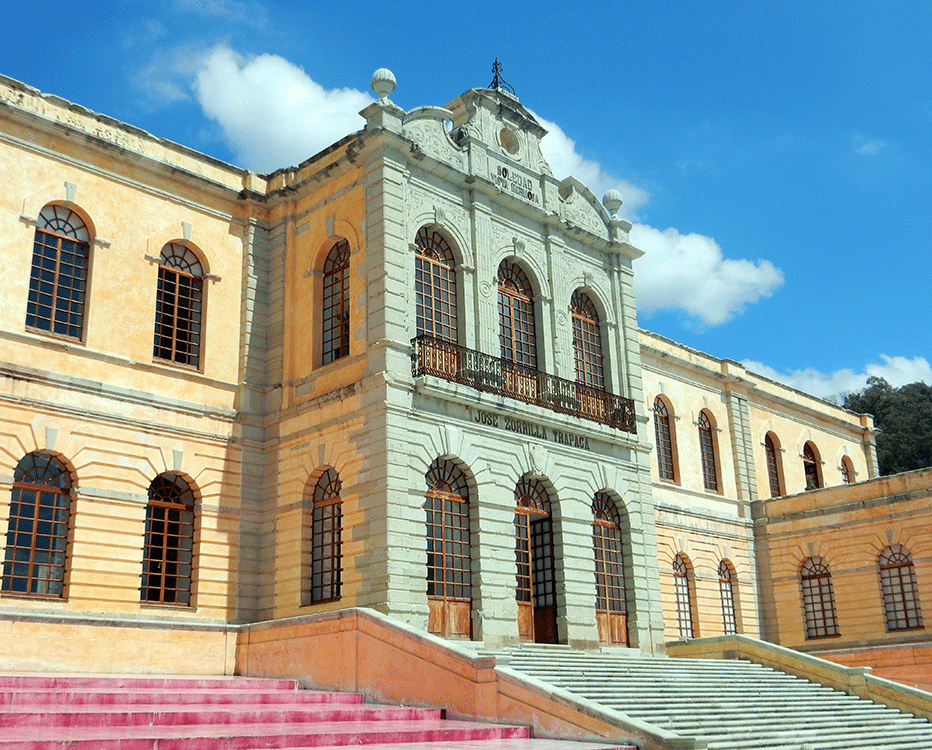
As someone who grew up going to school in one of those flat-roofed, aqua-paneled elementary schools built in an aesthetically-impaired period of the 1950s, bumping into architectural gems in rural Mexico is always amazing to me. Isolated from its surrounding landscape and thrown into the midst of photographs from around the world, the photo above would be difficult to place. But not only was this handsome structure built in 1883 in rural Oaxaca, its functional purpose was not to serve as a palatial retreat. It housed a spinning and weaving factory – Hilados y Tejidos La Soledad Vista-Hermosa.

In 2000, the shuttered factory in San Agustin Etla was reclaimed by artist Francisco Toledo, who had founded Arte Papel Vista Hermosa nearby two years earlier. The artist purchased the property to serve as an ecologically based arts center. With public and private funding underwriting its adaptive reuse, the property opened to the public in 2006 as the Centro de las Artes de San Agustin, or CASA.

A retrospective exhibit of photographs of Mary Ellen Mark, who died this past year, is currently on exhibit in the lime green Galeria del Chalet perched above the former factory.

In 1991, film director Louis Malle described Mark’s work in Rolling Stone:

Because she is so intensely involved with her subjects, because she gets to know them intimately, because she loves them, she often reveals in one single shot their history, their emotions, their souls. When she photographed runaway boys and girls in the streets of Seattle, she spent so much time with them that her portraits project a disturbing intimacy, a powerful bond between the camera and the children. Strangely, some of the photographs seem like self-portraits…. she knows how to find the perfect angle, the exact fraction of a second that will tell the story in one shot.

Not only did Mark leave behind a legacy of remarkable photographs, but she left her imprint on the work of the hundreds of photographers she taught through the years. She led workshops in Oaxaca for more than 20 years, and we were fortunate to catch an exhibition of some of her students’ works at the Centro Fotografico Manuel Alvarez Bravo in Oaxaca as well.

Postcard from Villa de Etla, Oaxaca: Pain paved the road to sainthood

Although the Church of San Pedro y San Pablo is far from small and fronts a spacious walled-in plaza in Villa de Etla, finding it though the maze of Wednesday market vendors with tarps obscuring upward views can be difficult.

The church and former monastery were founded by Dominican priests and built in the early 1600s. Their name honors two of the Catholic Church’s earliest and most famous martyrs, Saints Peter and Paul. The pair suffered rather painful ends under Emperor Nero: San Pedro was crucified, upside down at his request because he felt unworthy of dying in the same fashion as Jesus, while San Pablo was beheaded. Villa de Etla stages a major festival in their honor at the end of June.

But the San Pedro statue that catches one’s eye is of a Dominican priest who perished more than 1,200 years later. Brother Pedro’s preaching attracted papal attention, and he was promoted upward by Pope Innocent IV, who named him the Inquisitor for Lombardy in 1252. Charged with punishing heretics using some of the same brutal tactics as Emperor Nero had employed in Rome, San Pedro of Verona was pleasing the pope but made a number of powerful enemies. Assassins attacked him before he served even a full year in his position as Inquisitor. His enemies sliced his head open with an axe, and, when he continued to loudly profess his faith through prayers, they finished him off by stabbing him in the heart. San Pedro was rewarded with sainthood before the next year passed.

The statue of San Antonio of Padua bears such a sad expression; he appears to be mourning the loss of the original, more-to-scale sculptured companion of El Nino Jesus. Saint Anthony actually places second, falling only behind San Pedro of Verona, as the candidate canonized most quickly after death by the Catholic Church.

While in town on market day, many of the faithful visit the church to pray, light candles of hope and leave photos of loved ones in need of miracles.

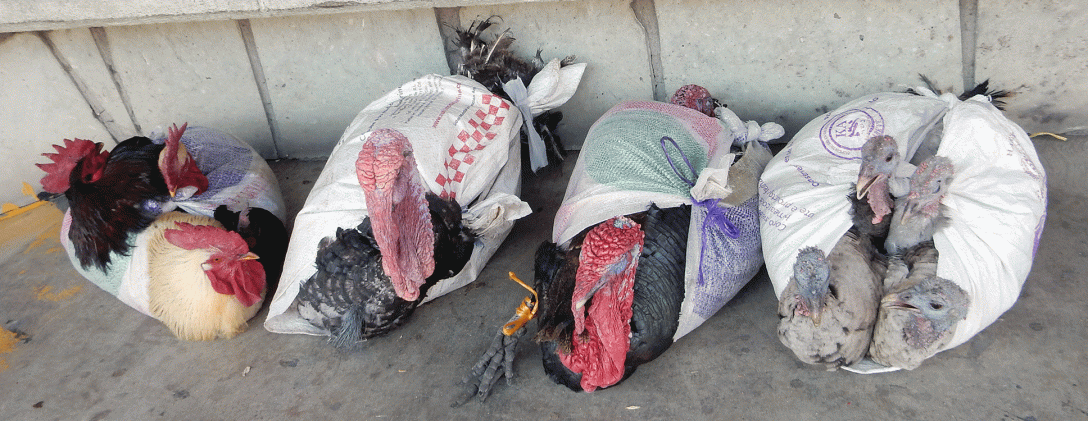
Postcard from Villa de Etla, Oaxaca, Mexico: Chicken and turkey bagged to go

Etla, a word meaning “land of beans” in Nahuatl, reflects the fertility of the valley located only a few miles from Oaxaca City. The population of Villa de Etla is less than 8,000, and Wednesdays bring all of them and farmers from throughout the valley to market, crowding blocks and blocks with their regional products. Tuk-tuks zip in and out of traffic ensnared by larger vehicles seeking to score scarce parking spots.

So many more vendors than buyers. Rows of women hopefully wait to sell bushel-size bags of plate-size tostadas. Huge bags of dried chiles scent the air surrounding tables of beautiful fresh produce, flowers and dulces.

Pop-up restaurants were packed. The variety of dishes a woman can prepare over a single comal never ceases to amaze. Evidence of the Coke vs. Pepsi war invades the main market house.

The Mister wisely steered me clear of the animal market, knowing I’d want photos of all. But a few vendors of live chickens and turkeys ready for the pot were peppered in among the fresh foods.

The unprepped poultry reminds of my city-raised mother’s (Thelma Virginia Williams Brennan) brief exile to the remote Eastern Shore of Virginia at the beginning of her marriage. She said she would stand out in the backyard holding a squirming live chicken until finally noticed by a sympathetic more experienced neighbor willing to be the executioner.

And, of course, I, a major believer in the middleman enabling the purchase of boneless skinless chicken breasts, proved even less fit for the self-sustaining country lifestyle. Our organic vegetable garden kept caterpillars and deer well-fed. After a year of raising chickens and ducks whose only eggs must have been gathered by raccoons and possums, we found them all a good home before moving from Boerne into San Antonio.