Postcard from Tlaxcala, Mexico: Daytripping through Mexico’s smallest state

A birdman caged underground for more than 1,000 years, Cacaxtla’s powerful priest of Quetzalcoatl now can be viewed in an archaeological site outside the town of San Miguel del Milagro, Tlaxcala, Mexico’s smallest state. Dressed in the guise of an eagle and surfing atop a feathered serpent, the priest was not uncovered until the 1970s.

The pyramid containing the best-preserved pre-Columbian murals recovered to date in this hemisphere is still undergoing restoration. The beehive of archaeological activity involves backbreaking labor seemingly not much different from that involved in the original construction. Yes, wheelbarrows are used, but they only cart the workers’ heavy loads to the bottom of the first step. Close to 100 men and women were scurrying on site in what must be a major public works boon to the small town’s economy.

The peaceful, hilly town of Tlaxcala City itself is a refuge for those from Mexico City, meaning tony shops and restaurants are tucked behind some of the humble-seeming facades.

But we pressed on, a lunch destination in mind. We headed to Apizaco to find Chef Francisco Molina’s Evoka, a restaurant many hail as among the most outstanding in all of Mexico. The chef is known for elevating regional ingredients and traditional dishes of Tlaxcala to new heights, and he did not let us down.

Pleased by a trio of amuse-bouche and emboldened by a mysterious mezcal margarita and a mojito de toronjil (melon liqueur, ancho reyes and lemon balm), we decided this was the place to experience one of those insect dishes we had yet to try. Yes, we’ve consumed grasshoppers and chicatanas numerous times, but never escamoles. The caviar-like delicacies prized since the time of Quetzalcoatl are eggs stolen from venomous giant ants inhabiting the root systems of agave plants. The volcan de escamoles emerging from the kitchen is a chaulpa layering the large eggs with beans, wild mushrooms harvested from the slopes of the nearby Malinche volcano, artisanal cheese and avocado. Quite a refreshingly tasty combination.

Our main courses were chicken with cilantro pesto and robalo with adobo sauce steamed in mixotes, packages of agave skin, with an assortment of vegetables harvested from the restaurant’s garden. We finished the feast with a quartet of nieves, scoops of house-made lemon balm and strawberry sorbets and hoja santa and dried corn ice cream.

Definitely worth a detour.
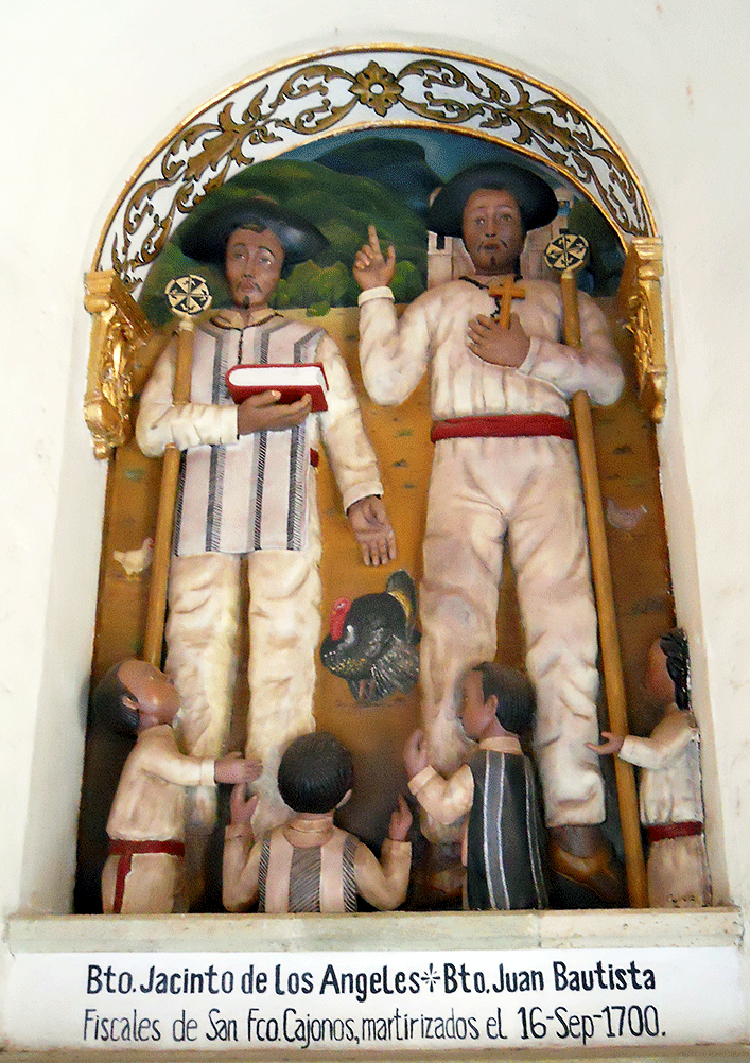


Holy card from Oaxaca, Mexico: Zapotecans in line for sainthood

DSCN2359

A long list is found on one of the walls of La Compania de Jesus Church in Oaxaca. A list of those waiting. Those whose lives in Mexico were so full of sacrifice Rome surely will notice and promote them on the road to sainthood.

I’m pulling for the child martyrs of Tlaxcala, the land of corn tortillas. Poor Christobalito, Antonio and Juan were, after all, children. Antonio and Juan were clubbed to death, but Christobalito’s own father, a confirmed pagan, condemned him to be beaten with clubs and then set ablaze for his faith. The trio was beatified by Pope John Paul II in 1990, but they hardly seem on the fast-track. They have been waiting in line a really, really, really long time. Ever since the late 1520s.

But in Oaxaca, a pair of Zapotecs stand out, although newcomers to the waiting list by comparison to the ninos above.

Back in 1700, Dominican priests in Oaxaca would commission converts to serve as “attorneys general,” assigned to police the purity and practices of those living in rural areas. Jacinto de los Angeles and Juan Bautista of San Francisco Cajonos, “the town in the clouds,” were so honored. Overhearing those worshipping the harvest god, Huitzilopochtli, talking about a clandestine evening gathering in his honor, the attorneys reported back to the Dominican friars. Intervention was planned, and Jacinto and Juan led a group to break up the idolatrous meet, seizing the men’s musical instruments.

Unfortunately for Jacinto and Juan, their Zapotec brethren did not take kindly to what they viewed as tattle-tale turncoat interference. A mob seized the two from the sheltering confines of the convent. The pair refused to recant their faith, even under torture.

They survived being thrown off Tanga Hill in the village of San Pedro, but clubs still were viewed as a popular way to deal with Christians anyway. The mob clubbed them and cut them with knives before cutting open their chests and feeding their hearts to the dogs. (I don’t make these things up. Read the Vatican’s version here.)

Whatever parts were left were gathered later by the faithful, who put them in the church of Villa Alta until 1889. The remains were moved to a chapel in the Cathedral of Oaxaca, a chapel almost always locked for their protection.

DSCN1067

A bad thing happened to what should be set aside as their day. Jacinto and Juan attained martyrdom on September 16, but, unfortunately, 110 years later Father Hidalgo absconded with their day on the calendar. His cry for independence from Spain changed what would be their feast day to Mexican Independence Day, a celebration far overshadowing their sacrifices.

But an exhausted-looking but determined Pope John Paul II rescued them from obscurity, beatifying them in 2002 as examples “of how, without regarding one’s ancestral customs as myths, one can reach God without renouncing one’s own culture but letting oneself be enlightened by the light of Christ, which renews the religious spirit of the best popular traditions.”

While their hearts probably wouldn’t be fed to the dogs, one wonders what kind of reception church spies would receive in someplace like San Juan Chamula today. “Hey, they are sacrificing chickens in your church.” “Hey, do you know that elder over there has four wives?” They would be so expelled from town.

But, the good part of this story is how Jacinto and Juan are revered in their hometown. Their stories didn’t rise up on the Vatican radar without help. A trio of maize and chickpea farmers championed their cause at the grassroots level. According to a story by Stephen Henderson in the Los Angeles Times, they researched the story at City Hall and then chronicled the testimonies of more than 30 locals who claimed prayers to Jacinto and Juan were answered with miracles. This represents 1/10 of the entire town.

The task took decades of dedication, but it paid off. A group of Cajonos proudly accompanied the glass-encased heartless remains of Jacinto and Juan to Mexico City for the papal ceremonies taking them one step closer to sainthood. Plus, the pair was given a new feast day of their own – September 18.


The Pope-blessed glass-encased relics can still be glimpsed sitting on the altar in that side chapel in the Cathedral of Oaxaca, a destination for Zapotecan pilgrims.