Postcard from Coimbra, Portugal: Saintly secrets whispered from walls

Aside from choosing a saint’s name for First Communion, the stories of saints were pretty much swept under the rug during my Catholic upbringing. But there are more than 10,000 mere mortals whose miraculous deeds, and/or martyrdom, have merited elevation to sainthood.

Their lives envelop you in Portugal, in churches, convents, monasteries and museums. Some saintly stories send signals arousing skepticism, such as the painting of the miracle “St. Bernard and the Lactation” in the Machado de Castro Museum in Coimbra. I didn’t take a photo because it seemed juvenile of me, but baby Jesus nursing on one of Mary’s breasts with a stream of milk squirting out the other into the open mouth of an adult man is a little hard to swallow as an appropriate vision for a sane man to proclaim publicly. And yet attain sainthood?

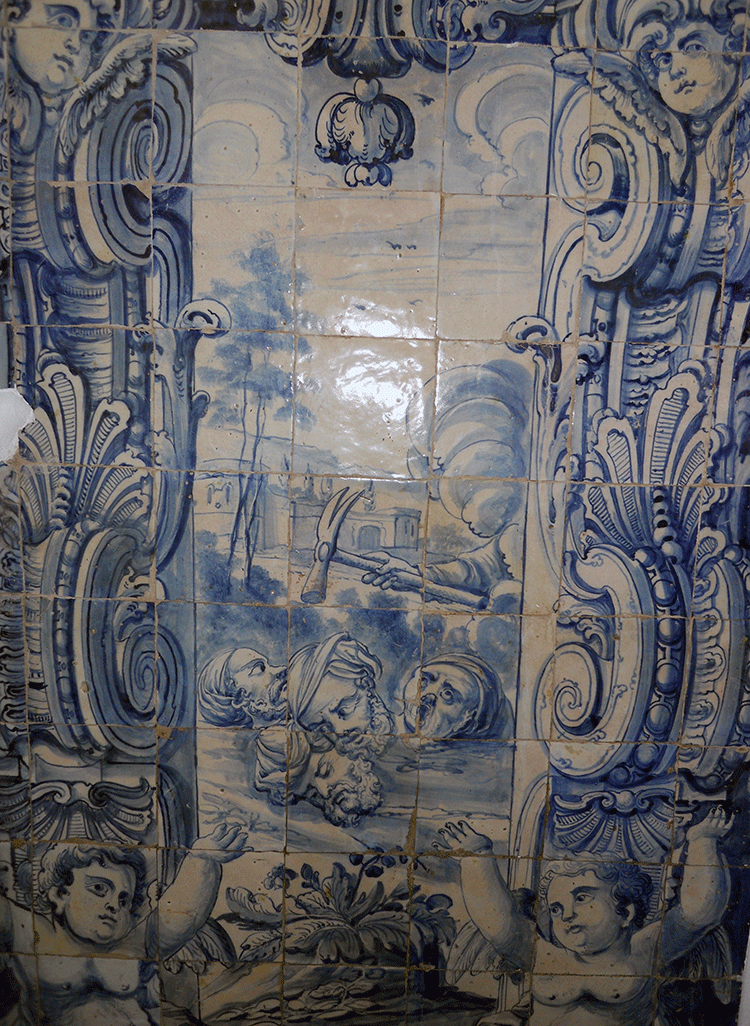
The fate of the five faithful Franciscans St. (that title bestowed later) Francis sent, or sentenced, to proselytize to the Moors in southern Spain and Morocco, on the other hand, is easier to grasp as saint-worthy. Not surprisingly, the Sultan did not embrace their message. So much so he personally beheaded the five (their shocked expressions captured on the azulejos above), whose remains were miraculously moved to Coimbra where they would inspire missionary zeal in a young Anthony – later to become St. Anthony and a great excuse for someone from a city named in his honor to journey to Portugal in advance of his feast day.

And Queen Isabel (Saint Elizabeth of Portugal, 1271-1336) certainly is recorded as a virtuous role model. Pledged to King Dinis at age 12, she plunged herself into daily devotions as he continued to relish rowdy romps at court while awaiting the actual marriage date a few years later. Once at court, she slowly began to alter the king’s ways by her pious example of prayer and service to the poor, pressuring ladies of the court to assist her, not welcomed as a popular pastime by all.

Queen Isabel was known as a peacemaker, even positioning herself upon a mule between two armed factions poised on the battlefield. She managed to broker peace between her son Affonso and his father during the Civil War arising because Affonso felt the King favored the rise in power of one of his illegitimate sons. (“Ah, Mom,” whined the Prince. “My wife, ever the party-pooper,” grunted the King.) Queen Isabel lavishly funded construction of the Santa Clara Convent while the king was still alive, and, after his death, retreated there herself to serve the poor.

This slideshow requires JavaScript.

And, of course, it’s not just their stories. Often it’s parts of them. Literally. Portugal hosts many gleaming reliquaries designed to preserve and display a bone or two of various sizes. As the Mister once remarked years ago with amazement, “One saint sure goes a long way.” Although mysteriously, many of the bones of the reliquaries prominently displayed in Portugal seem to be missing.

One day, much later, I will post my confession about my fascination with relics of saints.

But must be going, if we can make our way through all the partying Spaniards swarming Lisboa for a major soccer match. Two Spanish teams, for some reason. The Lisboa police might welcome some intercessions by Saint Isabel in the streets tonight to part the well-lubricated factions.
Postcard from San Miguel de Allende: Sun rises again at La Aurora

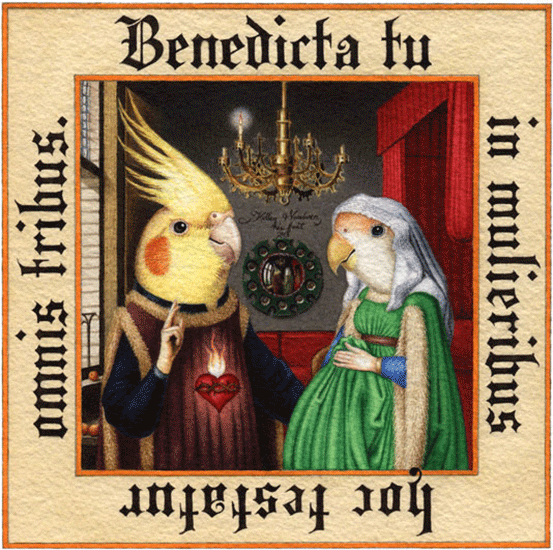
“Holy Wedding,” watercolor by Kelley Vandiver

More than 300 workers lost their livelihoods when the giant mechanical looms quit spinning cotton at Fabrica la Aurora in 1991. After 90 years, the massive mill stood silent.

Twenty years later, artists began to breathe new life into the abandoned structures as developers reopened one after another to create a vibrant center of art and design. The studios of working artists, art galleries, antique stores, restaurants and cafes now number more than 40, meaning meandering through the campus can take several hours.

This slideshow requires JavaScript.

Naturally, my favorite space belongs to artist Kelley Vandiver because every painting tells a story – the kind I call “saintly stories nuns never told me.” And Vandiver splices wonderful iconography into the tales he weaves.

Why live in Mexico? Vandiver’s answer:

This is a beautiful country that embraces the insane and the artistic with open arms.

Ceci n’est pas un grafitti: Random snapshots and superficial observations of Quebec City

Ah, historic old Quebec City. So clean, so orderly. It makes sense the only graffiti we spotted would deny its very existence.

Building upon the initial observations of Quebec found in my post about Montréal, the following represents additional random thoughts from our stay in Quebec City:

This slideshow requires JavaScript.

1. Quebec City is spotless. Amazingly litter-free. Everywhere. Even by the port where we were staying.

2. Within the walls of the old city, the buildings are beautifully preserved. Williamsburg-perfect. Virtually everything appears as if it has been carefully restored only yesterday. Even the architecture of the train station is Disney-castle-looking perfect.

3. While we often appeared to be the oldest couple in restaurants in Montréal, Quebec City made us feel the opposite. Blame it on “the boat people,” as I call them. Cruise ships pull up at the port at the base of the city, and empty their contents ashore. Herds of elderly (at least in the fall) take over the streets, swarming their way through the shops.

4. Which means the oldest part of the city is filled with shoppes (which I pronounce shoppies) designed to appeal to the repetitive invasions of the upscale boat people. People who might think opera-length giraffe gloves a necessity.

5. While we loved the pedestrian-dominated streets climbing upward and the perfectly restored buildings, it was when we broke out of the walls and walked past the state capitol that we found the Quebec City I liked. The buildings were all still historic; everything was clean; but there it felt real. More people lived and worked there on a daily basis, there out of the walking range of most of the boat people. Instead of shoppes, the ground floor of buildings housed businesses providing practical services and necessities. Small, neighborhood multi-ethnic restaurants flourished. Outside the old walls, the city has a more authentic feeling personality.

6. And, saints alive. Well, dead actually. Canadian Catholics still elevate relics, as in bones, to prominent display. American Catholics tend to ignore this old-world religious tradition. While I am fascinated but strangely accepting of this, to the point I was not content until I purchased some saint’s bones of my own, the Mister is more mystified. He always comes up with remarks such as, “One saint sure must go a long way.” And he worries about when they chop up the saints into all those little pieces spread out to inspire faith and prayers in churches around the world. Is this the fate of all saints, or only the ones who were martyred in such a brutal fashion their bones already were rendered into shards? Out of curiosity, I thought I would check on the disposition of the body parts Canada’s newest saint, Kateri Tekakwitha, declared so by Pope Benedict on October 21. Stumbled across a virtual audit of her skeletal remains from skull to sternum. The Mister is right. One saint does go a long way.

To view more snapshots taken during our vacation in Quebec City, visit shutterfly.