Lo! Cintra’s glorious Eden intervenes
In variegated maze of mount and glen.
Ah me! what hand can pencil guide, or pen,
To follow half on which the eye dilates
Through views more dazzling unto mortal ken
Than those whereof such things the bard relates,
Who to the awe-struck world unlocked Elysium’s gates?
Childe Harold’s Pilgrimage by Lord Byron
I must just observe that the village of Cintra in Estremadura is the most beautiful in the world.
Lord Byron in a letter, 1809
These photographs from our wanderings around Sintra did not fit in the earlier more focused posts. They range from a rally of classic Porsches crowding the narrow streets to flavorful contemporary Portuguese fare at Meia Tigela.
During interrogation by the Inquisition, a Templar knight cryptically stated: “There exists in the Order a law so extraordinary on which such a secret should be kept, that any knight would prefer his head cut off rather than reveal it.”[40)
from First Templar Nation: How the Knights Templar Created Europe’s First Nation-State by Freddy Silva
When the royal family summered at Sintra, society followed. Among those was the Baroness da Regaleira, who purchased Quinta da Torre, dating from the 1700s, in 1840 and transformed it into a place of elegance.
But the next owner lavished more embellishments on the estate, known now as Quinta da Regaleira. Born in Rio de Janeiro to Portuguese parents, Carvalho Monteiro (1848-1920) engaged Italian architect Luigi Manini (1848-1936), who designed the Bussaco Palace for the royal family, to work on the main house and grounds from 1898 to 1911. By the time Monteiro completed his extravagant transformation of the quinta, the days of summering with the royals had come to an end. Following the assassination of his father, young King Manuel II was living in exile In London.
This slideshow requires JavaScript.
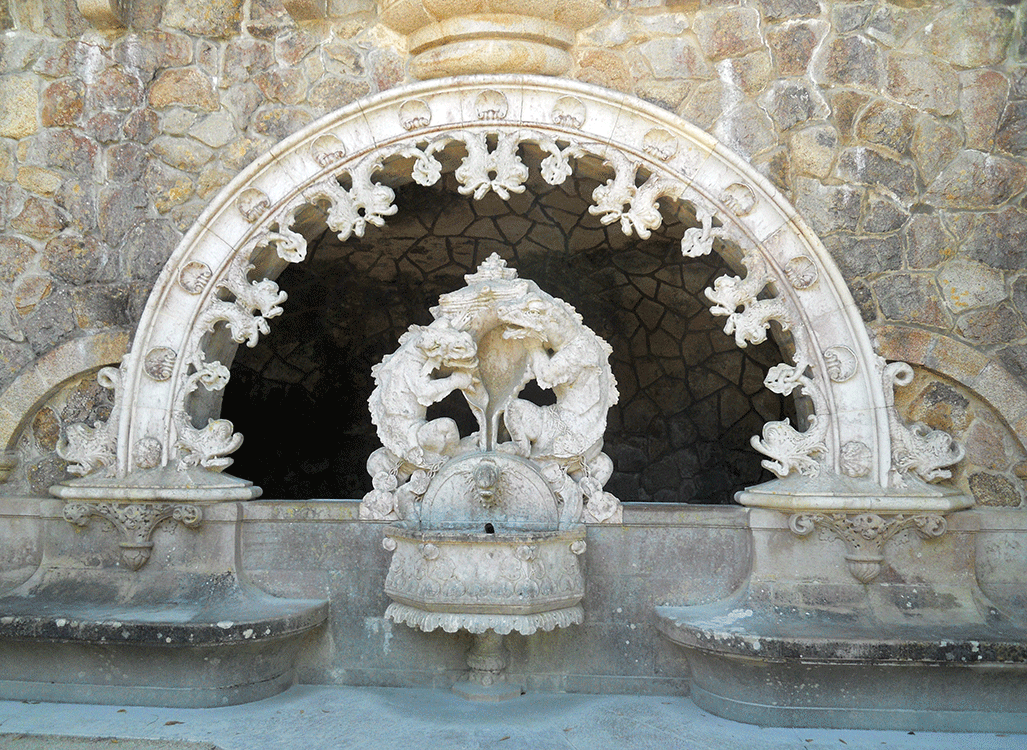
The extensive grounds designed as an image of the Cosmos are filled with a network of mysterious towers, tunnels and grottos associated with Masonic rituals. The initiation well spirals dramatically downward into the earth (The Mister took the photo peering upward from the depths; one of us does not do subterranean spaces well.). Near the upper gate, workers were assembling stage and props for a Masonic ceremony.
In 1152 Afonso Henriques — by now first king of Portugal — donated the entire village to a man who would become the fourth Templar Master of Portugal, Gualdino Paes (one of the five knights sent by Hugues de Payens to “establish a Portuguese crown”), and he did so under unusual circumstances — in absentia, while Paes was in Palestine with the then Templar Grand Master André de Montbard (also allegedly head of the Ordre de Sion).[38] Hundreds of years of earthquakes, neglect and time made their mark on the Templars’ properties in Sintra, but their original foundations remain and now serve modern day businesses, such as the Hotel Central and Café Paris. In 1970 a hypogeum or ritual chamber with access tunnels was discovered beneath said café, with a connecting passageway leading one way to the nearby Palace, and the other uphill towards the Templar castle.
Fifteen minutes’ walk from Sintra’s main square lies another property that right up to the Middle Ages was described as the Forest of Angels. Today it is the site of an extensive property owned by successive Masonic families dating to at least the early 18th century; in 1371 it was still in the possession of the Knights Templar.[39] Its gardens can only be described as a deliberately designed ritual landscape. One of its many wonders is a labyrinth of tunnels dug into the solid bedrock of the mountainside, penetrating deep into the hill as though meant for initiates wishing to immerse themselves in the dark seclusion of the womb of the Earth Mother, much like Gnostic sects have done throughout history. One of these tunnels leads to a shaft sunk forty feet into the earth.
It is described in official brochures as a well, and yet a close examination shows it never did, nor is it capable of retaining water. It consists of five levels of unevenly stacked and undressed limestone blocks, here and there patched and repaired. Behind the blocks hide five low and narrow circular galleries, each accessed through claustrophobic spiral stairs set into the rough wall and in a measured style that suggests a later refurbishment. The top of the shaft is literally an eighteen-foot diameter hole, level with the ground and surrounded by a rough, dry-stone wall in the shape of a horseshoe. This entrance faces northeast and, like Stonehenge’s horseshoe of bluestones, it references the highest position of the light, the summer solstice sunrise, the esoteric reference to ancient wisdom and, coincidentally, the feast day of John the Baptist, to whom the Templars dedicated a disproportionate amount of churches in Portugal and elsewhere.
Now owned by the municipality of Sintra, Quinta da Regaleira (click link to see videos) is operated by a nonprofit. The general public, and Freemasons, share the magical space.
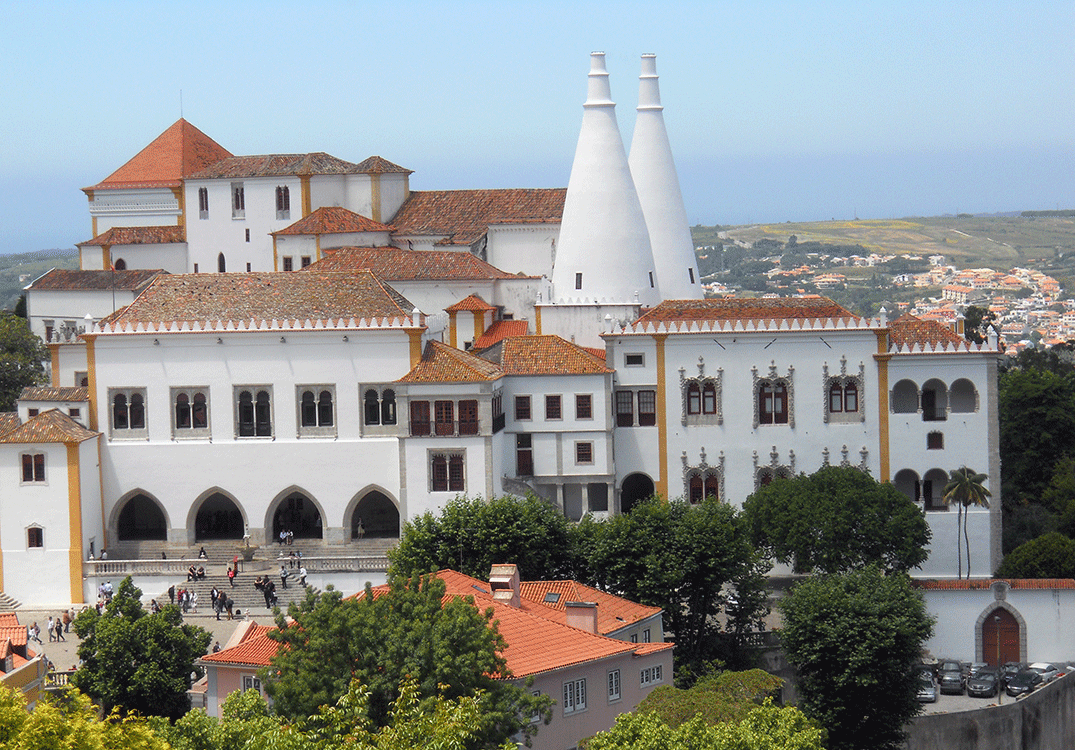
Only 15 miles from Lisboa but several degrees cooler, Sintra was a popular summer retreat for the royal family for centuries. King Joao I (1385-1433) began layering changes upon the Moorish base, and successive kings continued altering the National Palace to suit current styles.
This slideshow requires JavaScript.
Major feasts must have been served, as the conical twin chimneys top enormous stoves and ovens in the palace kitchen. And, as always in Portugal, a multitude of tiles color the walls.


 Postcards from Barton Springs