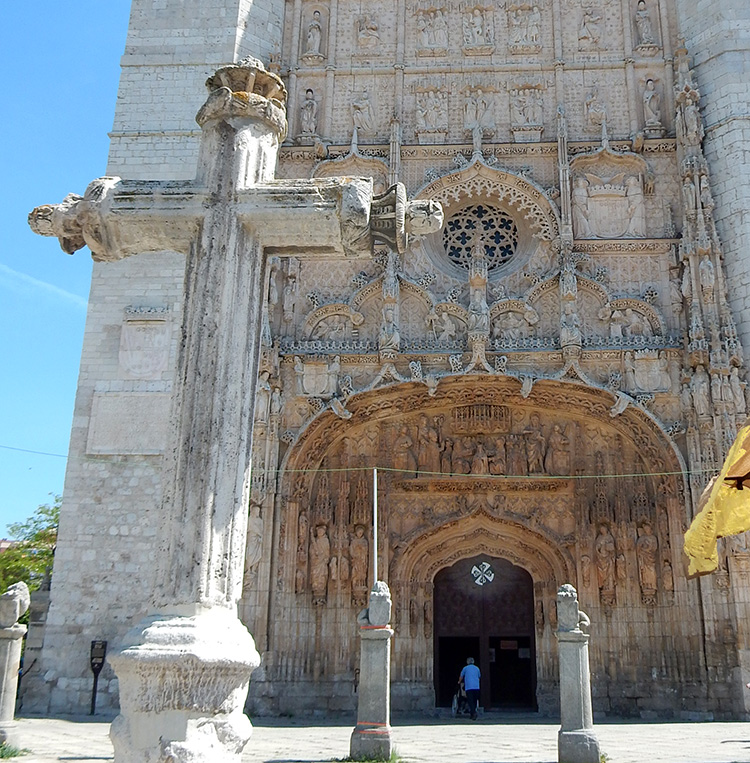
Postcard from Valladolid, Spain: Iglesias and a maligned queen

Above, Iglesia de San Pablo

Valladolid was flourishing in the 15th century when Isabella I, Queen of Castile, married King Ferdinand of Aragon in the city – an elopement with private ceremonies, as they were second cousins. With the city a favored spot for the Catholic royal family members to hold court, Pope Clement VIII elevated it to a bishopric, the center of an archdiocese.

Bolstered by this recognition, city fathers launched efforts to build a suitable cathedral, the largest in Europe. Architect Juan de Herrera (1530-1597) was commissioned for the design of Nuestra Senora de la Asuncion. Despite Herrera’s death, completion appeared possible with the official establishment of Valladolid as the capital of Spain by King Philip III (1578-1621) in 1601.

The rosy future dissipated as a royal advisor standing to personally benefit through his real estate holdings persuaded Philip of the need to move the capital back to Madrid in 1606. The cathedral budget was slashed – about 60 percent.

Continue reading “Postcard from Valladolid, Spain: Iglesias and a maligned queen”

Postcard from Valladolid, Spain: Plateresque architecture competes with sculpture within

Above, Isabelline Plateresque details surround the courtyard of Colegio de San Gregorio in the complex serving as Museo Nacional de Escultura.

The National Sculpture Museum is housed in three historic landmarks clustered together in one block in Valladolid.

With the nationalization of convents and monasteries in 1836, the government of Spain seized a wealth of artistic treasures in need of housing. Many of those from the region of Castile first went on display in Valladolid in 1842 in the Colegio de Santa Cruz. In 1933, the collection was designated a national one and was moved to the Colegio de San Gregorio.

The exterior of the 15th-century building is characterized by intricate sculptural reliefs in the Isabelline Plateresque style. The gorgeous façade demonstrates a complete lack of a uniform theme – resulting in a fascinating hodgepodge of biblical and secular components with an abundance of putti and floral and vine-like flourishes intertwined among them.

Continue reading “Postcard from Valladolid, Spain: Plateresque architecture competes with sculpture within”

Postcard from Salamanca, Spain: Stonemasons’ soaring work pays homage to patron saint

Saint Stephen earned the honor of serving as the patron saint of stonemasons the hard way. An early convert from Judaism to Christianity, Stephen traditionally is regarded as the first of the faithful to be martyred for his beliefs in the Holy Trinity. He was stoned to death for his alleged blasphemy, so he often is depicted bearing a trinity of stones.

But the stonemasons constructing the Dominican church and adjoining cloisters in Salamanca over a century or two beginning in the 1500s created a monumental tribute to their patron saint. His massive church stretches 275 feet in length and rises more than half that high at the transept. Primarily Gothic on the interior, the church’s façade reflects the Plateresque detailing in vogue at the time of its completion.

And, given that we are always on the lookout for our hometown saint…. Alas, an ancient statue of Saint Anthony has lost something major. While Baby Jesus rests safely in Saint Anthony’s hands on the façade of the church, inside he is missing. We don’t know how many hundreds of years ago the kidnapping occurred, but the shadow of the statue of the empty-handed patron saint of misplaced or stolen items seems attempting to follow the advice of the children’s chant imploring: “Saint Anthony, Saint Anthony, turn around. I’ve lost something that can’t be found….”