Postcard from Istanbul, Turkey: Modern art seems a culture clash

Postage stamp depicting Mustafa Kemal Ataturk unveiling the new Turkish alphabet in 1928, symbolizing a cultural shift.

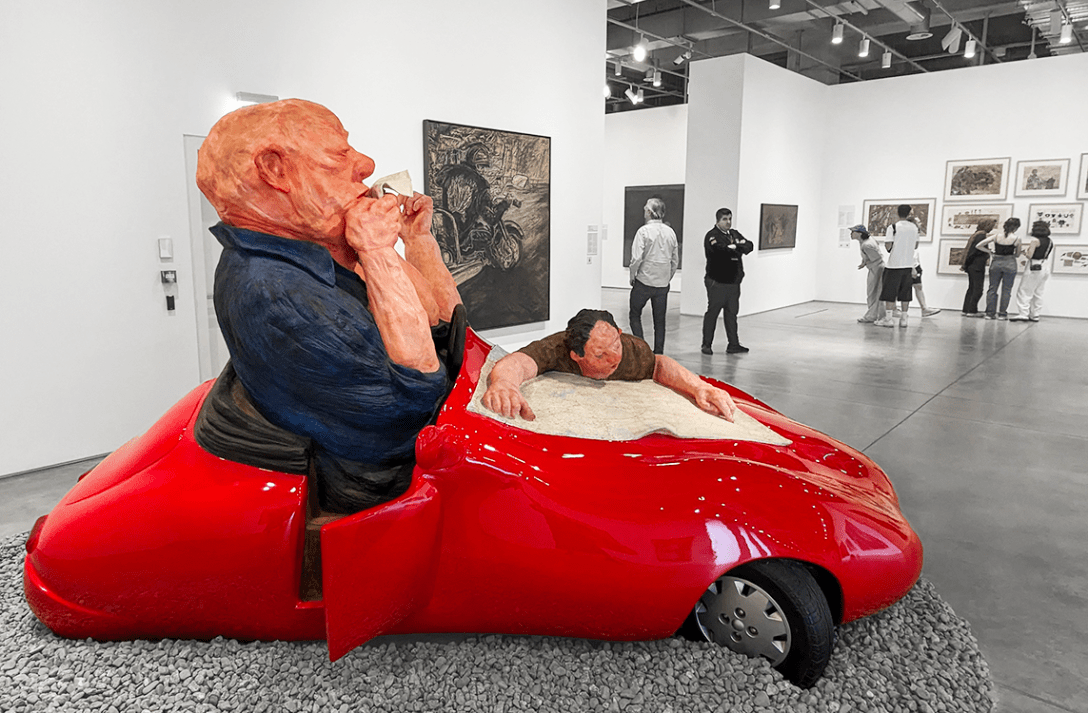
Above: “Racing Car,” Mehmet Guleryuz, 2017, Istanbul Museum of Modern Art

But I’m not going for realism…. I’m not going to paint his cage. Lemon will be perched in front of the window like a wild bird who has alighted there of his own free will.”

The Museum of Innocence, Orhan Pamuk, 2009

Birdcages. Potent symbols. Ever since visiting Orhan Pamuk’s Museum of Innocence in Istanbul on this same trip, it seems I have been seeing birdcages incorporated in artworks everywhere I go. Often with human figures inside – women.

A large projection screen dominating a gallery in Istanbul Modern Art Museum confronts you with a discomforting cage, a performance art piece by Nezaket Ekici (1970-), wearing an Alice-in-Wonderland-style dress.

In ‘But All that Glitters Is Not Gold,’ the challenge is to choose the right one from among the many identical-looking keys hanging at various distances around the cage. What initially looks like a fun game over time becomes an agony.”

Curator’s Notes, Istanbul Modern

Continue reading “Postcard from Istanbul, Turkey: Modern art seems a culture clash”

Postcard from Istanbul, Turkey: Controversies resurface with conversion of Chora

Above: Angels surround an image of the Virgin Mary and Child in a 14th-century Byzantine fresco in the dome crowning a side chapel of the former Church of the Holy Saviour in Chora, recently reopened as the Kariye Mosque.

I have no religion, and at times I wish all religions at the bottom of the sea. He is a weak ruler who needs religion to uphold his government; it is as if he would catch his people in a trap.” 

Mustafa Kemal Ataturk (1881-1938)

For many in Turkey, Mustafa Kemal Ataturk remains the most respected figure in the republic’s history. Banners bearing Ataturk’s image still flutter across streets and on buildings throughout Istanbul.

Following the defeat of the Ottoman Empire during World War I, Ataturk led a successful revolution against the Allied Forces to prevent them from dividing up Turkey as spoils of war. He abolished the Sultanate and then proclaimed Turkey an independent republic in 1923.

As the country’s first president, Ataturk launched a host of aggressively progressive reforms: free and compulsory elementary level education for all; equal rights for women; and secularization of the state. Later, both Hagia Sofia and Chora Church were converted into museums, demonstrating Turkey’s tolerance of different religions.

In 2020 to cement his support on the conservative right, President Recep Tayyip Erdogan succeeded in convincing the court to overturn Ataturk’s original decree and announced the conversion of both into mosques. The conversions were accompanied by a promise to keep the mosques accessible to those of all faiths.

Continue reading “Postcard from Istanbul, Turkey: Controversies resurface with conversion of Chora”