Postcard from Istanbul, Turkey: Modern art seems a culture clash

Postage stamp depicting Mustafa Kemal Ataturk unveiling the new Turkish alphabet in 1928, symbolizing a cultural shift.

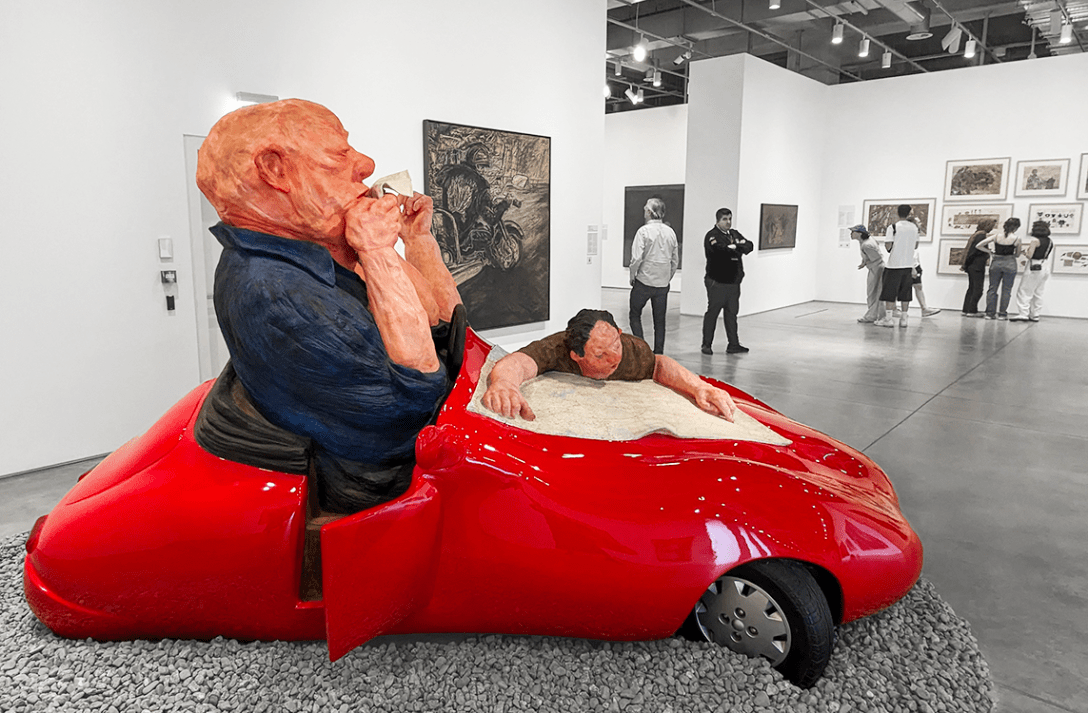
Above: “Racing Car,” Mehmet Guleryuz, 2017, Istanbul Museum of Modern Art

But I’m not going for realism…. I’m not going to paint his cage. Lemon will be perched in front of the window like a wild bird who has alighted there of his own free will.”

The Museum of Innocence, Orhan Pamuk, 2009

Birdcages. Potent symbols. Ever since visiting Orhan Pamuk’s Museum of Innocence in Istanbul on this same trip, it seems I have been seeing birdcages incorporated in artworks everywhere I go. Often with human figures inside – women.

A large projection screen dominating a gallery in Istanbul Modern Art Museum confronts you with a discomforting cage, a performance art piece by Nezaket Ekici (1970-), wearing an Alice-in-Wonderland-style dress.

In ‘But All that Glitters Is Not Gold,’ the challenge is to choose the right one from among the many identical-looking keys hanging at various distances around the cage. What initially looks like a fun game over time becomes an agony.”

Curator’s Notes, Istanbul Modern

Continue reading “Postcard from Istanbul, Turkey: Modern art seems a culture clash”

Postcard from Paris, France: Purging art to ‘cleanse’ culture

French stamp depicting a figure being restrained by two soldiers, symbolizing resistance.

Above: “The Pinch of Snuff (Rabbi),” Marc Chagall (1887-1985), mid-1920s

This painting, in which a rabbi sells his soul to Satan for a pinch of tobacco, was acquired by the Mannheim Kunsthalle in 1928. In 1933, Mannheim became the scene of an intense campaign of purge and defamation of modern art orchestrated by the Nazis…. the painting was dragged through the streets of the city with the message: ‘You who pay taxes should know where your money is being spent.'”

“‘Degenerate’ Art: Modern Art on Trial under the Nazis,” Curator Notes, Musee Picasso Paris, 2025

One evening at the end of May, we were fortunate to slip into a last remaining timeslot for viewing “‘Degenerate’ Art: Modern Art on Trial under the Nazis” at Musee Picasso Paris. It was packed with procrastinators, rendering the air-conditioning incapable of keeping the day’s lingering heat at bay. Yet, we all found ourselves crowding close to the artwork in an attempt to devour every word of the informative curator notes.

Most of the featured art had been included in a major exhibition of 600 works mounted by the Nazi regime in Munich in 1937. The purpose of this was not to shine light on exemplary art; instead, it was designed to condemn entartete kunst, or degenerate art, and the evil artists who spawned it.

Continue reading “Postcard from Paris, France: Purging art to ‘cleanse’ culture”

Postcard from Marseille, France: Cantini’s insider to outsider art

A close-up view of a postmarked envelope featuring various stamps, including a red priority mail stamp and green stamps depicting abstract figures, along with handwritten details and doodles.
Above: Postal art incorporated in a collage by Louis Pons.

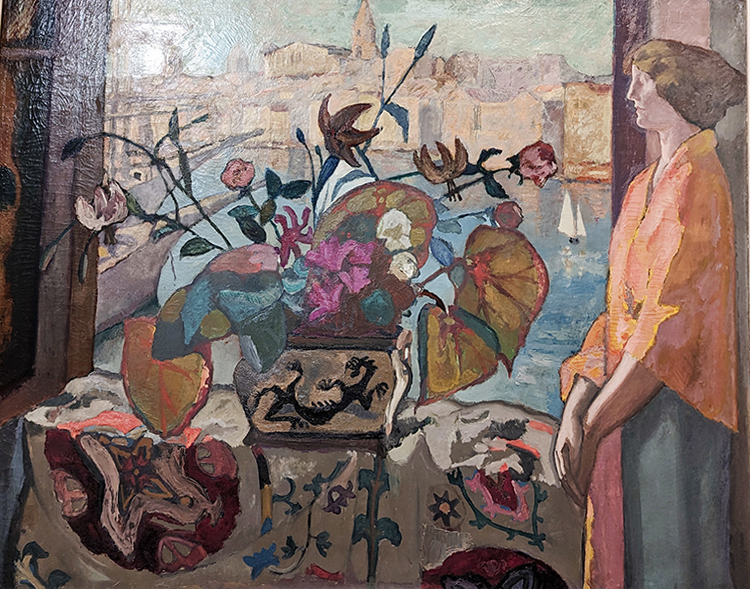
Above: “Les Fleurs et le Matin,” Alfred Lombard (1884-1973), 1913

I kill time with the strokes of the pen…. It will take a long time.”

Louis Pons (1927-2021)

A palace built at the tail end of the 17th century by wealthy trade merchants was acquired a century later by the artistic son of a stonemason. With a ready supply of fine marble at hand, Jules Cantini’s (1826-1916) attraction to sculpture was only natural. He designed altars for some of Marseille’s most important churches.

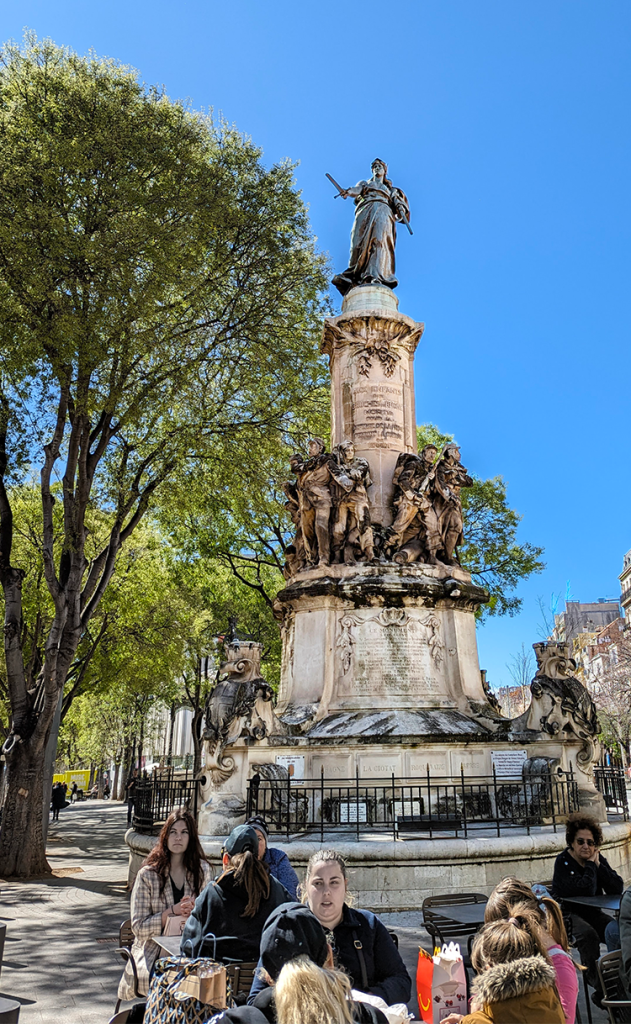
A statue atop a monument stands in a park with people seated at tables below it, surrounded by trees and a blue sky.
1894 “Monument des Mobiles” funded by Jules Cantini.

Retaining the profitable marble business of his father, Jules began to assemble a major art collection. For his native city, Cantini underwrote the construction of a landmark fountain and memorial designed by architect Gaudensi Allar (1841-1904) and dedicated to the citizens who perished during the 1870 Franco-Prussian War.

Cantini bequeathed his home to the Marseilles for use as a museum dedicated to decorative arts. The city opened the museum in 1936, eventually spotlighting emerging trends in French art from 1900-1980. A random sampling of works are found below.

Continue reading “Postcard from Marseille, France: Cantini’s insider to outsider art”