Postcard from Rome, Italy: A numbers game sparked by the baths

Visualizing times gone by is difficult, even when surrounded by highly visible ancient remnants.

Baths to accommodate 3,000? That number finally hit me for some reason. Wait, how big was Rome?

The Diocletian Baths, built beginning about the year 290, could accommodate 3,000 people bathing, getting a shave and a haircut, exercising, reading in the library, gathering for gossip and, well okay, visiting the brothel. Not sure in which order these activities were engaged.

But the Diocletian Baths were not the only baths. There were hundreds and hundreds of them in ancient Rome.

Which finally sent me back to try to understand the immense size not of the sprawling Roman Empire, but of Rome itself.

The AlamoDome in San Antonio seems large to this girl; it can accommodate 64,000. The Coliseum in Rome could house somewhere in the range of 75,000 people, who could all exit within a 15-minute period after Emperor Diocletian (244-311) had executed some of the thousands of Christians he made into saints during several prime years of persecution.

But that was still a small house in Rome. Other special events attracted even larger crowds; close to 300,000 could gather to watch chariot races at Circus Maximus.

Wait, where did all those people come from? The majority were just locals. The population of Rome then was well over 1,000,000. So hard to envision an ancient urban environment that dense.

Things would change dramatically in only a view years. The collapse of the empire, invasions by those pesky Goths. The population evacuated for new opportunities or was devastated by pestilence. During the 1300s, with schism in the papacy between Rome and Avignon, Rome had fewer than 20,000 inhabitants.

But I digress, once again.

The photos below are from the collection of the Museo Nazionale Romano housed on the grounds of the former baths and portions renovated/remodeled into cloisters for a Carthusian monastery, commissioned in 1561 by Pope Pius IV (1499-1565) of the Medici clan and designed by Michelangelo (1475-1564).

More recent remodeling to house the collection and special exhibits was completed in 2014. Thousands of the museum’s holdings once crammed akimbo into this one location are now spread out for improved viewing around several locations.

And, by the way, sometimes there was a lot of r-rated activity happening on the outside of those sarcophagi.

Postcard from Rome, Italy: When hell freezes over, build a church

On summering in Rome:

…even dawn is hot…. The city is drugged with heat; the stones are dead; the streets are devastatingly quiet. From one until four, no one moves. Shutters are drawn, storefronts sealed – it might as well be 3 a.m.

Anthony Doerr, Four Seasons in Rome

Now it’s springtime. The weather in Rome this month approaches perfection. But memories of visiting here in the summertime more than 40 years ago still sizzle in my memory.

So, if, in the midst of a sultry night, the Virgin Mary appeared to you in a dream to announce you should build a church when and where it snowed? Well, duh.

Legend has it that Pope Liberius (310-366) had what would have seemed a pipe dream, except…. One August the 5th, it snowed on Esquiline Hill. Definitely a hard-to-ignore sign to erect what would eventually evolve into the Basilica of Santa Maria Maggiore.

Through the centuries, the church continued to benefit from papal enhancements. Mosaics along the central nave were added by Pope Sixtus III (390-440), while the mosaics depicting the “Coronation of the Virgin” over the apse by a Franciscan friar, Jacopo Torriti, were commissioned by Pope Nicholas IV (1227-1292), depicted on the far left of the grouping. The geometric Cosmatesque flooring was added during the same period. Lorenzo Cosmati (1140‑1210) is credited with this marquetry technique of slicing thin layers of colored stone salvaged from “leftovers” of Roman antiquity.

Pope Gregory XI (1329-1378) added the 246-foot high bell tower, the tallest in Rome, soon after his return from Avignon. King Ferdinand II (1452-1516) and Queen Isabella (1451-1504) contributed gold from the journeys of Christopher Columbus (1451-1506) to the New World for the coffered ceiling dating from 1450.

Pope Sixtus V (1521-1590) commissioned architect Domenico Fontana (1543-1606) to design the Sistine Chapel. Fontana achieved acclaim for his engineering feats erecting some of the city’s massive obelisks imported from Egypt, including the one in front of Santa Maria Maggiore. The 327-ton one in front of Saint Peter’s required 900 men and 75 horses to haul and install into its upright position.

A little spirited papal competition led Pope Paul V (1552-1621) to try to outdo that chapel by enlisting architect Flaminio Ponzio (1560-1618) to design Cappella Paolina. Paul V was of the Borghese clan, and Ponzio also designed the Villa Borghese Pinciana, home to one of Rome’s most prominent museums. And then there is a chapel designed by Michelangelo (1475-1564) but completed by another architect.

In the heat of a summer afternoon, churches are the only refuges, dim and cool…. I want to stay in these churches for hours; I want to take off my shirt and lie on the marble, my chest against the stone, and let the perpetual dusk drift over me.

Anthony Doerr, Four Seasons in Rome

An August snow is like a never-occurrence in Rome, but, every year on the fifth, in commemoration of the miraculous time it did, showers of thousands of snow-white flower petals flutter down from the gilded ceiling upon the congregation.

Postcard from Bologna, Italy: The ornate resting place of Saint Dominic

Saint Dominic (1170-1221) was born and educated in Spain, with extensive studies in theology and the arts. During a famine in 1191, he sold all of his belongings to purchase food for the poor.

The Dominican Order he founded was based on strict discipline and prayer and embraced an austere lifestyle, contrasting with the opulence favored by many priests of his day. The bald pate in the tonsure haircut Saint Dominic favored demonstrated his humility, and he removed his sandals to enter towns where he was preaching barefoot. Some believe he originated the saying of the Rosary following a vision of the Virgin Mary to aid in the conversion of heretics.

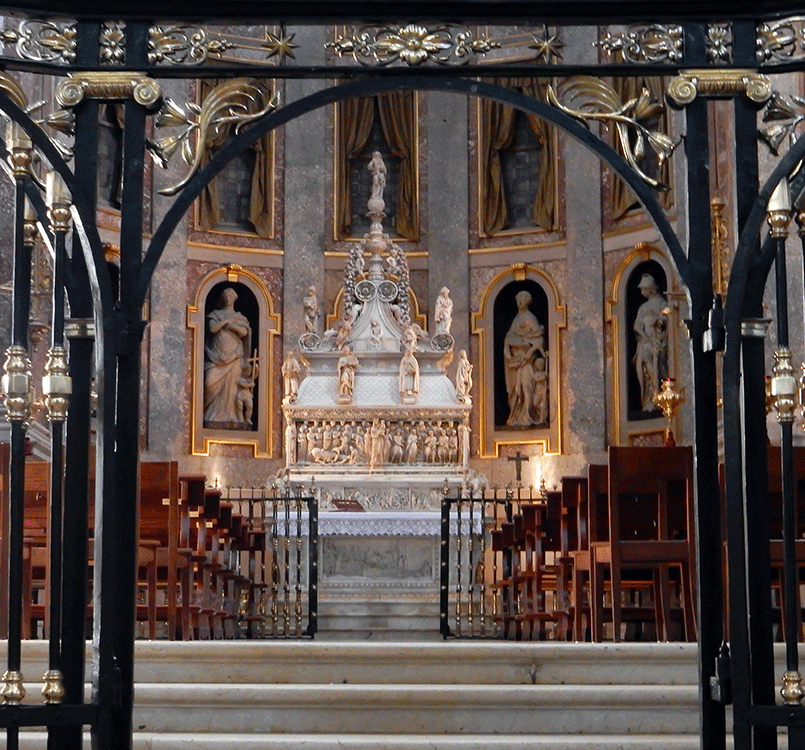
Even when exhausted and dying in Bologna, Saint Dominic refused a bed, insisting as always in sleeping on the floor. He was buried in the floor of the convent, but, following his canonization in 1234, there were those who dreamed of a more grandiose resting place appropriate for a saint.

Saint Dominic’s new sarcophagus is ringed with sculptural depictions of his life carved by Nicola Pisano in 1267. Two centuries later this arc was crowned by a new tier of sculpture crafted by Niccolo da Bari, attaining such notoriety for the artist he became known as Niccolo dell Arca. Among other artists later adding additional ornamentation to the saint’s final resting place was Michelangelo.

The Basilica of San Domenico is no humble resting place but an exuberant celebration of the religious arts.