Postcard from Villa de Etla, Oaxaca: Pain paved the road to sainthood

Although the Church of San Pedro y San Pablo is far from small and fronts a spacious walled-in plaza in Villa de Etla, finding it though the maze of Wednesday market vendors with tarps obscuring upward views can be difficult.

The church and former monastery were founded by Dominican priests and built in the early 1600s. Their name honors two of the Catholic Church’s earliest and most famous martyrs, Saints Peter and Paul. The pair suffered rather painful ends under Emperor Nero: San Pedro was crucified, upside down at his request because he felt unworthy of dying in the same fashion as Jesus, while San Pablo was beheaded. Villa de Etla stages a major festival in their honor at the end of June.

But the San Pedro statue that catches one’s eye is of a Dominican priest who perished more than 1,200 years later. Brother Pedro’s preaching attracted papal attention, and he was promoted upward by Pope Innocent IV, who named him the Inquisitor for Lombardy in 1252. Charged with punishing heretics using some of the same brutal tactics as Emperor Nero had employed in Rome, San Pedro of Verona was pleasing the pope but made a number of powerful enemies. Assassins attacked him before he served even a full year in his position as Inquisitor. His enemies sliced his head open with an axe, and, when he continued to loudly profess his faith through prayers, they finished him off by stabbing him in the heart. San Pedro was rewarded with sainthood before the next year passed.

The statue of San Antonio of Padua bears such a sad expression; he appears to be mourning the loss of the original, more-to-scale sculptured companion of El Nino Jesus. Saint Anthony actually places second, falling only behind San Pedro of Verona, as the candidate canonized most quickly after death by the Catholic Church.

While in town on market day, many of the faithful visit the church to pray, light candles of hope and leave photos of loved ones in need of miracles.

Postcard from Zinacantan, Chiapas, Mexico: Roosters Rule the Roost

Densely clustered deep plum and royal blue embroidered flowers blanket the huipiles of women running errands in San Cristobal de las Casas from the nearby Tzotzil town of Zinacantan. They were my favorites spotted on the streets.

As with San Juan Chamula, male leaders operate the small town of Zinacantan somewhat autonomously, charging a toll to outside visitors. But here the women are not subjected to polygamous marriages.

The feathers young women spend months weaving into their bridal outfits do symbolically spell out their standing in the marriage. The feathers aren’t brilliant parrot or peacock feathers but are those of the humble hen. Unable to fly, hens don’t flee the coop. Chickens stay close to home, subject to the rooster’s whims.

This slideshow requires JavaScript.

Several churches abut plazas at the heart of Zinacantan. The church of San Lorenzo dates to 1546. We are not sure why Saint Lawrence was popular, but he is the patron saint of chefs.

As punishment for having distributed the church’s wealth to the poor instead of Roman authorities in the year 258, Lawrence was slowly grilled upon an iron grate. He is alleged to have quipped to his tormenters, “Turn me over; I’m done on that side.” Perhaps Nana (Katherine Ann Conway Brennan, 1887-1972) was prescient in naming my father Lawrence (Lawrence Conway Brennan, 1918-1988), for no one enjoyed grilling a thick sirloin steak, fork in one hand and Bourbon in the other, more than Dad.

San Sebastian has a more obvious connection to a second church built about 200 years later. Some believe the saint who was martyred about the same time as Saint Lawrence miraculously appeared to construct this church in Zinacantan with his own hands, a feat he accomplished in only three days.

Others claim he reappeared in Mexico only to be pierced by arrows shot by Spanish soldiers, as he originally had been in Rome. He died, once again, on the site of the church and was buried there. Saint Sebastian is a patron of athletes and soldiers and a protector against the plague, particularly beneficial when Spanish soldiers are spreading European diseases among the native population with no immunity to them.

Postcard from Coimbra, Portugal: Saintly secrets whispered from walls

Aside from choosing a saint’s name for First Communion, the stories of saints were pretty much swept under the rug during my Catholic upbringing. But there are more than 10,000 mere mortals whose miraculous deeds, and/or martyrdom, have merited elevation to sainthood.

Their lives envelop you in Portugal, in churches, convents, monasteries and museums. Some saintly stories send signals arousing skepticism, such as the painting of the miracle “St. Bernard and the Lactation” in the Machado de Castro Museum in Coimbra. I didn’t take a photo because it seemed juvenile of me, but baby Jesus nursing on one of Mary’s breasts with a stream of milk squirting out the other into the open mouth of an adult man is a little hard to swallow as an appropriate vision for a sane man to proclaim publicly. And yet attain sainthood?

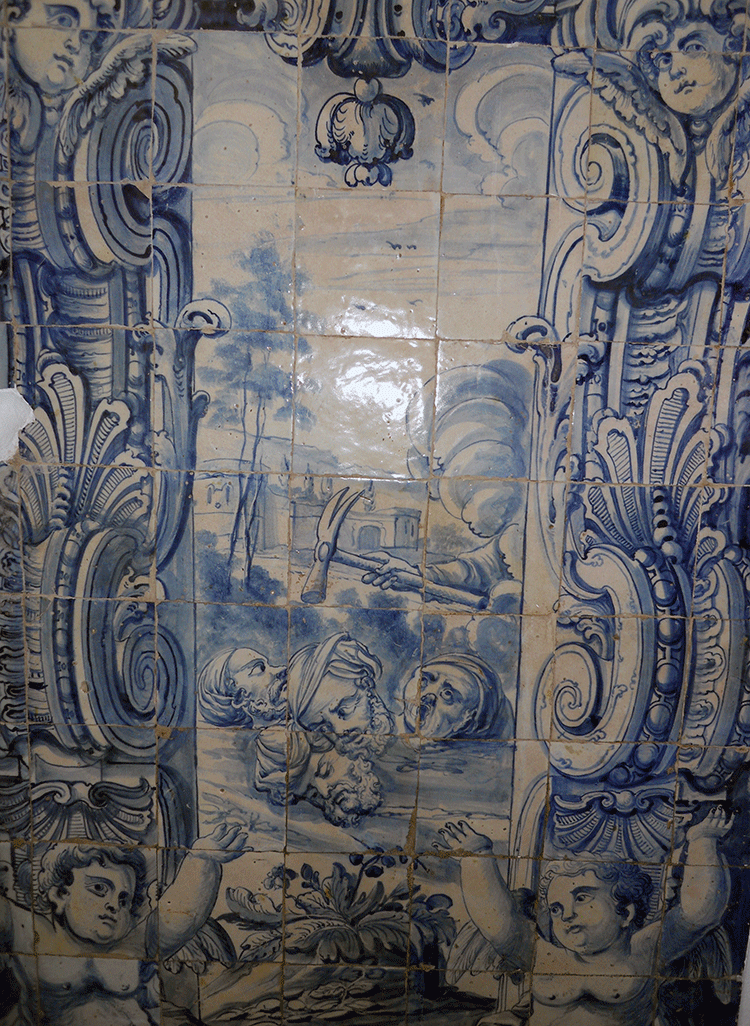
The fate of the five faithful Franciscans St. (that title bestowed later) Francis sent, or sentenced, to proselytize to the Moors in southern Spain and Morocco, on the other hand, is easier to grasp as saint-worthy. Not surprisingly, the Sultan did not embrace their message. So much so he personally beheaded the five (their shocked expressions captured on the azulejos above), whose remains were miraculously moved to Coimbra where they would inspire missionary zeal in a young Anthony – later to become St. Anthony and a great excuse for someone from a city named in his honor to journey to Portugal in advance of his feast day.

And Queen Isabel (Saint Elizabeth of Portugal, 1271-1336) certainly is recorded as a virtuous role model. Pledged to King Dinis at age 12, she plunged herself into daily devotions as he continued to relish rowdy romps at court while awaiting the actual marriage date a few years later. Once at court, she slowly began to alter the king’s ways by her pious example of prayer and service to the poor, pressuring ladies of the court to assist her, not welcomed as a popular pastime by all.

Queen Isabel was known as a peacemaker, even positioning herself upon a mule between two armed factions poised on the battlefield. She managed to broker peace between her son Affonso and his father during the Civil War arising because Affonso felt the King favored the rise in power of one of his illegitimate sons. (“Ah, Mom,” whined the Prince. “My wife, ever the party-pooper,” grunted the King.) Queen Isabel lavishly funded construction of the Santa Clara Convent while the king was still alive, and, after his death, retreated there herself to serve the poor.

This slideshow requires JavaScript.

And, of course, it’s not just their stories. Often it’s parts of them. Literally. Portugal hosts many gleaming reliquaries designed to preserve and display a bone or two of various sizes. As the Mister once remarked years ago with amazement, “One saint sure goes a long way.” Although mysteriously, many of the bones of the reliquaries prominently displayed in Portugal seem to be missing.

One day, much later, I will post my confession about my fascination with relics of saints.

But must be going, if we can make our way through all the partying Spaniards swarming Lisboa for a major soccer match. Two Spanish teams, for some reason. The Lisboa police might welcome some intercessions by Saint Isabel in the streets tonight to part the well-lubricated factions.