Krayolas To-Go a Flashback to the 70s

We wanted this to be just like in the ’70s when bands would load all their equipment up on a truck and go play.

That’s what Hector Saldana of The Krayolas told us during a band break early Sunday evening.  Casting aside the extensive national media attention focused on the unpretentious band three decades ago and now during the past year or so, The Krayolas trucked on over to the intersection of Nogalitos and Zarzamora to provide one of those puro San Antonio moments.  The band enthusiastically offered those gathered at Los Valles Fruteria, the subject of one of their lighter songs, with two admission-free sets showcasing their diverse musical sounds.

The peppy “La Fruteria” is balanced by such songs as a narco-corrido, “Twelve Heads in a Bag;” a song mourning a soldier whose life was lost in Iraq, “Alex;” and a protest song about Arizona’s new immigration law, “1070 (I’m Your Dirty Mexican).”  Hap Mansfield recently described The Krayolas’ Americano sound for the San Marcos Local News:

The Krayolas have been kickin’ out the Tex-Mex pop jams since the late 1970s. Their 2010 release, “Americano,” demonstrates that they’ve still got the chops, but their poetry is 30 years better and deeper. Unafraid of confrontation, the Saldana boys’ recent “1070 (I’m Your Dirty Mexican)” deals with the inherent racism in the controversial Arizona immigration bill. On a lighter note, their recent “Fruteria” may be the happiest Tex Mex pop tune ever.

Click here to catch David Martin Davies’ in-depth interview with the Saldana brothers for KLRN’s Conversations.

P.S.  Please, please don’t fail to bail Gayle out of jail!

Note Added on July 25:  The Krayolas are paired with a reading by author John Phillip Santos from The Farthest Home Is in an Empire of Fire as part of the Macondo Writers Workshop.  The admission-free event will be held from 7 to 9 p.m. in Thiry Auditorium at Our Lady of the Lake University on Wednesday, July 28.
May my neurons make many promiscuous synapses.

Frustrated with hearing incorrect words, un when it should have been una, and the always scrambled ser and estar come haltingly out of my mouth on my two recent trips to Mexico, I felt like finding a new home far from mine for my expensive RosettaStone CDs.  Often it seems my addled brain has posted a “No Occupancy” sign, refusing to admit one more fact into the inn.

Indirectly, John Phillip Santos, whose The Farthest Home is in an Empire of Fire:  A Tejano Elegy is due out in April, makes me feel compelled to put the headset on again, when only the computer can hear me and indicate my pronunciation was wrong yet again.  In an interview by Mo Saidi in the current edition of Voices de la Luna, Santos says:

I’m in favor of promiscuous proliferation of language instruction. The biggest error of my youth was thinking the world was perfectly fathomable with just English and Spanish….  The more languages Americans speak, the more likely we’ll have a chance to imagine perpetual peace.

The biggest mistake of my youth was being born in in a city where English was the only tongue heard.  My development was stunted by this event beyond my control.  In my teens, I idealistically thought Esperanto was key to world peace, but its proliferation is snail-like.

So, I’m back where I left off before my trips, coincidentally, “El nino escribe arabe.” 

May my neurons make many promiscuous synapses.

Note:  Every time I bump into Jim LaVilla-Havelin (April reading at Bihl Haus), he is bursting with enthusiasm for San Antonio’s celebration of National Poetry Month.   A partial calendar of events can be found on the website of Voices de la Luna.  Mo Saidi will be reading at The Twig on March 29, and remember to put a Poem in Your Pocket on April 29.

Note added on April 5:  Steve Bennett interviews Santos, and Robert Bonazzi reviews The Farthest Home in the San Antonio Express-News.

Barbara Ras’ ‘Elephant’ in ‘New Yorker’

Barbara Ras, director of Trinity University Press, has one of her poems featured in the March 15 issue of The New Yorker:

Washing the Elephant

by Barbara Ras, March 15, 2010

Isn’t it always the heart that wants to wash
the elephant, begging the body to do it
with soap and water, a ladder, hands,
in tree shade big enough for the vast savannas
of your sadness, the strangler fig of your guilt,
the cratered full moon’s light fuelling
the windy spooling memory of elephant?

What if Father Quinn had said, “Of course you’ll recognize
your parents in Heaven,” instead of
“Being one with God will make your mother and father
pointless.” That was back when I was young enough
to love them absolutely though still fear for their place
in Heaven, imagining their souls like sponges full
of something resembling street water after rain.

Still my mother sent me every Saturday to confess,
to wring the sins out of my small baffled soul, and I made up lies
about lying, disobeying, chewing gum in church, to offer them
as carefully as I handed over the knotted handkerchief of coins
to the grocer when my mother sent me for a loaf of Wonder,
Land of Lakes, and two Camels.

If guilt is the damage of childhood, then eros is the fall of adolescence.
Or the fall begins there, and never ends, desire after desire parading
through a lifetime like the Ringling Brothers elephants
made to walk through the Queens-Midtown Tunnel
and down Thirty-fourth Street to the Garden.
So much of our desire like their bulky, shadowy walking
after midnight, exiled from the wild and destined
for a circus with its tawdry gaudiness, its unspoken pathos.

It takes more than half a century to figure out who they were,
the few real loves-of-your-life, and how much of the rest—
the mad breaking-heart stickiness—falls away, slowly,
unnoticed, the way you lose your taste for things
like popsicles unthinkingly.
And though dailiness may have no place
for the ones who have etched themselves in the laugh lines
and frown lines on the face that’s harder and harder
to claim as your own, often one love-of-your-life
will appear in a dream, arriving
with the weight and certitude of an elephant,
and it’s always the heart that wants to go out and wash
the huge mysteriousness of what they meant, those memories
that have only memories to feed them, and only you to keep them clean.

Barbara, who will publish a collection of poems, The Last Skin, later this month, also had a poem appear in The New Yorker in 2006.  She will be one of the more than 20 writers in the spotlight for Wordworkers, an exhibit opening at Bihl Haus Arts from 5:30 to 8:30 p.m. on Friday, March 19.   During the opening, poets photographed by Melanie Rush Davis “will scrawl their poetry on gallery walls.” 

Other featured writers include Carmen Tafolla, Marian Haddad, Naomi Shihab Nye, Sandra Cisneros, Nan Cuba, Rosemary Catacalos, Jenny Browne, John Phillip Santos and Bryce Milligan.  As the exhibition at Bihl Haus continues, there will be a reading and small press book fair from 1 to 4 p.m. on Saturday, March 27, and a poetry reading by Jim LaVilla-Havelin from 7 to 9 p.m. on Thursday, April 8.  Bihl Haus Arts is located at 2803 Fredericksburg Road.

Barbara’s “Washing the Elephant” brought forth memories of the weekly visits to the confessional that forced me, as well, to make up imaginary sins to tell the rigid Father Habit at Star of the Sea.

Note Added on May 9Review of “Washing the Elephant” and Ras’ The Last Skin

Update on November 5:  Barbara Ras will discuss The Last Skin at The Twig Book Shop at Pearl Brewery from 3 to 5 p.m. on Sunday, November 14.

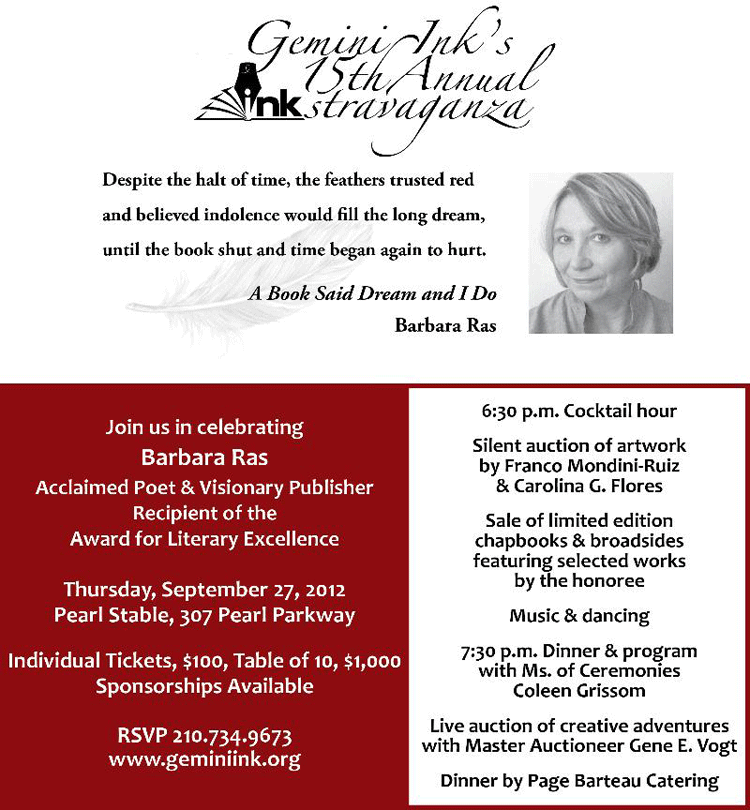
Update on September 11, 2012: Gemini Ink is honoring Barbara Ras at its 15th Annual Inkstravaganza at Pearl on Thursday, September 27, and one should never miss an opportunity to hear the utterances emitted by Coleen Grissom.