Postcard from Ferrara, Italy: Cathedral honors the dragon-slayer

Saint George is the patron saint of Ferrara, so, first, here’s a wandering tale about the saint.

Collecting water for the day was a major chore, but a fierce dragon guarding your water supply really complicates matters. The wise villagers in a kingdom somewhere, perhaps Lebanon or Libya, placated the beast by releasing two sheep to it before fetching pails of water. But the dragon consumed sheep faster than the villagers could raise them, so soon their supply was exhausted.

Some “wise” person, obviously a male, determined the best way to appease the dragon was to feed him young women. A lottery was held to see which young woman would become his supper first, and the beautiful daughter of the king drew the short straw.

The villagers took her to meet her fate, tying her near the dragon’s lair. Fortunately, just in the nick of time, along came a brave Roman soldier who heard the princess cry out for help. The brave soldier slew the dangerous beast and freed the princess.

This tale was one picked up during the Crusades and embellished by soldiers returning home. The hero was reputed to be Saint George, a patron saint of soldiers, a saint who helped protect them not only during warfare but also from diseases they might pick up along the way, such as the plague or syphilis.

The legend of Saint George and the dragon has persisted through thousands of years, mainly because it is such a fairy-tale-type story. Although to truly fit into the Disney-type mold by which many of us were shaped, shouldn’t George then have married the beautiful princess and lived happily ever after?

There are lots of hard-to-believe stories of saints, but this one is considered more legend than fact. As one early pope purportedly said, George was included in the group of saints “whose names are justly revered among men, but whose actions are known only to God.”

But George did earn his sainthood. He became a valued officer serving in the guard of Emperor Diocletian. The emperor, however, demanded all his soldiers renounce Christianity. George steadfastly resisted. The emperor sentenced him to death via several brutal methods we will not describe, but, somehow, George was revived three times. Finally, he was beheaded in April of the year 303.

The grand Duomo is dedicated to Saint George. The façade was begun in the 12th century but took another century or so to complete. Some of its treasures have been moved to the Museo della Cattedrale nearby.

The cathedral with its spacious plazas in front and on one side is an integral part of daily interactions among citizens in Ferrara constantly crisscrossing them. At some point long ago, a shopping arcade of inferior architecture was attached to one side. Fortunately, the arcade is only one story high, so much of the cathedral’s details are preserved for viewing, including the wonderfully funky pairs of wave-like columns running along the side.

These photos are of the Cathedral and some of the contents of its museum.
Postcard from Ferrara, Italy: Bicyclists rule both streets and sidewalks

How stereotypical to post photos of bicycles in Italy.

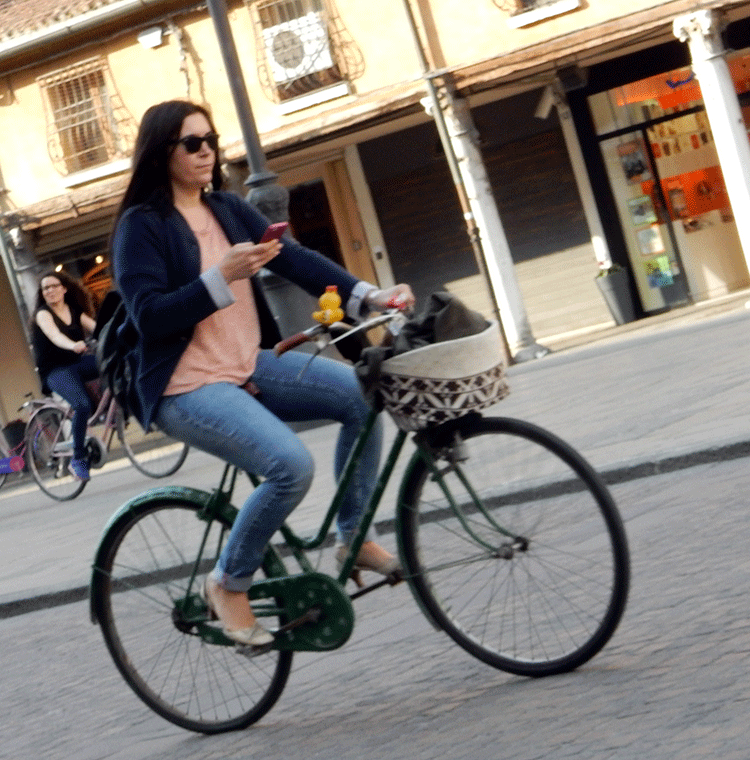
But Ferrara is different. It seems almost as though everyone has a bicycle, whether young or old. In contrast to many Italian cities, there were few motorcycles and Vespas zipping around.

The bike traffic is constant, and pedestrians, particularly distracted tourists gazing at the architecture, need to be wary. If automobile traffic laws apply to bicyclists, no one seems to have notified them in Ferrara. While cars yield to “walk” lights, bicyclists rarely do.

There are riders crisscrossing plazas running errands to pick up groceries, flowers or laundry. Parents ride to collect children from school or daycare, the children perched on seats attached to the front, back or both. A young adult talks her mother into sitting on the crossbar after lunch. Silver-haired gangs of retirees pedal to gather in the squares. Suits ride to work on bikes tricked out with handsome leather seats and matching saddlebags, and women dressed to the nines wearing spiked heels somehow manage to maneuver astride bikes as well.

From a pedestrian point of view, bicyclists reading texts were particularly scary. And, observing one ancient woman (meaning even older than this blogger who once had some kid start humming the Wicked Witch of the East theme song when I pedaled through downtown San Antonio) weaving obliviously in the middle of several lanes of traffic, I wondered: Do children in Italy struggle with the dilemma of at what age do you take away your parents’ bicycles?

Self-driving automobiles appear to be arriving in time to offer many in my generation an opportunity to remain behind the wheel a few extra years, but is anyone developing a self-driving bike for Italian seniors?

Postcard from Ferrara, Italy: Machiavellian Times

The influence and power the Este family exerted in Ferrara clearly was demonstrated when they began construction in 1264 on a palace directly across from the front door of the city’s cathedral. But the palace now serving as city hall proved not grand enough to accommodate the ducal family.

Next door, a castle-like fortress begun in 1100 as a single watchtower was undergoing major expansion to counter continual threats from enemies. The royal court began moving into the larger accommodations afforded by Castello Estense, surrounded by its protective moat, in 1479.

Careers in politics and religion were not peaceful pursuits in those times. Ferrara-born Girolamo Savonarola (1452-1498) joined the Dominican order and promoted a puritanical campaign against secular art and culture in Florence, offending many by even trying to reinsert religion into the exuberant pre-Lenten carnival celebrations for which Florence was known. Savonarola railed against the corruption within the church itself, predicting an apocalyptic event such as a biblical flood on the horizon.

Pope Alexander VI (1431-1503), a member of the Borgia family, found Fr. Savonarola’s assertions of corruption offensive and summoned him to Rome. Snubbing the papal invitation proved unwise, and Savonarola found himself excommunicated, shortly before his public hanging.

If an injury has to be done to a man it should be so severe that his vengeance need not be feared.

Niccolo Machiavelli, The Prince, 1513

The papacy was different then, and the words above written by Machiavelli (1469-1527) applied to practices embraced by Pope Alexander VI. Casting aside ethics in favor of political expediency, the pope proved himself worthy of serving as the poster child for what we now label Machiavellian behavior and as a master of nepotism.

The pope chose to legitimize illegitimate children born to his favorite mistress prior to his ascension to the papacy. Daughter Lucrezia Borgia (1480-1519) became a political pawn for maneuvers to consolidate power under his authority. Her first marital liaison was deemed not effective enough to achieve her father’s increasing desires for supremacy, so Pope Alexander VI had it annulled on the grounds that it had never been consummated. While the marriage was being annulled, however, Lucrezia was tucked away in a convent where she secretly gave birth.

Following her second marriage, the pope elevated his illegitimate daughter to governor of Spoletto. But having served his usefulness in increasing the Borgias’ power, Lucrezia’s second husband soon was deemed disposable as well. He was murdered mysteriously, possibly by a brother of Lucrezia.

The pope needed to bring the Estes family under his control, so a third marriage was arranged for the beautiful Lucrezia. This marriage to Alfonso d’Este (1474-1534), the duke of Ferrara, proved more long-lasting than her earlier ones. Presumably, Alfonso breathed somewhat easier after the death of his father-in-law in 1503. Lucrezia died soon after giving birth to her tenth child 16 years later.

One could say Savonarola had the last laugh over the descendants of Pope Alexander VI, as his statue is perched predominantly on a plaza between the Este castle and the cathedral. But he does not appear to be smiling; his dour expression seems still to condemn those who are enjoying themselves on the surrounding public plazas.

Covering almost two blocks, the Castello Estense and its moats could be a major impediment to the movement of pedestrians in the heart of modern-day Ferrara. Instead, with its drawbridges down, the castle courtyard proves a convenient passageway for locals continually moving between the city’s Renaissance addition and its medieval quarters.