Postcard from San Miguel de Allende: Redirecting Grafitti Artists, Part One

Several years ago, Colleen Sorenson fell under the spell of a colorful, compact neighborhood of homes, Colonia Guadalupe, increasingly attracting artists priced out of the center of San Miguel de Allende.

She loves it but began to be alarmed by some of what she saw surfacing on buildings all around her. Tagged walls and graffiti attacks on property without permission damage the fabric of a neighborhood.


This slideshow requires JavaScript.

But Colleen had seen this before in San Antonio, and she knew there were remedies. She was determined to corral the talent behind some of those marred walls, redirecting taggers toward more positive forms of artistic expression.

The gringa transplant with little command of Spanish has made a huge impact on her adopted home in an extremely short time. And, whether working class or artist, everyone on every corner in Colonia Guadalupe seems to know her name.

Some of the results of her efforts, both grassroots and at city hall, will be seen in a series of forthcoming posts.


Postcard from Oaxaca: ‘Hecho’ street art invades museum’s colonial walls

The contrast of edgy modern art housed within colonial-era walls is always striking, but even more so at Hecho en Oaxaca, an exhibit bringing urban art into the Museum of Contemporary Art, or MACO, in Oaxaca.

This slideshow requires JavaScript.

As a linguistically challenged blogger, translating websites from Spanish to English to conduct my own research would not be a reliable option. Instead I’ll rely on Carole Turkenick’s words from her Oaxaca Tips (a great, inexpensive resource to pick up at Amate Books the second you arrive in Oaxaca) relay the late-17th or early-18th-century building’s history:

The mansion initially belonged to the noble estates of the Pinelo and Lazo de la Vega families whose coats of arms are engraved in the stone façade on either side of St. Michael Archangel. Following Independence, the structure passed through a series of private owners including in the early 1900s a professor at the local Institute of Sciences and Arts who had the distinction of owning the first automobile in Oaxaca. By the 1970s, the building had seriously deteriorated and was taken over by the state to be converted into a museum of colonial history. The effort failed and the mansion passed to a local civil organization led by Francisco Toledo who together with the National Institute of Fine Arts opened the MACO in 1992. The building was restored again in 2009-2010,

Postcard from Oaxaca: Art of the streets

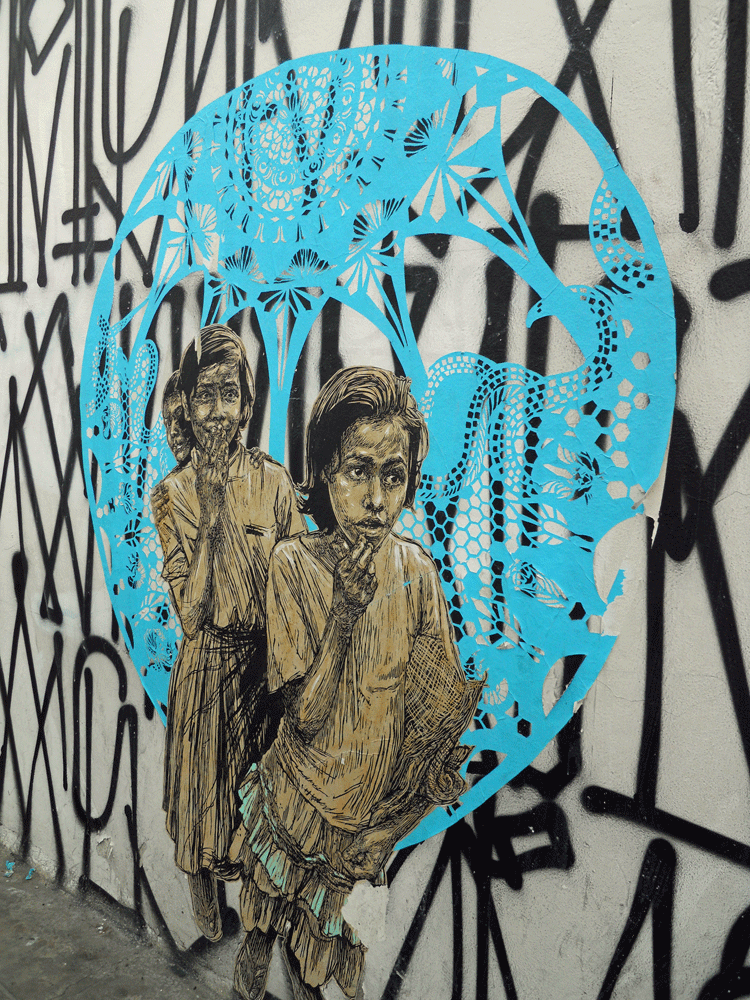
Wandering the streets of Oaxaca, we keep encountering urban art transcending youthful graffiti.

When we entered the Museum of Contemporary Art, or MACO, our belief the caliber of the art is far from serendipitous was confirmed. Some of the street art is part of an external and internal exhibition, Hecho en Oaxaca, and was commissioned for the July opening.

I’m posting a few random shots, including some commercial signage, separately from those taken inside the museum because a few, by the same artists, would be indistinguishable.

This slideshow requires JavaScript.