Postcard from Provence, France: Monumental cemeteries where Impressionists rest

Blue postage stamp featuring a scenic view of Nice, France, with trees and hills, inscribed with 'République Française' and 'CFA'.

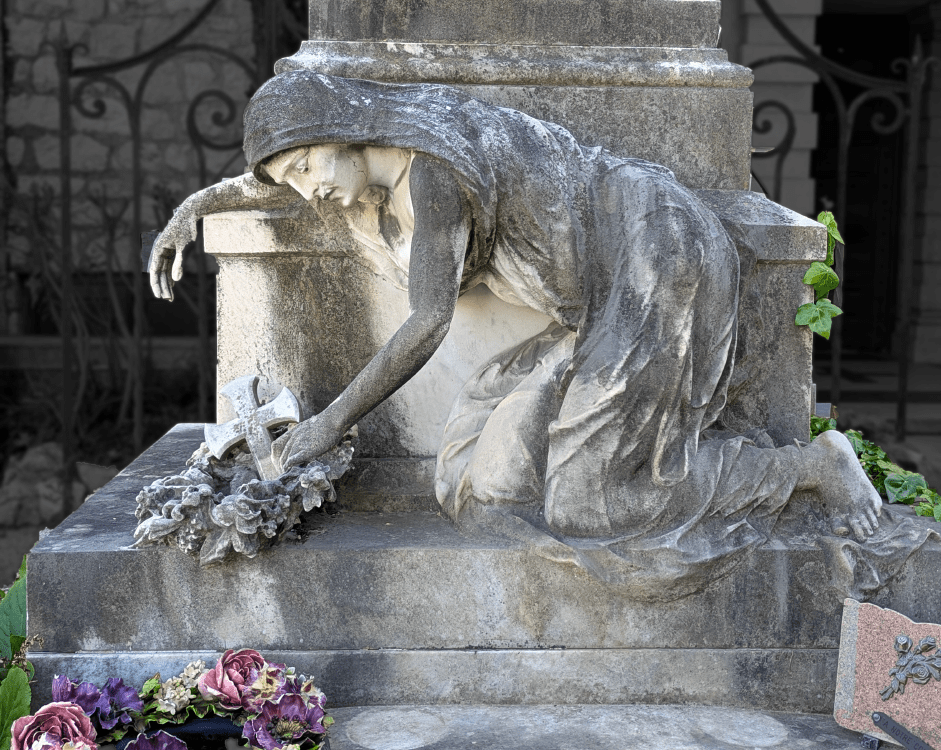
Above: Monument in Cimitiere du Chateau, Nice, France

A military citadel once crowned a hill overlooking the Bay of Nice. Bearing in mind that Nice did not become a permanent part of France until 1860, as part of one of the many wars fought during his reign, King Louis XIV (1638-1715) of France ordered the castle-fortress destroyed in 1706.

A portion of the grounds of the old citadel were opened as Cimetiere du Chateau in 1783. Instead of sentinels, monuments in the cemetery now occupy the most prominent vantage points for viewing the bay and surrounding countryside.

The cemetery* is an open space among the ruins, covered in winter with violets and daisies. It might make one in love with death, to think that one should be buried in so sweet a place.”

Preface to Adonais, Percy Bysshe Shelley, 1821

Continue reading “Postcard from Provence, France: Monumental cemeteries where Impressionists rest”

Postcard from Paris, France: Purging art to ‘cleanse’ culture

French stamp depicting a figure being restrained by two soldiers, symbolizing resistance.

Above: “The Pinch of Snuff (Rabbi),” Marc Chagall (1887-1985), mid-1920s

This painting, in which a rabbi sells his soul to Satan for a pinch of tobacco, was acquired by the Mannheim Kunsthalle in 1928. In 1933, Mannheim became the scene of an intense campaign of purge and defamation of modern art orchestrated by the Nazis…. the painting was dragged through the streets of the city with the message: ‘You who pay taxes should know where your money is being spent.'”

“‘Degenerate’ Art: Modern Art on Trial under the Nazis,” Curator Notes, Musee Picasso Paris, 2025

One evening at the end of May, we were fortunate to slip into a last remaining timeslot for viewing “‘Degenerate’ Art: Modern Art on Trial under the Nazis” at Musee Picasso Paris. It was packed with procrastinators, rendering the air-conditioning incapable of keeping the day’s lingering heat at bay. Yet, we all found ourselves crowding close to the artwork in an attempt to devour every word of the informative curator notes.

Most of the featured art had been included in a major exhibition of 600 works mounted by the Nazi regime in Munich in 1937. The purpose of this was not to shine light on exemplary art; instead, it was designed to condemn entartete kunst, or degenerate art, and the evil artists who spawned it.

Continue reading “Postcard from Paris, France: Purging art to ‘cleanse’ culture”

Postcard from Lyon, France: Film trivia challenge

A postage stamp featuring a black and white image from the film 'La Femme du Boulanger' by Marcel Pagnol, with the inscription 'République Française 2,20' and the year 1986.

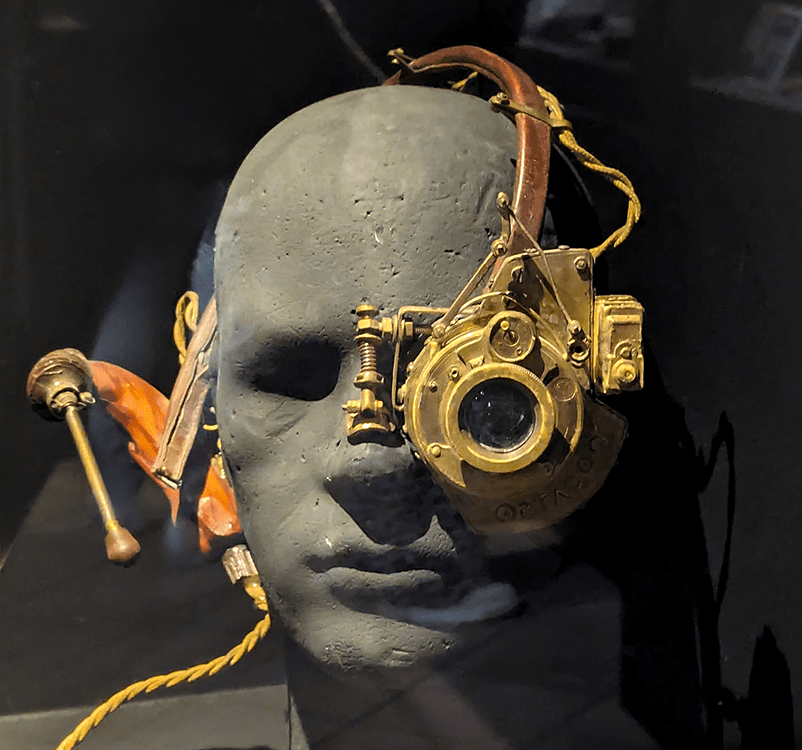
Above: Mechanical eye and listening device used by cyborgs in The City of Lost Children, 1995, Musee de Cinema et Miniature

I’ve always been a fan of science fiction, of models used in cinema. But I prefer miniatures, to dream a little…. I freeze frames of moments in life, places that touch me.”

Dan Ohlmann interviewed by Ludivine Corporal, “His Miniatures Have Been Wildly Successful for Years in This Renowned Museum,” Actu France, November 17, 2024

Dan Ohlmann’s construction of realistic miniatures is more time-consuming than it even looks, yet, by 1990, he had accumulated a substantial enough collection to open his Palais de la Miniature. As his fascination with set-design continued, he expanded to the acquisition of film memorabilia, costumes and props. A lot of them.

With a museum bursting at the seams and attracting an increasing amount of international attention, a Swiss fan arose as a major beneficiary. The donor purchased an early 15th-century Renaissance inn and turned it over to house the collection in 2004 – Le Musee de Cinema et Miniature.

Continue reading “Postcard from Lyon, France: Film trivia challenge”