Jimmie Draper: Rain, shine, sleet, heat

mariachi-festival

This post needs a soundtrack. Nothing would be more fitting than San Antonio high school students belting out mariachi music, so please play this while you read. For Jimmie.

1968. I think James Miller Draper, Jr., was there when the Paseo del Rio Association started, raising his hand to volunteer to do whatever it took to get attention for the River Walk.

It might be hard to imagine now, but the few businesses opening along the river were desperate. There were times when the only live things walking down the sidewalk in the heart of the river bend were pigeons. Things were so dull, there was even a night when some bored unnamed river operators shot fish. With guns.

Jimmie served as president of Paseo del Rio Association twice, in 1975 and 1984. But assumption of that responsibility is minor compared to his continual presence through thick and thin for more than four decades.

The coldest mornings in December always were the Fridays we placed luminarias along the river’s banks. Bob Buchanan made the coffee, and Jimmie brought the doughnuts. Without fail. For decades. Nancy Hunt, current executive director of Paseo del Rio Association, said that even last year Jimmie rode the bus downtown to deliver sweets to those delivering bags to the river’s banks.

No weather forecaster was more accurate than the first night of the annual Great Country River Festival the first weekend in February. Guaranteed sleet. Jimmie was always there.

The event closest to his heart always, though, was the Fiesta Mariachi Festival. It was his. I believe he was the first and only chair of the festival for more than 40 years. He threatened to retire one year. Paseo even threw him a party to recognize chairing the event 25 years or so. That just made him sentimental and mushy about the whole thing, so he kept coming back. Every year, he gave up four nights of Fiesta to meet the high school students boarding the barges. Without fail. Until this past year. Being 86 is a pretty good excuse for easing up a bit.

Generally Jimmie had the patience of Job. The time he really lost it, although not publicly, was at City Hall. The Paseo’s contract with the city in the late ’70s required we continually appear before Council to request approval for each event.

It should have been routine, but poor Mayor Lila Cockrell had a rather rowdy bunch to try to keep corralled. Those were colorful times.

I could almost see the hairs on the back of Jimmie’s neck bristle as a councilman went off on a rant about gringos being in charge of putting on a mariachi festival.

Then there was without a doubt the most incredible remark I ever heard at City Hall. Councilman Joe Webb interrupted the diatribe: “Mariachis. Cucarachas. What’s the difference? They’re all the same to me.”

Councilman Bernardo Eureste leapt to his feet and challenged Councilman Webb to duke it out. The scuffling councilmen went out in the hall to settle things, but were restrained before striking any serious blows.

Permission to stage the admission-free festival was granted, but, on the way out of City Hall, Jimmie said that was it. He would never go back there and be insulted like that again.

But he kept on volunteering again and again and again. Rain, shine, sleet, heat. No matter.

Gringo Jimmie might not have been known for shouting loud gritos in public, but, in those early years working with Belle San Miguel, his belief in bolstering the talents of young musicians gave fledgling programs in public schools a stage on which to shine. Before there were statewide competitions, the Mariachi Festival was the event inspiring students to strive for professionalism in their performances. Jimmie loved to see students board the barges, proudly wearing their festival medals from each year they had participated.

This spring will bring the 44th annual Fiesta Mariachi Festival. Jimmie was there for 42.
luminaria

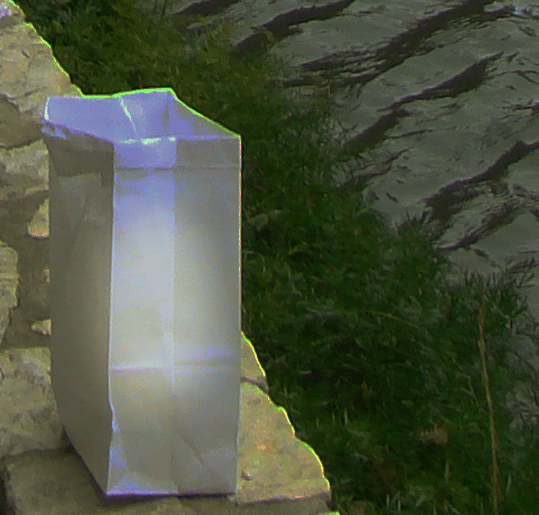
Light a luminaria for Jimmie this holiday season. If it goes up in flame, it’s his unselfish and generous soul flying up to heaven.

Maggie Cousins: Urban Trailblazer

I wasn’t looking for Maggie this afternoon. But her name called out to me in the middle of a UTSA Libraries list of recorded interviews you can listen to online. I wanted to hear her voice, resurrected from the past.

At first, I was disappointed to find hers was only a transcript from an interview on KLRN. But, as I started reading, I realized it didn’t matter. I could hear her.

maggie-cousinsSusan Margaret Cousins (1905-1996) had one of the most distinctive voices I’ve ever heard. Maggie lived in New York City during much of her illustrious career including time as editor of Good Housekeeping and McCall’s and at Doubleday Publishing; yet years in the Big Apple failed to tame her Texas accent. In the March 24, 1974, edition of the San Antonio Express-News Mildred Whiteaker wrote, “Authoress Edna Ferber used to visit Maggie to get the flavor of the dialogue for Giant.”

Maggie’s pitch was incredibly low, and the words drawled out gruffly from somewhere deep in her chest. Most sentences ended with her wonderful chuckle rippling through her entire body.

Of course, most of the time I was listening to her it was happy hour. You never wanted to miss it when Maggie was holding court in the huge wooden corner booth where the “River Rats” gathered five days a week shortly after 5 p.m. as diligently as if punching a job-required time clock.

Maggie Cousins, 1986 Induction into Texas Women's Hall of Fame, http://www.twu.edu/twhf/
Maggie Cousins, 1986 Induction into Texas Women’s Hall of Fame, http://www.twu.edu/twhf

Maggie was a regular as long as she and her cane could propel her slowly huffing and puffing down the River Walk to the Kangaroo Court from her double-apartment in the Clifford Building. As a professional woman, Maggie broke the glass ceiling, inspired others to follow and never stopped writing, but the undated interview on UTSA’s website deals with Maggie in her role as a true urban trailblazer in downtown San Antonio in the 1970s:

I’ve been unusually happy in the city because when I first came I used to just walk up and down the River Walk. Sat down at Kangaroo Court one day and had a drink. Bob (Buchanan), the owner, came out and talked to me and from then on it became my place. I met all the young people that work downtown and the people that have the dreams and hopes and ideas and I was able to be in and listen to all their plans and most of them have come through with a lot of them. The wonderful young people who are downtown.

The booth in the Kangaroo Court was a great incubator and percolator for ways to improve downtown. But Maggie was one of the few “rats” who actually lived right downtown.

Here are a few of the Maggie-isms about dwelling downtown from the interview transcript:

  • There isn’t any atmosphere in the suburbs. You know, people live in large houses, have great manicured gardens, and they never go outdoors. I never see them using their lawns for any purpose.
  • I intended to have a car when I first came , and I couldn’t find a place to park. Living alone, you need a place to park and you can’t leave it in front of the building. So, I waited until they built a garage and then I was too old to drive.
  • Since the big boom in building has come and many of the old buildings have gone; when the new ones are built the rents are too expensive for small-time businesses like typewriter repair. When I moved here that was very important to me. There were three repair shops within walking distance of a block.
  • Mr. Butt, who lives in King William, has not built a grocery store for us poor people. But I presume when all these big condo projects are inhabited there will have to be a grocery store. I’ll be 95 years old. I’ve faced that.
  • I’d rather put up with the inconvenience and enjoy the things I enjoy down here. This place is within walking distance of the public library, which is important to me.
  • I have women friends who haven’t been downtown in ten years, they say proudly. I say, you gotta be crazy.
  • …I thought if I show people that they can live downtown they’ll get interested in it, but Texas people are very hard to change. But sooner or later, this generation will be interested in it.
  • If I ever get bored, all I have to do is look out the window….
  • Your lives are always made up of the past, present and future and without the past you just don’t have very much to look back on. And I think that San Antonio, that’s one of its great charms, the fact that it has some extremely fine 18th century architecture and lots and lots of 19th century architecture which I think gives it a quality that no other city in Texas has.
  • Imprint of human life on a place makes it more interesting and more attractive.

And Maggie’s imprint was rich and lasting.

I can hear her even now.

Update on June 13, 2013: Maggie’s obituary from the New York Times

Update on June 14, 2013: For more Maggie, visit these pages from When I was Just Your Age by Robert Flynn and Susan Russell:

I didn’t have any children to play with, but I had Grandpa and Grandma and aunts and people who had time to talk to me. They told me stories. That’s one reason why I became a writer.