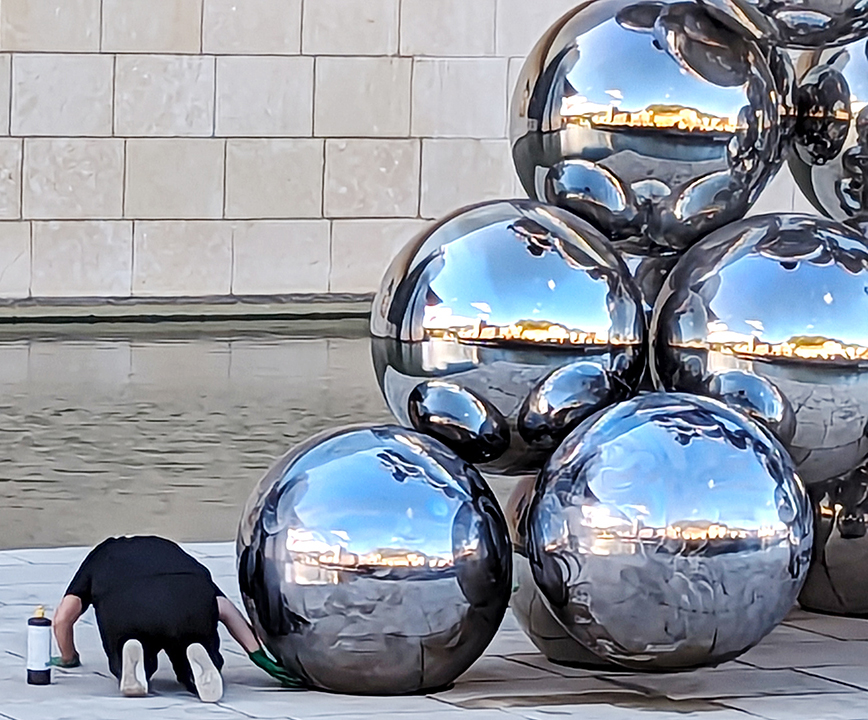
Above: Detail of “Tall Tree and the Big Eye,” Anish Kapoor
Guggenheim Bilbao has turned 25. While 25 years is but a small blip on my age chart, I feared it might prove too long to wait to visit architect Frank Gehry‘s monumental project. People described it as a ship, a giant flower, a fish with shimmering titanium scales. Would it simply seem dated, as much contemporary architecture does after a decade?
My answer is no! It’s a massive, awe-inspiring, sculpture – its scale rendering it overwhelming both inside and out. The deconstructive shapes seem not unlike the Pablo Picasso sculptures of women featured in a major exhibition while we were there. Or Richard Serra’s curvilinear weathered-steel sculpture, “A Matter of Time,” drawing people inside like a giant human mousetrap.
Even spectacular, large-scale artworks encounter difficulties asserting themselves inside the soaring sensuous interior. This is a building one would pay to explore even if there were no art inside.
Maybe that should not be a conflict up for debate. So often architecture is dumbed down by budget, with function superseding inspirational design.
Above: “Life in His Mouth, Death Cradles Her Arm,” Naufus Ramírez-Figueroa, 2016. Photo grab from video.
St. Paul’s Cathedral
Architectural Challenge Number One, 1940s: Design an industrial complex on a site directly across the Thames from one of London’s most cherished landmarks – Saint Paul’s Cathedral. Sir Giles Gilbert Scott (1880-1960) was an accomplished architect by the time he was tapped to tackle the Bankside Power Station. Unlike his earlier two-chimneyed Battersea Power Station, Bankside featured a single soaring chimney front and center, prompting some to refer to it as the cathedral of industry.
Architectural Challenge Number 2, 1990s: Convert a massive decommissioned power station into a frame for modern art. An international competition attracted 168 submissions, with the Swiss architectural firm of Herzog & de Meuron selected for the adaptive reuse project. The firm’s respect for and desire to preserve the external features of the brick power station impressed the selection committee of the Tate Modern.
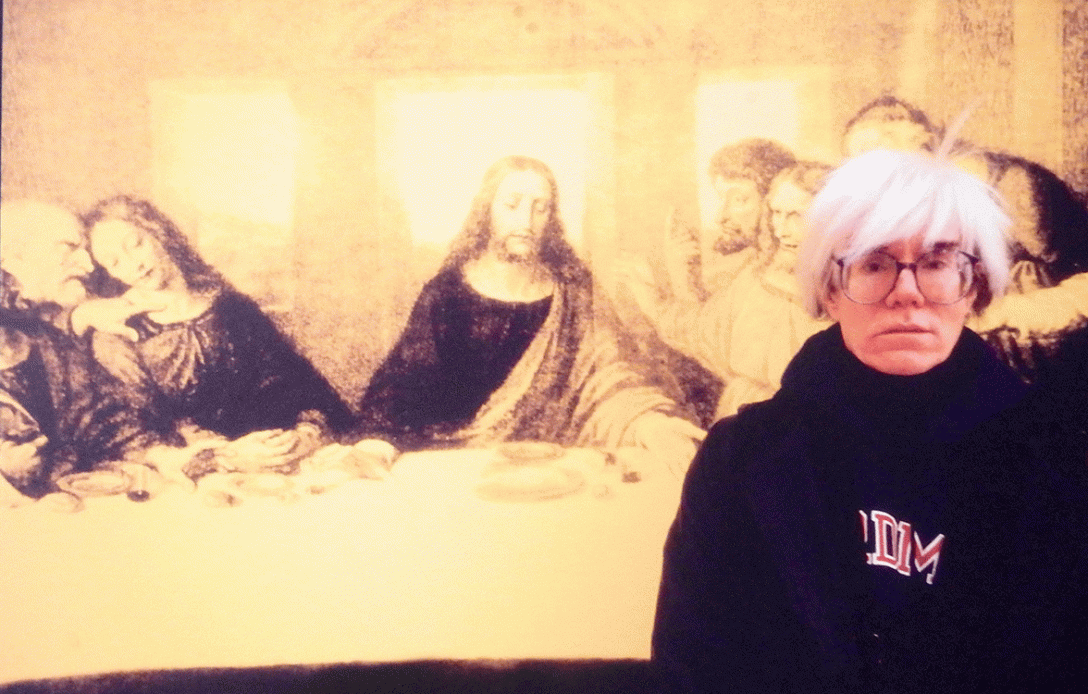
In 1984, gallerist Alexandre Iolas commissioned Warhol to create a group of works based on Leonardo Da Vinci’s Last Supper (1495-97) for an exhibition space in the Palazzo Stelline in Milan, located across the street from Santa Maria delle Grazie, home of Leonardo’s masterpiece. Warhol exceeded the demands of the commission and produced nearly 100 variations on the theme. Indeed, the extent of the series indicates an almost obsessive investment in the subject matter, which takes on an added significance in light of the revelation of the secret religious life revealed after Warhol’s death, which occurred only a month after the opening of the Milan exhibition in January 1987.
Encountered an Andy Warhol exhibition our first weekend wandering around Naples. The setting seemed so unlikely. The Basilica di Santa Maria Maggiore alla Pietrasanta, constructed atop the remains of a Temple of Diana by a Bishop of Naples in the year 525 and purportedly the first sanctuary dedicated to the Virgin Mary.
Of course, that church was remodeled numerous times, and I really am unsure how it became an art venue. But Pop art is occupying the sanctuary through February 23: “The True Essence of Warhol.” The exhibition is presented by the Arthemisia Association.
The pairing of pop culture and religious altars is unusual. A neon “Warhol e il Brand” crosses in front of a painting of the Virgin Mary. “Warhol e l’Italia” glowing in front of a crucifixion. Mick and Keith staring down from niches?
Church is not what my memory associates with Andy Warhol (1928-1987). My memories place him more in the throbbing celebrity melee of the Studio 54 disco scene. Or hanging with the Rolling Stones.
His art was sensational via his calculated and stated commercial associations.
Mr. Warhol’s keenest talents were for attracting publicity, for uttering the unforgettable quote and for finding the single visual image that would most shock and endure. That his art could attract and maintain the public interest made him among the most influential and widely emulated artists of his time.
“Andy Warhol, Pop Artist, Dies,” Douglas C. McGill,The New York Times, February 23, 1987
We played around in this church of Warhol….
But it was not until several months later I learned that Andy Warhol’s Catholic upbringing was lurking close to the surface of his wild partying veneer. He was frequently spotted on Sundays in a pew of St. Vincent Ferrer on the Upper East Side of New York.
People are complicated.
I always thought I’d like my own tombstone to be blank. No epitaph, and name. Well, actually, I’d like it to say “figment.”





 Postcards from Barton Springs