The grinch who stole Pocahontas

Pocahontas

Like a lump of coal in your Christmas stockings, I’m writing this for the next generation: Cecil, Bill, Lawrence, Tarrall and Kate.

I don’t mean to be a bah-humbug type, but it’s a lot worse for your mothers and me. We grew up told we were Indian princesses, the 13th-great-grandchildren of Pocahontas (Pocahontas “Rebecca” Powhatan Matoaka Rolfe, 1595-1618). I don’t think we promised you that you are the 14th with the same degree of certainty.

But we were told this by your Great-Great Aunt Mary (Mary Virginia Williams, 1894-1967), a rather intimidating Victorian-type woman whom we did our best not to cross and who, thank goodness, has no idea that we produced offspring who might pronounce her title as “Ant” Mary.

As long as she was alive, no one challenged her story to her face. And would she lie? Well, maybe, if it were something she viewed as extremely important, such as qualifying for the Daughters of the American Revolution.

Diluted through generations, Pocahontas never could provide enough Native American blood to qualify for scholarships, but she added something exotic to our ho-hum English-Irish combative combination.

But it’s time to strip that false heritage away once and for all.

Your Great-Great Aunt Mary fudged, or her “professional” genealogist did. The shortcut to Pocahontas they took was through Elizabeth Bernard in the 1700s. While we have an Elizabeth Bernard, the one they claimed was married to John Lambeth, Jr. (1726-1813, your 6th-great-grandfather) actually was married to Philip Gooch.

The line of our Elizabeth Bernard (1750-1796) definitely takes us back to daughters and sons qualifications, which I don’t think any of us have considered tapping into, but not to Pocahontas. If you are related to Pocahontas, it’s not direct. At most, Pocahontas might be something more like the 4th-great-grandmother of your 1st-cousin 6-times removed.

You are losing Pocahontas, but, hey, there are a ton of people (many fudging like Aunt Mary) who claim to be her descendants. Instead, it’s time to put away your moccasins and embrace your Spanish blood.

Yes, it’s true, or possibly true, you have Fernandez blood lurking in your veins. And that was a pretty rare infusion in Virginia in the 1800s.

A remote cousin who I have never met and I both have come to this conclusion. Her leap might be based more on fact than mine, and, if it’s wrong, I’ll blame her.

But we think your 4th-Great-Grandfather, Nicholas Marshall Tarrall (1809-1852), married Ann Biddle Fernandis (1815-1884). Ann and her brother Joseph P. Fernandez (1817-1876), a shipmaster before the Civil War demoted to a watchman afterwards, lived in Norfolk, Virginia, but were born in Maryland. Ann Fernandis was christened in Saint Paul Protestant Episcopal Church in Baltimore. Alas, poor Joseph drowned in the Norfolk Harbor.
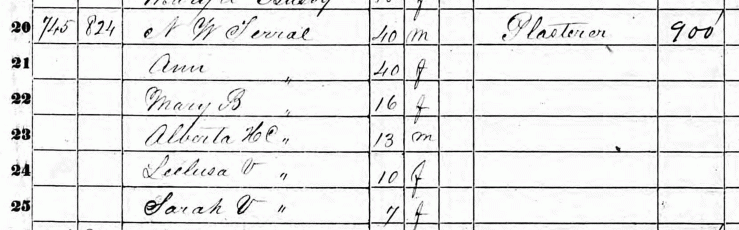
1850-norfolk-census
1850 Norfolk, Virginia, Census: Nicholas Marshall Tarrall 1809-1852: Ann Biddle Fernandis Tarrall 1815-1884; Mary B. Tarrall Nottingham 1835-1886; Henry Alberti Tarrall 1836-1907, your 3rd-great-grandfather; Secluseval V. Tarrall Bryan 1840-1893; and Sarah Virginia Tarrall 1842-1850.

Now these Spanish roots might be part of Aunt Mary’s disapproval of Grana’s background, your great-grandmother (Thelma Virginia Tarrall Williams, 1899-1999), but the joke might be on Aunt Mary. We’re not positive when our Fernandis ancestors first set foot on American soil, but there were not many around and only a handful living in Maryland.
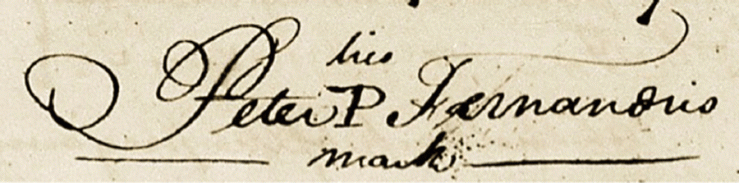
pedro-hernandez

Pedro, or Peter, Fernandise (1652-1736) was born in Valenciana, Spain, and died in Marbury in Charles County, Maryland; although his body has gone missing. Two of his sons served in the American Revolution. I’m hoping they represent our Fernandez roots. If so, Pedro might be your 7th-great-grandfather.

Sorry about Pocahontas, but paella is part of your past. So put on some flamenco music for the holidays, stamp your feet and douse your pasta with extra olive oil. Olé!


Sorry, Grandpa Jacob, but you’re just going to have to live in the closet for a while….

Jacob Radcliffe, 1764-1844
Jacob Radcliff, 1764-1844

I was feeling guilty when I took you down.

After all, you are the Mister’s third great-grandfather and the source of his middle name.

And you’ve been around a long time, a very long time.

radcliffegashYour frame certainly shows it. It appears to have endured a war or two; although I’m not sure wars were what caused its wounds. You are merely an engraving of sorts, but your frame was impressively regal at one time. We’re not sure what time, but I’ve never encountered another frame with such a heavy, brown ceramic interior. When did they make such frames?

Before I removed you from our hall, a temporary relocation of sorts, I thought I should write a few words about you. But all I knew was you were a mayor of New York City, which always impressed me.

In Bayard Tuckerman’s name-dropping family history, A Sketch of the Cotton Smith Family of Sharon, Connecticut, Jacob and his wife sound so perfectly civilized:

They lived first at Albany, where he was Judge of the Supreme Court, and afterwards in New York of which he was three times elected Mayor between 1810 and 1818. The Radcliffs had a country home near Poughkeepsie called Chestnut Hill, and there Juliana continued to have “literary evenings,” which are mentioned in letters of Chancellor Kent, Edward Livingston, Chancellor Livingston and Miss Janet Montgomery as “delightful gatherings where youth and age, fashion and wit, met for pleasure and improvement.”

Your resume looks pretty good. Graduated from Princeton. Sat on the Supreme Court of New York State. You joined with your friend Alexander Hamilton in a partnership founding Jersey City. Was that a good thing? Hamilton never got to see if that was a good idea or not, as he made the fatal mistake of insulting Aaron Burr. I do thank you for having the good sense not to follow suit.

The Bowery Boys website is rudely dismissive of you:

Politics is a messy, incomprehensible thing sometimes. Keep Blagojevich, Senate appointments, and all other recent government scandals in mind as you traipse through the thickets of political absurdity below.

The year 1815 marks the real beginning of New York City’s Tammany Hall era.

And that’s where Jacob Radcliff and John Ferguson come in. They are by no means exceptional leaders; they were Tammany men at the right time, in an era before absolute corruption pervaded the society’s every activity….

On top of the usual partisan stew of a swiftly growing city, the war of 1812 left party affiliations malleable, with Federalists opposing action (even suggesting secession from the United States!) and staunch Democratic-Republicans generally favoring the conflict. Thus, as you can imagine, it would be difficult to remain balanced in such unstable political waters, even for somebody as savvy and popular a career politician as (DeWitt) Clinton.

In this wily tug-of-war between the Federalists and Tammany candidates, Clinton was again unceremoniously ousted in 1810 and replaced with Jacob Radcliff….

The winds shifted again the next year, and Clinton was placed back in the mayor’s seat in 1811. (Following this so far?)

As war broke out with England in 1812, all political parties and affiliations seemed to disintegrate entirely. As James Renwick says in his biography of Clinton, “On this occasion the old party lines were completely obliterated; no trace of affection for Great Britain remained in any mind, and the very name of federalist only exists to be used as a mode of discrediting a political adversary in the minds of the ignorant.”

As a result, many Federalists jumped ship to join the surging Tammany Democrats. Among their number was former mayor Jacob Radcliff, warmly greeted by Tammany head ‘grand sachem’ John Ferguson.

A perfect storm brewed in 1815 when Tammany for the first time controlled the state senate and enjoyed great gains in local elections. For the first time, Tammany could really do what it wanted. And what it wanted was to get rid of that old stalwart Clinton. Once and for all.

And who better to replace him than the head of Tammany himself, John Ferguson? However, whether by intent or sudden whim, Ferguson stepped down after only three months in office to take on the far-more lucrative job of officer of the Port of New York custom house, according to one source a major center “of federal revenue, political patronage and potential graft.”

And so he was replaced with….Jacob Radcliff again, now a mayoral appointee representing an entirely different political party from the first time he had the job!…

Meanwhile, Radcliff was caught up in a scandal when, halfway into his term, he was caught distributing a list of potential Tammany replacements for all still-remaining Federalist council members, a politically insensitive move which galvanized the Council and ensured that 1816 would be Radcliff’s last year ever as mayor.

jradcliffeMaybe if you didn’t look quite so pompous. Maybe if it wasn’t quite so obvious that you have been looking down your sharp nose at me all these years. Maybe then I wouldn’t have dug deeper into your resume.

The Bowery Boys website even calls you “politically wishy-washy.” The original flip-flopper.

But, as Juliana’s first cousin, three times removed, once said:

           History is the story of events, with praise or blame.

And, whoa. Speaking of looking down one’s nose.

If that cousin had ever been offered for us to hang in the hall beside you, I certainly would have known better. His reputation preceded him.

This is what he would say about the Fiesta-colored garb I sport on a daily basis:

For an old woman to flant [flaunt] it in a youthful dress, is altogether as prodigious a Disorder as for the Flowers of May to appear among the Snows of December.

He never would have made it out of our closet. I could never have borne his disapproving glare on a daily basis.

Besides, Cotton Mather would have burned me at a stake.

Juliana’s puritanical father, John Cotton Smith (1765-1845), a Yale-educated governor of Connecticut, might not have drowned me but certainly would not have approved either.

But that’s partially his son-in-law’s fault. So eager for votes, Jacob Ratcliff was willing to stoop to courtship of the immigrant population swarming into New York City.

You let those damn Irish Catholics get a foot in the door, and, the next thing you know, only a couple of generations later, one of them marries into your family.

So hard to keep that puritanical bloodline pure.

Note Added June 6, 2013: In 1968, one of the Mister’s first cousins, once removed, purchased and restored John Cotton Smith’s former home in Sharon – Weatherstone.