Looking for a feel-good holiday story? Don’t click here.

Hola my Teresa, I’m thinkin’ of you now in San Antonio.
I have 27 dollars, and the good luck of your picture framed in gold.
Tonight I’ll put it all on the fighting spurs of Gallo del Cielo,
Then I’ll return to buy the land Pancho Villa stole from father long ago

Gallo del Cielo by Tom Russell
 
Men lay down their bets on their roosters on this plate produced in San Antonio by San Jose Pottery.

I’ve listened to Joe Ely weaving the sad tale toward the inevitable death of El Gallo countless times.  It’s tragic, but I dismiss it as more of a folk tale than a current event. 

After all, one of my favorite possessions is a cockfighting plate produced in San Antonio by Ethel Harris’ San Jose Pottery

And I find it amusing to reflect on San Antonio’s rough and tumble past as evidenced in the pages of the 1911-1912 edition of The Blue Book, a visitors’ guide to the city’s red light district.  In addition to a multitude of brothels just south and west of City Hall, there were at least two cock pits – Ogden’s and Monterrey – located on South Santa Rosa.  I even incorporated their ads in one of my Blue Book series of prints:

The Blue Book No. 2. The Blue Book's listings for cock pits on South Santa Rosa Avenue in downtown San Antonio is combined with images of roosters and a period map of the area. Edition of 25. 10 1/4 x 3 1/4 inches.


“Mayor Callaghan crowed at City Hall during the week, but spirited fights could be found just two blocks to the west on weekends.”

The palenque, or cock pit, in Real de Catorce

The palenque, or cock pit, in the former ghost town of Real de Catorce remains one of my favorite landmarks to explore.  But that is made easier because I was not with my husband and his younger brother when they stumbled upon men placing their bets on an actual cockfight there. 

During one of our jaunts to Mexico, I tried to convince my husband we should buy the ruins of the palenque in Mineral de Pozos, a former ghost town near San Miguel de Allende, to incorporate in a retirement home for us (one of many ill-conceived notions expressed during more than three decades of marriage from which he wisely has managed to divert my attention until common sense returned, albeit always on a fleeting basis). 
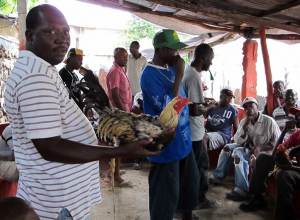
"A Competitor and His Cock," Haiti, June 2010, photograph by Vic Hinterlang

Our friend Vic pulled out his camera in Haiti this past June to document a cockfight at Delmas 31.  When he lagged on posting a follow-up, I feared he was hooked and was out training a cock of his own.  But my fears were groundless; he simply was flying back to Austin.

Cockfighting is something I prefer to pretend only occurs in the past tense, or, at least, takes place in some other country.  The world is becoming a kinder, more gentle place (dream on, Gayle).  But, in support of this argument, Spanish Catalonians recently enacted legislation drawing an end to their deeply entrenched tradition of bullfighting. 

Periodically, media intefere with my naive theories.  The other day, I made the mistake of reading Brandi Grissom’s coverage of cockfights, and their aftermath, outside of Dallas for Texas Tribune

One by one, Domanick Muñoz pulled bloody and battered bodies out of a pile of feathers, claws and beaks. Roosters that were still gasping for life….

The posted videos are not for the faint of heart.  Grissom makes it impossible to continue in a state of denial.  Cockfighting is not something that should be included in “It’s a Texas thing.”

Update Posted on February 8: Had to add this cautionary tale – “Man Killed by His Own Cock” (my headline)

Update Posted on March 17: Oscar Barajas, who recently wrote a post about his father’s disappointing cock, forwarded this link to “La Muerte de un Gallero.”

Update on May 22, 2011: Bobby Jones calm defense in Texas Monthly of his livelihood, breeding game birds, seems blood-chilling to me. “Harvesting” is the professionals’ word for cockfighting:

…what goes on at harvesting facilities is no different from what you see at a golf course, the rodeo circuit, or a bass tournament. It’s a gentleman’s wager, like betting on a football game.

As part of his explanation of legitimacy, he claims that gaffs for cockfighting were brought over on the Mayflower. But, his best point is:

No, what I’d like to see is a law that gives rural counties the power to decide what they want, instead of being told what to do by people in cities. Why are people in areas like Houston and Dallas, where there’s practically no morality, able to dictate what we do in rural areas, when they know nothing about it?

Poor guy:

Politics often gets in the way of my livelihood.

Making ‘Last Farm Standing’ a Living Document

So many attempts to find people who directly knew Max and Minnie Tomerlin Voelcker literally led to a deadend – the cemetery.  Now that Last Farm Standing on Buttermilk Hill: Voelcker Roots Run Deep in Hardberger Park is in print, people are emerging with wonderful stories and memories – some from unexpected places.  My hope is that people who read the book will return to  this post and share the memories the book unleashes, add to the narrative and (oh my!) make corrections.  I’ll share a few details gleaned from bits and pieces of conversations to start this process.

A neighbor of mine surfaced with a sleeve of Twilite Dairy bottle caps.  Located out Blanco Road about a mile past Voelcker Lane, this dairy was operated by Josephine and Onis Lester Harrison (1910-1954), the son of Nancy Cordelia Tomerlin (1889-1962),  Minnie Voelcker’s half-sister, and James Jot Harrison (1886-1956).  

During the celebration for the book at The Twig yesterday, James Jot Harrison’s nephew, Jim Harrison, the son of Allie Gay Stanley (1902-2001)and Willie Willis Harrison (1898-1982), shared a family tree for the Harrisons (which would have been quite a time-saver).

While conducting research, I visited by telephone with Elizabeth Katherine Monosmith (1918-2010), the daughter of Katherine Josephine Speier (1891-1968) and Henry Dudley Voelcker (1889-1919), Max Voelcker’s brother.  She was extremely tight-lipped with me, claiming she knew almost no family history.  A son-in-law arrived at The Twig, however, saying his mother-in-law had great tales about the Voelcker boys’ escapades and was lucid up until the day she died.  He pledged to share some here after reading the book.

The spouse of the man who built the old rock Coker church building appeared at the reception.  Max and Minnie contributed $10 in the midst of the Depression toward the construction of the church.  And Butch Gerfers, the third great-grandson of Joseph Coker (1800-1881), was letting everyone know about the dedication of a Texas State Historical Marker at Coker Cemetery on Saturday, November 27, at 10 a.m.  That event should elicit many stories from descendants of the dairy farming families who considered themselves part of the Coker Settlement.

COKER CEMETERY

SOUTH CAROLINA NATIVE JOHN “JACK” COKER CAME TO TEXAS IN 1834 AND FOUGHT IN THE BATTLE OF SAN JACINTO. IN GRATITUDE FOR HIS SERVICE, COKER RECEIVED FROM THE REPUBLIC OF TEXAS A ONE-THIRD LEAGUE, WHICH TOTALLED 1,920 ACRES AND WAS SITUATED ALONG THE BANKS OF THE SALADO CREEK, APPROXIMATELY TEN MILES NORTH OF DOWNTOWN SAN ANTONIO. JOHN COKER SOON WROTE TO HIS BROTHERS JOSEPH AND JAMES TO COME TO TEXAS AND HELP HIM TO SETTLE HIS LAND. WHILE BOTH BROTHERS MADE THE TRIP TO TEXAS WITH THEIR EXTENDED FAMILIES, JAMES DECIDED TO SETTLE WITH HIS FAMILY IN CHEROKEE COUNTY, TEXAS; JOSEPH AND HIS FAMILY JOURNEYED ON TO THE LAND ON SALADO CREEK.

THE COKER FAMILY SETTLEMENT SLOWLY GREW, BUT TRAGEDY STRUCK IN 1857 WHEN LOUCIOUS MONROE COKER, SIX-YEAR-OLD SON OF JAMES HARRISON AND SARAH (GANN) COKER, DIED FROM A RATTLESNAKE BITE. LOUCIOUS WAS BURIED ON A HIGH KNOLL NEAR SALADO CREEK, AND A LARGE LIMESTONE HEADSTONE WAS PLACED AT THE SITE—THE STONE REMAINS AS THE MOST PROMINENT MEMORIAL IN THE CEMETERY. JOHN “JACK” COKER DIED IN 1861 AND WAS ALSO BURIED AT THE SITE.

IN 1873, JOSEPH COKER CONVEYED A 201-ACRE TRACT TO HIS TWO SONS, AND SIMULTANEOUSLY CONVEYED A THREE-ACRE PORTION TO TRUSTEES FOR USE AS “A NEIGHBORHOOD CHURCH, SCHOOL-HOUSE AND GRAVE-YARD.” A SCHOOLHOUSE WAS SOON BUILT AND A METHODIST CONGREGATION WAS ESTABLISHED IN 1885. ALTHOUGH THE SCHOOL HAS RELOCATED, THE CHURCH REMAINS ADJACENT TO THE CEMETERY. THE COKER CEMETERY ASSOCIATION INCORPORATED IN 1967 IN ORDER TO CARE FOR THE SITE, AND TODAY, COKER CEMETERY SERVES AS A REMINDER OF AN EARLY TEXAS PIONEERING FAMILY.

HISTORIC TEXAS CEMETERY – 2009

The title of the book even inspired a board member of Hardberger Park Conservancy, Doug McMurry, to pick up his guitar and write a song.  I talked him into sharing an excerpt:

Last Farm in Town (Phil Hardberger Park)

by Doug McMurry

Here’s to Minnie and Max.

I think you’ll agree

What they left behind

Is incredible to find.

It’s the last farm in town.

Walking through the park,

It’s a different place now.

I think you will see

This was meant to be.

It’s the last farm in town.


History is not stagnant; it’s open to interpretation.  I hope others will continue to build upon this story by taking advantage of the interactive dialogue capabilities afforded by blogs and sharing their collective memories about Max and Minnie and life on Buttermilk Hill.

Update on November 23:  The Max and Minnie Tomerlin Voelcker Fund has donated copies of Last Farm Standing on Buttermilk Hill to the Coker Cemetery Association to use for fundraising purposes during the marker ceremonies on Saturday.

Update on November 29

Update on March 6, 2011:

Royce Jones recalled:  “I was 6 years old when I asked my father how to milk.  And he showed me.  To my chagrin, he then assigned a cow or two to me to milk every day before I went to school.”

The above story is among many V. Royce Jones (1917-2011), the second great-grandson of Joseph Coker (1800-1881), so generously shared with me two years ago to help me understand what life was like for those families growing up on dairy farms on “Buttermilk Hill.” I read in the Express-News this morning that the 93 year-old will be joining his ancestors and former neighbors resting in the Coker Cemetery on March 9. I’m so thankful for the conversations I was privileged to have with him.

Update on March 12, 2011:

Willie Mae Tomerlin remembered Minnie’s mother, “Grandma Tomerlin, cooked on a wood stove ‘til the day she died (1951).  She made the best biscuits on that wood stove.”

Willie Mae Tomerlin, who also granted me an interview, joined Royce Jones at the Coker Cemetery the following day. The 90-year-old was the widow of Minnie’s nephew Aubrey Tomerlin.

Update on April 22, 2011: A few weeks ago, Butch Gerfers, president of the Coker Cemetery Association, invited me to sign books during the association’s annual meeting. Members of families mentioned in Last Farm Standing – Tomasinis, Cokers, Isoms, Autrys and more – introduced themselves to me and shared stories I was unable to write down while signing books. Mitchell G. Tomasini, Jr., Max Voelcker’s first cousin once removed, said he was quite surprised by the photograph of himself in the book. While he did not remember the photo from the San Antonio Light, he remembered the day quite clearly.

The 1938 image shows him standing next to a wrecked plane in his grandparents’ cornfield. Mitchell said the pilot had been storing the plane on the farm and had taken it up twice that day.  While the pilot was teaching a student to fly, Mitchell waited with great excitement down below. The pilot had promised take the 11-year old up next for what would have been the first airplane ride in his life.

But Mitchell’s first flight was postponed. The plane crashed into the rows of tall corn, killing both student and pilot.

The donkey Minnie was astride in 1942 was Jim Harrison's Seabiscuit.

Update on April 23, 2011:

Jim Harrison, whose family lived near Blanco and West Avenue, grew up calling Max and Minnie by the same names his first cousin and Minnie’s half-nephew, Onis Harrison, did – Uncle Max and Sister.  Jim and his mother “would take my buggy and donkey and ride down Blanco Road to see Uncle Max and Sister.  My donkey was named Seabiscuit.”  Naming a donkey for the legendary racehorse of 1938 fame seems wishful thinking; it probably did little to inspire him to move at a rapid pace.

from Last Farm Standing on Buttermilk Hill

Can’t believe I had forgotten to share Jim Harrison’s excitement over discovering a photo of his donkey Seabiscuit, unidentified as such, in the book. 

Note added on July 23, 2011: The Coker Cemetery Association has copies of the available for sale through its website.


An Intimidating Week to Release a Book

The week started off with the head of Trinity Press, Barbara Ras, reading from The Last Skin at The Twig Book Shop.  Then there was the San Antonio Public Library Foundation’s spectacular Copyright Texas Dinner last night featuring the dynamic Carl Hiaasen.  His Star Island is populated with celebrities and paparazzi; there are drugs, sex and the excitement of a kidnapping.  Hiaasen’s book even has a sensational trailer. 

The stimulating journals of Anita Brenner, a young American Bohemian living in Mexico City amongst artists such as Frida and Diego, will be unveiled at the Instituto de Mexico in HemisFair Park at 6 p.m. on Thursday, November 18, and then Saturday brings David Sedaris to town.

With so many important literary events this week, how can I possibly convince you to come out to The Twig at 5 p.m. tonight to celebrate the publishing of Last Farm Standing on Buttermilk Hill: Voelcker Roots Run Deep in Hardberger Park – a book with no drugs, sex or celebrities? 

Think of it as an intervention.  How could you leave me there alone with a case of wine?  And how about the music of Hank Harrison and the Lone Star Swingbillies in full cowboy regalia and the opportunity to support the Phil Hardberger Park Conservancy? 

Minnie Tomerlin Voelcker certainly was no Cherry Pye, but that’s not a bad thing.  She was homegrown and reflects a part of our agricultural heritage we tend to forget. 

Hope to see you tonight at 5, or better call a cab for me.

Update on November 17:  Thanks to everyone who protected me by coming to share the wine!

The Max and Minnie Tomerlin Voelcker Fund is donating 60 percent of the cover price of books sold during the November 16 celebration at The Twig Book Store to the Phil Hardberger Park Conservancy, which kept the former mayor smiling. (photo by Kathy Babb)

Update on November 27:  “Urban Spotlight” blogger focuses on the celebration at The Twig….