Not sure how they find you, but I assume the inboxes of all bloggers are filled with pitches from public relations firms. As someone who has been engaged in public relations, I am sympathetic. But I think I have only bitten once, accepting one book to review. Not that the reach of my blog could make many waves for their clients anyway.
The topic of ghostwriting caught my attention this week though. Through the years, I have been called upon to ghostwrite speeches, a guest lecture for a college class, letters to the editor, scripts for parades, op-eds for publications, tweets and, yes, even an essay for a book. I’ve never thought that much about it.
Someone whose expertise lies elsewhere or who is simply too busy with other work commitments engages someone else to learn his or her voice and craft words into something they are willing to endorse publicly. No one expects politicians to prepare all their speeches, or the volunteer presidents of nonprofits to understand the mission and message as well as their staffs.
Writers often obscure their identities when writing fiction, particularly if it is in a different genre. What about Carolyn Keene? If she had ever been anything but a ghost, the length and productivity of her career would appear miraculous. She published her first Nancy Drew book in 1930 in time for my mother to read it as a young girl and is still churning out mysteries today.
Girl Online flew off the shelves during its first week of publication. According to the Christian Science Monitor, that number shattered all records for a debut novel in the United Kingdom.
The book was released at the end of November under the byline of blogger Zoe Sugg, which is why it sold so well. Zoe is a hot commodity. Her blog and youtube channel, Zoella, enjoy legions of followers. Glam Media handles the ads on her blogs, and products compete for placement.
Zoe’s certainly perky, but you don’t have to read or watch much about “beauty, fashion and life” to leap to the conclusion she might benefit from help in writing a novel. But with the not at all surprising revelation Girl Online mainly was written by someone other than Zoe herself, criticism erupted. Both those who use ghostwriters and those who write anonymously are under attack.
So the following reaction to the Zoella imbroglio popped into my inbox, and, given my ghostly past, I found it interesting. The defense of ghosts post is written, or is at least appears under the byline of, Michael Levin, author of more than 100 books and CEO of BusinessGhost:
Michael Levin
Stop Criticizing Ghostwriters (And Their Clients!) By: Michael Levin
Zoe “Zoelle” Sugg, a young woman who has developed a massive following in the online world for her fashion and beauty videos has just come under fire for allegedly using a ghostwriter to help her write her novel.
Her publisher, Penguin, all but threw her under the bus, failing to speak up in her time of need.
The novel only happens to be the fastest selling novel in the history of that publishing firm.
Her integrity has been shattered and her v-logging (regular video accounts of her life and thoughts, her primary means of communicating with her fans) has been temporarily suspended.
For what crime?
Books are hard to write. The learning curve is steep.
How do you choose and organize material in a manner that catches and holds the attention of readers for hundreds of pages?
It ain’t easy.
I know this is true because I run a ghostwriting and publishing company with more than 240 books to our credit.
That represents 240 individuals who needed a book, had developed through leadership in their respective fields, but didn’t have the time or desire to write it themselves.
We interviewed them, drafted chapters in their own voices, edited those chapters in accordance with their comments, and published the books.
As a result, readers have access to their ideas, which result in better lives, since we only do positive books.
Their finances, careers, health and fitness, relationships, and spiritual lives are stronger as a result of the books we created.
Did the authors commit a sin by hiring us?
Did we commit a sin by ghostwriting the books?
Did Zoella do a bad thing?
Let’s get real.
Most people who need books are better off having someone else “write” them.
They should be doing the things they do that make them useful to society, whether it’s being an entrepreneur, a CEO, a doctor, a chef, or a member of the Baseball Hall of Fame.
I tell prospective clients, “We only work with people who are too busy to talk to us.”
Meaning that our clients are so successful and in demand that they don’t have the time to sit in a spare bedroom staring at a laptop screen and tapping out, “It was a dark and stormy night.”
…Society works best when people practice their unique ability and then offload all other tasks onto others better qualified.
I ghostwrite.
God gave me certain gifts: the ability to write well and quickly; the ability to absorb large amounts of information and put them into a sensible order; and the ability to dial into the sound of another person’s voice and write in that voice.
Nothing wrong with any of that. As a result, our clients get books that extend their reach, brand them in the marketplace, and help them serve more people and make more money.
Their readers gain valuable ideas from books that are easy to read and understand.
And we get paid.
Sounds like a good thing to me.
Except for folks like Malcolm Gladwell or Lawrence Wright, staff writers for the New Yorker who also write books, a very high percentage of authors use ghosts or cowriters.
Even some very famous novelists, truth be told.
So let’s stop banging on Zoella, who may or may not have worked with a ghostwriter, but even if she did, she did nothing wrong.
We ought to be celebrating the fact that young people are buying and reading books instead of demonizing an author who doesn’t deserve the abuse.
Maybe we ghosts should hire a PR firm to increase our profile.
Here’s a proposed tagline: “I don’t want to boast, but I hired a ghost.”
OK, fine. If you need a tagline, call someone better qualified to write one for you.
But if you need a book, call a ghost.
We won’t tell a soul.
Evidently, Levin took his own advice and hired a public relations firm to enhance the image of ghostwriters and their clients or this wouldn’t have popped up in my inbox.
At first glance, I totally agreed with Levin, but his arguments leave me feeling conflicted. Saying everybody does it does not make it right. Suppose I had hired a ghost-mathematician to take my algebra finals? That would be called cheating.
Why don’t celebrity writers add “with major assistance from” so-and-so under their bylines? They really aren’t fooling many people and shouldn’t be trying to pull the wool over their eyes anyway.
The honesty would be refreshing.
If Zoe had done so, she probably would have sold the same number of books. Plus, her fans wouldn’t feel betrayed.
Perhaps the industry deserves its tarnish. The rich and famous who buy words to put into their mouths should openly admit it on the cover of their books.
There would still be plenty of work for wordsmiths like Levin, but ghostwriters could come out of the closet.
The same curious people will want to read their products, but celebrities would no longer be haunted by the fear of being outed by ghostbusters.
I value my purple card. In fact, my card number is written on the top card of the flipper on top of my desk because of the frequency I log into databases online, have books sent to the “S” section of holds at the Central Library and refresh the reading materials downloaded to my Kindle.
City budget season always worries me. As the San Antonio Public Library system is pressured to open more branches to better serve residents of the entire county, if its pool of funds is not increased, services have to be cut somewhere.
Texana, tucked away on the fifth floor of the Central Library, is easy prey because, unlike the circulation numbers for romance novels, the number of people who reference the historical records of Texana is relatively small. Count me among them. Perusing the online budget, I thought Texana was safe this year, but Paula Allen broke the news to me yesterday in her column in the Express-News: “Texana Room Back on the Chopping Block.” Beginning October 1, except by special appointment, Texana only will be open a total of 20 hours a week.
But this post is not really about Texana because I know that does not affect huge numbers of people. This is about another source of funds for the Library. A source endangered by hardball politics.
Currently, if you are a resident of Bexar County, the purple card you can acquire at any branch library at no charge provides you access to a collection of books and multimedia materials numbering more than 2 million and access to almost 50,000 eBooks. Pity the poor person who lives just outside the county line, though. If she wants to access this wealth, she has to pay $200 a year for the privilege.
But those of you who live outside the city limits yet still inside Bexar County really are not paying your fair share to keep our Library operating full-time. You have been hitchhiking on taxpayers who live within the city limits. According to Library Director Ramiro Salazar, as covered by The Rivard Report, Bexar County only pays $9 for each of its users, while the city contributes $21 in its annual allocation.
A year ago, the City of San Antonio requested Bexar County up its share to a more equitable number. But, again according to The Rivard Report, County Judge Nelson Wolff says “to bark at us is pretty ungrateful.” Ungrateful? What about San Antonio taxpayers disproportionately burdened to provide services to those who live outside the city limits? We are your constituents as well. And this one is growling.
So, what did Bexar County Commissioners do a year ago? They decided to start their own library system, BiblioTech, a 4,800-square-foot library with no books. Everything is digital. Certainly, this is the wave of the future. Judge Wolff explained what they wanted to accomplish during an interview on National Public Radio:
Well, a couple of things gave rise to this. One was trying to bring library services to the citizen at a competitive price. Second idea was to break down the barriers to reading, with the eBooks that we have and without having to physically come to the library. And then it was to bring technology to an area of the city that is economic disadvantaged, highly minority, and do not have access to the Internet and the various modes that we have to access it. So we provide eBook readers that they can check out.
Those reasons are sound, and Bexar County has established an innovative, inexpensive prototype that fulfills a portion of community needs. But numerous offerings duplicate digital resources already available to those holding the purple card. So this already ungrateful San Antonio/Bexar County taxpayer is paying for duplicate services. And now Bexar County wants to cut back its annual contributions to the full-service Library system in San Antonio because it has its own system? What about the other unmet needs?
If politicians can’t cooperate enough to keep services consolidated, then Bexar County can plunge ahead without agreeing to an equitable cost-sharing arrangement.
But then, Bexar County Commissioners, you will have to face your constituents who live outside the city limits. You break the news to them. Hey, if County Commissioners continue heading in this direction, those of you who live in neighboring townships – including Alamo Heights, Balcones Heights, Castle Hills, China Grove, Converse, Elmendorf, Hill Country Village, Hollywood Park, Leon Valley, Olmos Park, Somerset, Windcrest and Terrell Hills – might have to turn in your purple cards or pay the fee – $200 a year.
Of course, County Commissioners do not have to warn their outside-the-city-limits constituents about the possible loss of their San Antonio Public Library privileges before the November election because the Library Board was nice enough to play softball instead of throwing a curveball. The motion made at last week’s meeting only requests Bexar County participate in establishing a joint task force (not the first one) to examine the city/county service model by October 31. Agreement would not have to be reached until March 31, when the Library Board will determine whether the services to Bexar County residents living outside of the city limits should be terminated because of inadequate funding from Bexar County.
If that purple card is of value to you who live outside the city limits of San Antonio, you might need to come down from your heights and hills to let County Commissioners know. Or, you can stay silent and risk having to pay $200 for it. Or you can all try to squeeze into one or two little 4,800-square-foot Bexar County Bibliotechs in search of the degree of service you are accustomed to receiving from the professionals in your neighborhood branches.
The Judge appears to think he hit a home run on this issue. But he really is stuck on third base waiting for the City of San Antonio to bring him home because this is not-an-us-against-them thing.
As one of the Bexar County constituents who checked out a few of the 7.4 million items circulated by the San Antonio Public Library this past year, I feel County Commissioners are out in left field in the wrong ballpark. Their point has been made, but it’s time to come back and play on the same team. Taxpayers just don’t have the will or wherewithal to support two teams.
You make the call.
Please note: This blogger periodically, through the years, has been engaged to provide contract services for the San Antonio Public Library Foundation. As a professional courtesy, this blogger met with a representative of my former client to issue a warning of impending blogging. In no way should this post be considered as representational of any opinion other than my own.
Also, this bookworm would never make a voting decision based solely on one issue…. but I do value my purple card and the services it brings highly.
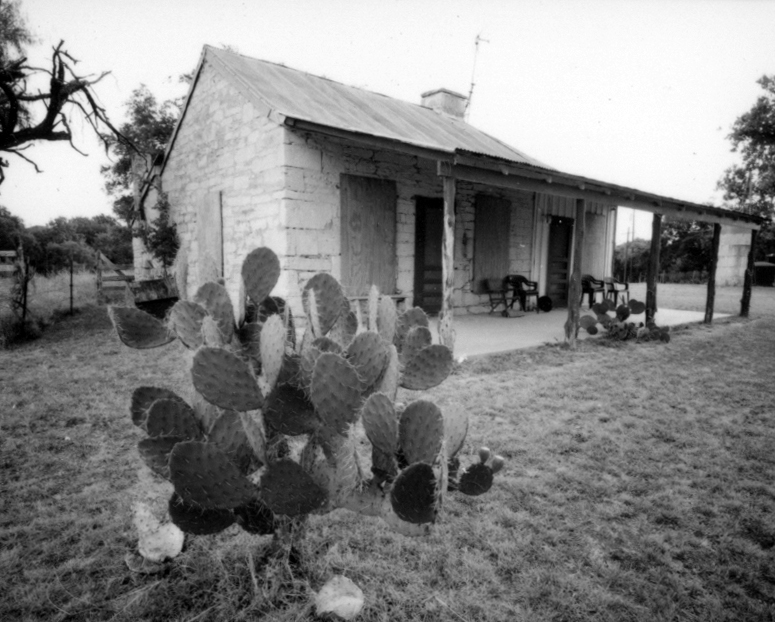
Photograph of the old rock house on the Voelcker Farm taken by Dudley Harris from “Last Farm Standing on Buttermilk Hill”
Max and Minnie Tomerlin Voelcker loved and fiercely protected their land from encroaching, encircling development swallowing up neighboring farms. The towering trees shading walkers in Phil Hardberger Park result from their stewardship.
Max and Minnie were not well-known in San Antonio, unless you were a frustrated real estate developer trying to court them. They were just plain, ordinary people. Like most of us.
Photograph by Dudley Harris of the Voelcker Dairy barn from “Last Farm Standing on Buttermilk Hill”
What the retired dairy farmers never would have envisioned is that their old farm would end up safeguarded by the city that endangered it. The city’s Office of Historic Preservation has submitted a nomination to include the farmstead on the National Register of Historic Places, according to Preservation News:
The Max and Minnie Voelcker Dairy Farm, located in San Antonio’s Phil Hardberger Park, was nominated to the National Register of Historic Places this past spring. The farmstead exemplifies a turn-of-the-century agricultural landscape with preserved late nineteenth and early twentieth century buildings. The State Board of Review met on May 17, 2014, in Austin to review the application. The Office of Historic Preservation (OHP) received a matching $10,000 Certified Local Government Grant to hire a consultant to prepare the nomination. The nomination assessment was prepared by Brandy Harris, M. Kelley Russell, Lila Knight, Ryan Fennell, Nesta Anderson, and Karissa Basse. The $10,000 grant was matched in-kind by the OHP through the execution of a survey in the West Sector Plan area of the city. OHP staff members involved in the survey included Adriana Ziga, Kay Hindes, and OHP volunteer Brenda Laureano. The nomination will now move forward to the National Park Service.
I never met Max and Minnie but was offered the opportunity to delve into their lives deeply when retained by the Max and Minnie Tomerlin Voelcker Fund to tell their story. The resulting book, Last Farm Standing on Buttermilk Hill, in turn led me to even more concentrated involvement in the history of the dairy farms that surrounded the Voelcker Farm on San Antonio’s near north side.
As I struggle to uncover bits and pieces of the lives of their neighbors from the Coker Settlement resting beside them in the Coker Cemetery and weave them together into a new book for the Coker Cemetery Association, I am grateful for that introduction to Max and Minnie. Getting to know them and digging into the past of the Coker Settlement has given me incredible respect for the tough-skinned early residents farming on the outskirts of San Antonio.
Life was hard for those pioneering farmers, and it’s wonderful the Voelcker Farmstead has been spared as testimony of the city’s vanishing rural heritage.

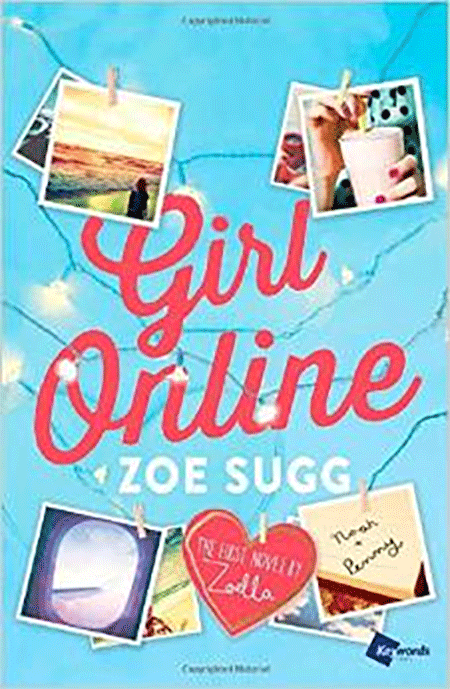 Girl Online flew off the shelves during its first week of publication. According to the Christian Science Monitor, that number shattered all records for a debut novel in the United Kingdom.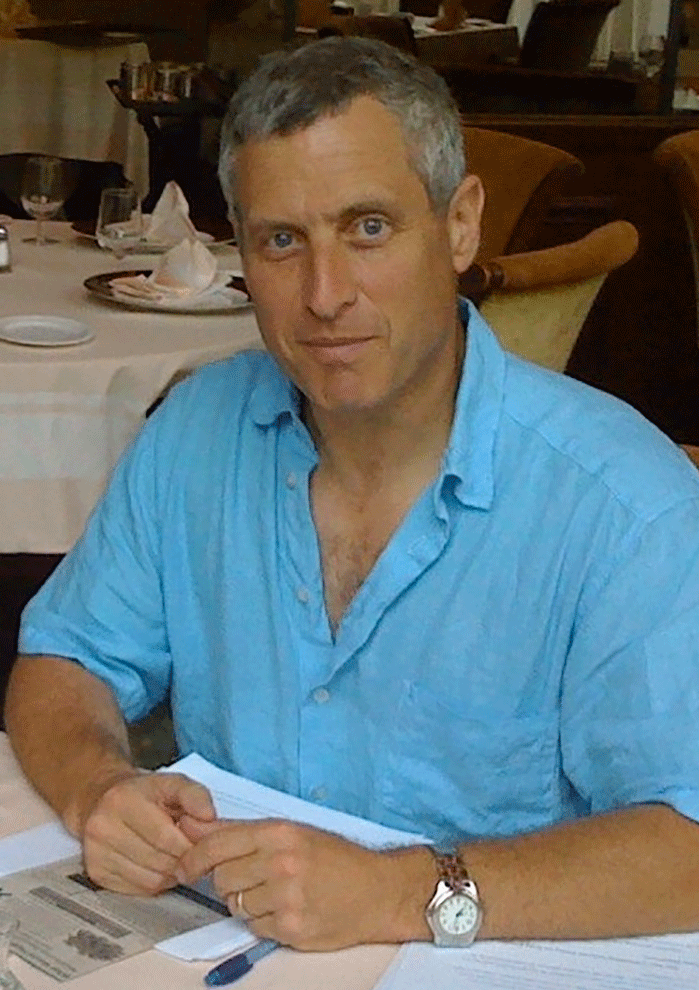



 Postcards from Barton Springs