Postcard from Budapest, Hungary: Bittersweet reflections from window-shopping

We’re not much on shopping. We return from trips with nothing new aside from calories consumed.

But we appreciate the efforts shopkeepers make to entice us to enter.

We bought no teapots or fine porcelain in Budapest. We added no snazzy men’s shorts, furry hats, Chucks, Sergeant-Pepper-worthy jackets, funky used clothing or Gucci doggie sweaters to our wardrobes. We felt no need for war “nostalgia” and ate such ample lunches neither a plate of rainbow-colored macarons or the stunning architecture of the New York Café could tempt us with sweets.

We flunked the frugality test when it came to coffee.

The apartment we rented came equipped with a Nespresso machine. I have no complaints about the quality of the coffee. It is pretty close to perfect.

But Nespresso manages patent law effectively to prevent much interference from competitors imitating their jewel-toned, diamond-cut capsules.

With no opportunity for ordering by mail when traveling, we were forced to seek out Nespresso storefronts staffed by black-suit-wearing, model-perfect young men and women with command of numerous foreign languages.

Okay, a limited command. But we were in his country. “Less bitter” to describe the coffee I wanted left him totally befuddled. He kept on repeating my request as “less better.” I don’t think anyone ever had requested capsules that were “less better” before.

We finally negotiated a less bitter score and made a $60 purchase we hoped would take us through the month. It did not quite make it. Even that amount required a supplemental coffee allocation.

It’s a necessity, right?

Window-shopping is certainly a less expensive hobby.

Hey, what the hell can one expect from a company that has George Clooney for window-dressing?
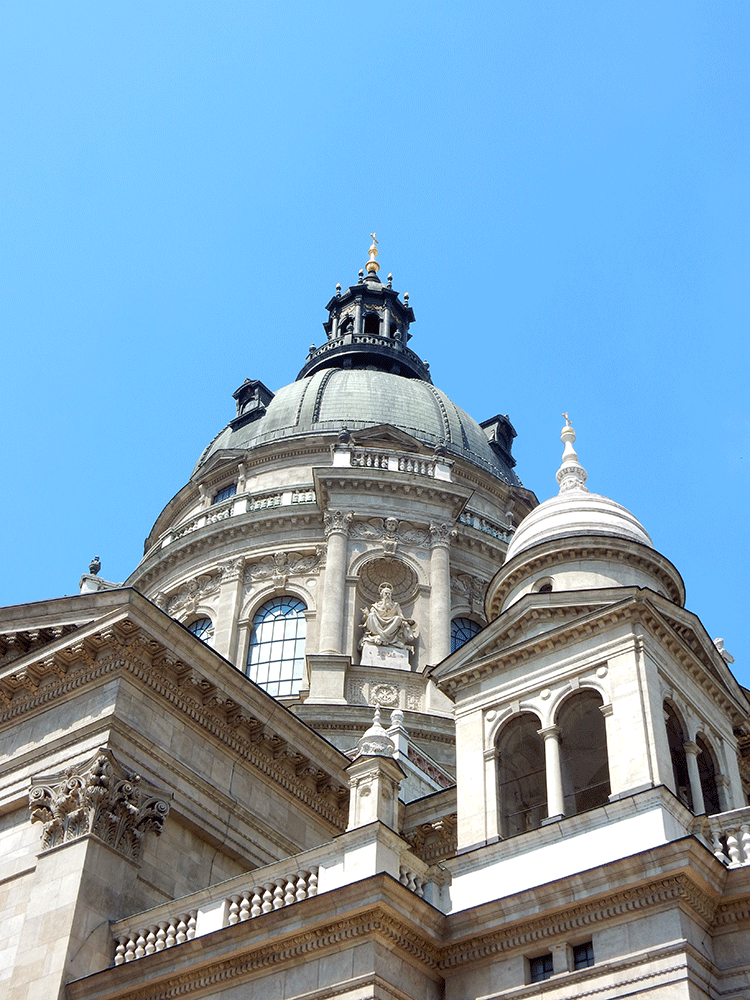
 

Postcard from Budapest, Hungary: Home for Saint Stephen’s holy dexter

The right hand of the blessed man was deservedly exempt from putrefaction because, always reflourishing from the flower of kindness, it was never empty from giving gifts to nourish the poor.

Bishop Hartvic, Life of King Stephen of Hungary, about 1116

Construction of the Basilica of Saint Stephen in Budapest took more than 50 years because the original dome over the facility designed to accommodate up to 8,500 worshippers completely collapsed in 1868. During the intervening years, the desired style evolved from neo-classical to neo-renaissance by the time the church was inaugurated by Emperor Franz Josef in 1906. The dome is the same height as that of Parliament, and no buildings in the historic center are allowed to tower above them.

Saint Stephen (975-1038) is celebrated as the first king of Hungary. His royal coronation was held on the first day of the second millennium, and the crown itself was a gift from Pope Sylvester II. King Stephen’s later sainthood was merited for his commitment to crush paganism in Hungary and for miracles credited to his right hand, the holy dexter.

The incorrupt hand was stolen at one point, recovered, hidden by nuns and finally returned and honored with a public procession in 1938 and enshrinement in a chapel in the basilica. The annual procession of the mummified dexter was ended abruptly by the communists in 1950. Since 1988, the church has been free to parade it through the streets annually on his day, August 20.

The crown presented to King Stephen served as the coronation crown for all subsequent kings of Hungary, but, like the dexter, spent some time in hiding. It and some of the royal jewels were spirited away for safekeeping in the United States during World War II. They remained locked in Fort Knox until returned to the Hungarians by an order of President Jimmy Carter in 1978. The crown and jewels are displayed in the House of Parliament.

Postcard from Budapest, Hungary: Brightening up bare walls

Blank walls in the area of Budapest known for ruin pubs make seductively tall canvases for street artists. A façade rehabilitation project enlisted Neopaint Works to transform a number of buildings in the neighborhood. Several of our encounters with street art in Budapest are the result of this project. Not sure of the origin of the life-size cut-outs on the balcony above.