If you didn’t meander through the streets from the Central Library to the Tobin Center last night, this evening brings another opportunity to experience the art, lights and sounds of Luminaria San Antonio 2014. Los Angeles-based La Santa Cecilia plays the main stage tonight. Had the opportunity to enjoy this group performing at the International Accordion Festival a couple of years ago. For a preview, watch the Tiny Desk Concert provided by National Public Radio.
Posting after an event, after I’ve been there and have taken photos, is much more enjoyable than writing about it in advance. But this is important.
You would be angry with me for not alerting you ahead of time because this is San Antonio’s best festival. Well, second best. Right after the San Antonio Book Festival. And that says a lot in a city known for non-stop-fiesta-ing.
(Pause here and scroll to the bottom first if you would like a soundtrack to get you in the mood for this post.)
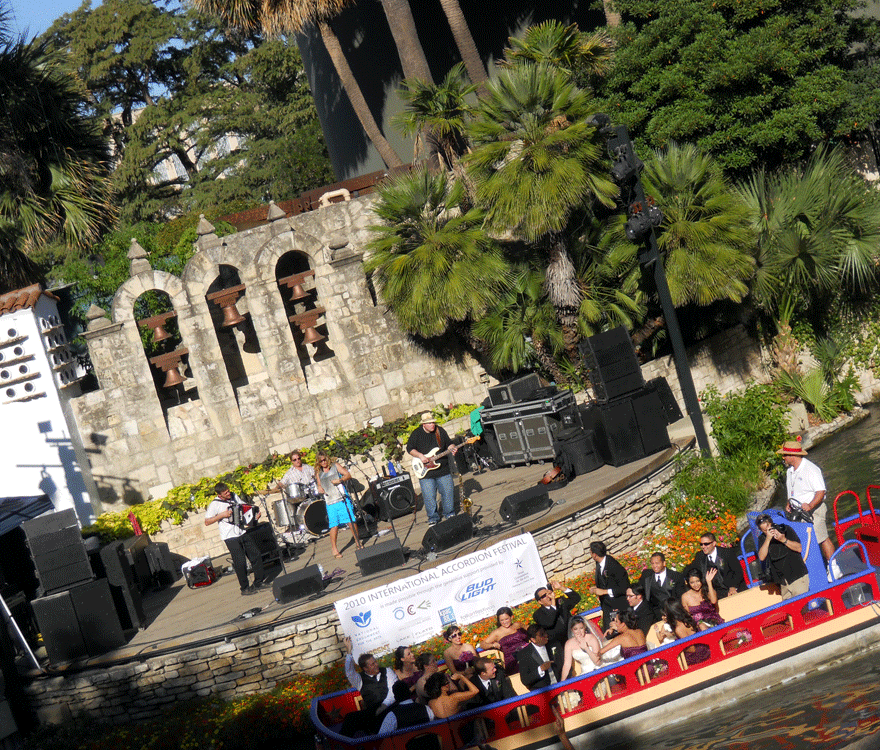
The International Accordion Festival takes place Saturday, September 13, from noon to 11 p.m., throughout La Villita. And it’s admission-free.
Expect a United Nations of sound. Some traditional. Some contemporary. All highly addictive. And it’s admission-free.
Expect the unexpected.
Accordion with a dizi, Chinese bamboo flute, and a pipa, Chinese four-string lute, employed by the Cross-Strait Trio. Chinese and Taiwanese musicians who collided while studying ethnomusicology in Texas.
The New York-based Matuto. “Appalachia-gone-Afro-Brazilian sound.”
The Italians, Canzionere Grecanico Salentino. With their traditional drum, the tamburello, that “sounds like a beating heart:”
The style is based on the ancient ritual of healing a dangerous tarantula bite called pizzica tarantata and a local cultural phenomenon called tarantim. Their music includes frantic strumming and mad trance-inducing dancing.
And on a much slower note, the lyrics of one of the Cansionere Grecanico Salentino’s more serious songs translates as though written to apply to immigration politics in Texas:
…we children of the horizon, washing us up, spilling us out. No police can abuse us more than what we’ve suffered already. We’ll serve as your servants the children you never had our lives will be your adventure tales. We carry Homer and Dante, the blind man and the pilgrim, the smell that you’ve lost the equality you’ve repressed. No matter the distance, millions of paces, we will come, we are the feet and we carry your weight. We shovel the snow, comb the lawns, beat your rugs, collect your tomatoes and insults….
In violation of the spirit of this artwork from the National Museum of Contemporary Art – Museu do Chiado, or maybe demonstrating the truth of the message, I invite you to go fado while you observe these slides. Headsets introduce you hear some of the great musicians and vocalists associated with fado in Museu do Fado, so turn on this soundtrack and pretend you are in Lisbon.
In Lisbon for a month, we came close to visiting a museum a day. Having already posted about several, including the Berardo Museum of Modern Art and the Museu Nacional do Azulejo, the National Tile Museum, these photographs represent a few of the others. There were more, but some museums do not allow cameras.
Contemporary structures completed in 1969 built around lush gardens comprise the setting for the Museu Calouste Gulbenkian, a broad collection or works assembled by Gulbenkian, an Armenian forever grateful he escaped starvation. Gulbenkian was born in Istanbul in 1869, studied in Marseille and earned a First Class degree in engineering and applied sciences from King’s College in London by the age of 19.
In 1895, his wife’s family was able to charter a ship for their extended families to flee to Egypt to avoid the wave of persecutions of Armenians. His knowledge of the oil industry and connections to the Prime Minister of Egypt opened doors for him, and he was instrumental in the founding of the Royal Dutch Shell Group and played roles in numerous ventures involving Russian, Ottoman, British, Persian, French and American oil companies.
Gulbenkian’s passion for collecting led him to assemble more than 6,000 works of art from ancient civilizations to paintings by Gainsborough, Renoir, Degas and Monet. His statue of “Diana” belonged to Catherine the Great of Russia and was purchased from the Hermitage.
Major portions of his collection were housed at various times in Paris, London and Washington, D.C. He considered housing his collection at the National Gallery in London on a permanent basis, but world politics intervened. The British government labeled him an “enemy under the act” during World War II, so, offended, he changed his mind and began negotiating with the National Gallery of Art in Washington. By the time of Gulbenkian’s death in 1955, he was still undecided what country should receive the collection, but the place where he felt most warmly welcomed during the war years – Portugal – eventually won out. I’m not sure what the fate of the director of the National Gallery of Art in Washington was when he lost the quest to gain this, but Lisboa takes great pride in the resulting Museu, the adjacent Centro de Arte Moderna and the Gulbenkian Musica.
This slideshow requires JavaScript.
An installation of marble chanclas (flip-flops) was among the contemporary works layered into one house museum attempting to attract return visitors. Instead of keeping the antiques housed in Museu Anastacio Goncalves frozen in the time, the foundation regularly weaves in contemporary art exhibitions to keep the space relevant.
Our favorite house museum was that of Antonio de Medieros e Almeida (1865-1936). His ability to collect art was fueled by his successful domination of the automobile and, later, aviation market in Portugal. Included in this was an amazing group of ornate timepieces, from pocket-size to majestic.
Wish I had written down the words of explanation of why he focused on these because they were particularly appropriate for the end of our trip. But, poorly paraphrasing, the automobile magnate collected timepieces because the passage of time was the one thing beyond his control.
And, taking it farther, demonstrating I should be heeding the advice of the top work of art instead of listening to fado, money can’t buy any additional time on the parking meter of life.



 Postcards from Barton Springs