Pearl Farmers Market

On Sunday afternoon after the San Miguel Writers Conference, I had been charged with fetching some freshly made sauce and pasta from Natura on my way back up the hill to Chorro.  Sunday, however, meant it and seemingly all of the neighborhood tiendas were closed.  I asked an ex-pat at the conference where to head, and, much to my disappointment, she recommended the Mega.  Naturally, I headed in the opposite direction, to the old market house in the heart of downtown San Miguel de Allende, where produce and flowers are artfully displayed, even on Sunday.

Upon my return to San Antonio, the Saturday market at Pearl Brewery provided a welcome transition back to reality.  While pop-up tents perched in a parking lot are not as colorful as the old market house, the produce and fresh meats were bountiful.  Children were dancing to the live music, and the browsers – arriving not only by car, but by bike or on foot – came armed with their reusable cloth sacks  from home.

The vendors Pearl has assembled seem to be have chosen with great care.  Last Saturday brought rustic breads from Sol y Luna Baking Company; artisanal cheeses from Humble House Foods; jams and soaps from Imagine Lavender of Vanderpool; guajillo honey pecans form Al’s Gourmet Nuts; luscious-looking jams produced by Watson Farms of Stonewall; and olive soaps and oils from the Sandy Oaks Olive Orchard near Elmendorf, site of Les Dames d’ Escoffier San Antonio Chapter’s second annual Olives Ole! festival on Saturday, March 27. 

I might just have to return to Pearl for another transitioning session when I return from Merida next week.
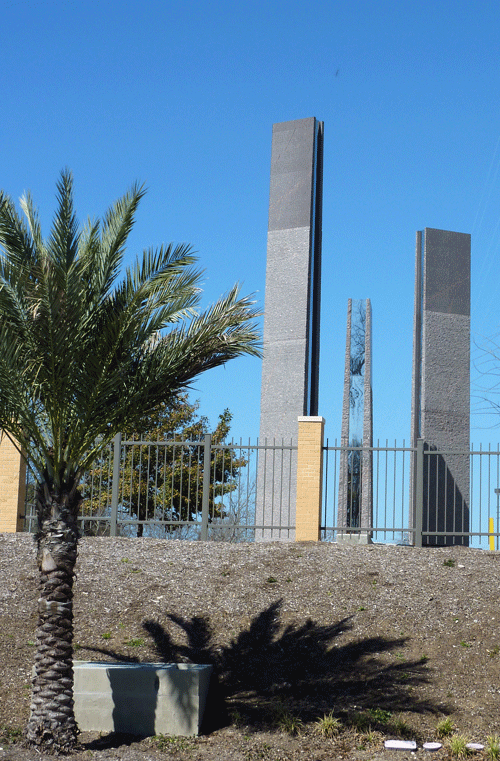
‘Underlooked’ Jesus Moroles Installation

If one is watching where one is walking, they are easy to miss.  But south of Jones Avenue above the west bank of the San Antonio River, a trio of granite sculptures by Rockport-based sculptor Jesus Moroles pierce the sky.  The reflective spaces Moroles inserted between the slender slabs of granite forming River Steles make the sculptures appear to change constantly, depending on the viewer’s angle or the color of the clouds and sky.

River Steles, on loan to the San Antonio Museum of Art from the family of William W. Atwell, stands  on a piece of land created when a bend in the river was eliminated years ago to control flooding.

Jesus Moroles
River Steles by Jesus Moroles are found above the Museum Reach of the river, south of Jones.

In Need of Bird Identification Assistance

Water birds seem to be migrating to the San Antonio River as a result of improvements in water quality.  Morning walks bring sitings of comical crested ones wearing pinstripes (Obviously, this post is in need of a bird blogger’s identification comments.); kingfishers; dark broody-looking ones with curved beaks who can hold their breath underwater for an amazingly long time; and tall white egrets who, during daytime hours, seem so territorial over their crawdad-fishing grounds one wonders how they ever manage to preserve their species.

Romance must be carried out at dusk, when three species take the opportunity to get cozier with one another in trees just to the west of the Alamo Street Bridge – the dark divers, the white egrets and kingfishers.*  Their “apartment houses” there are carefully segregated, though, with the kingfishers’ tree fronting directly on the bridge.

An unwelcome morning guest, perhaps a Katrina refugee, is a nutria spied rapidly munching his way through several beds of water plants along the King William stretch of the river.  Hopefully, that animal has no mate with whom to get cozy every evening.  According to www.nutria.com:

Nutria breed year round and are extremely prolific. Males reach sexual maturity between 4 and 9 months, whereas, females reach sexual maturity between 3 and 9 months…. With a gestation period of only 130 days, in one year, an adult nutria can produce two litters and be pregnant for a third. The number of young in a litter ranges from 1-13 with an average of 4.5 young. Females can breed within a day of having a litter.

*Note added on March 15:  A San Antonio Audubon Society member, Metha Haggard, has pointed out that my “kingfishers” are actually black crowned night herons.  The photo of the heron on Cornell’s All About Birds appears more “combed,” buy maybe mine just have cowlicks.