Shiny legacy from HemisFair hints at wealth of SAMA’s Asian Wing

A shiny hint heralding the wealth of Asian art housed in the Lenora and Walter F. Brown Asian Art Wing recently was installed across the river from the San Antonio Museum of Art.

Leiwen, the interwoven thunder pattern on the nine pewter panels, was popular on bronze vessels during the Shang Dynasty, 1800-1200 BCE. These particular panels were crafted for and installed in the Taiwanese Pavilion during HemisFair 1968.

This slideshow requires JavaScript.

May Lam donated 14 pairs of the rescued 3 x 1-foot panels to the San Antonio River Foundation during ceremonies at the Asian New Year Celebration more than five years ago. She wanted them to serve as a tribute to the rich cultural contributions of early Chinese immigrants to San Antonio, particularly the hundreds General John Pershing brought from Mexico as the United States entered World War I (I would include a photo of the adjacent panel explaining this and spare myself from typing, but I stubbornly refuse to reproduce materials failing to recognize “River Walk” as two words.).

While General Pershing was pursuing Pancho Villa in Mexico, Chinese businessmen had gathered around his encampments, operating stores and  cafés for his troops. When he returned to San Antonio in 1917, many of the Chinese retreated under his protection and were encamped at For Sam Houston until President Harding granted them legal resident status in 1921.

According to author Mel Brown in Chinese Heart of Texas, some of these new San Antonians, known as “Pershing Chinese,” were able to qualify as “merchants,” an exception to the 1882 Exclusion Act that deprived Chinese of many rights accorded other immigrants and banned additional Chinese immigration. 

Brown wrote: 

Following release from Fort Sam, a somewhat communal lifestyle was assumed at first as the Chinese Camp men stuck together for practical reasons and mutual assistance. If one of them had skills as a cook, the group contributed economically to help establish his café. As the business grew, that man hired his cronies or pitched in monetarily to set up another’s store or café…. This communal response to problems or needs was typical of the Chinese immigrant experience in America. It was a rich cultural resource which strengthened all the Cantonese communities during many years of prejudice, discrimination and exclusion. 

The Exclusion Act was not repealed until 1943.
Saplings to Shade the Next Generation

Reports from Spanish missionaries exploring what was then northern Mexico almost 300 years ago described a river with lush, tree-lined banks. Native Americans, who called the land Yanaguana, valued these trees for much more than shade from the brutal summer sun. Trees provided wood for fuel and tools and bark for medicinal purposes. Brasils, Mexican plums and persimmons all provided fruit, and pecans and walnuts provided food that could be stored for months. 

The much maligned, homely honey mesquite tree was among the most useful. The hard wood could be hewn into tools or musical instruments; the gum and bark served as an antiseptic. While the tough seeds were discarded, the blossoms and pods were eaten. But don’t expect mesquite pods to be the next gastropub trend in the locavore movement. According to Texas Beyond History:

The Cahuilla utilized mesquite in three different forms – blossoms, green pods, and dried pods. Blossoms were collected and either boiled or roasted on heated stones, squeezed into balls, and consumed. Green pods were pounded into a juice using a mortar and pestle. Most of the harvest probably was pounded into meal using a mortar and pestle. The meal was moistened with water, then allowed to harden into flatcakes a few inches thick. It was stored in this form, but often bruchid beetle eggs would hatch and the cakes would become infested with larvae (Bean and Saubel 1972). The Pima, at least, are on record as saying that the larvae simply added some zest to the meal. Informants said that the pods could be consumed without any preparation by breaking them into small pieces and chewing them (Russell 1908).

While the area off Avenue A adjacent to the River Road neighborhood provides a glimpse of what the river might have looked like in its natural state, the recently opened stretches of the Mission Reach of the San Antonio River Improvements Project are virtually treeless. 

Flood-control projects of years ago were single-minded; trees impeded flood waters so were removed leaving a barren flood channel. Native grasses and wildflowers planted the past several years as part of the San Antonio River Improvements Project have improved that landscape dramatically, but 100-degree summer days cry out for shade.

My grandmother always said, “Little acorns grow into tall trees;” although she was reassuring a young girl she would one day blossom bosoms. And in greenhouses and fields outside of Lubbock, the Texas Forest Service is nursing acorns and those pesky Anaqua seeds that embed themselves in the ridged valleys of my walking shoes into a huge crop of saplings to shade the next generation hiking along the banks of the San Antonio River. 

In November, crews from the San Antonio River Authority will begin planting 3,000 saplings ranging in height from a few inches to a few feet in the first phase of the Mission Reach. Depending on the species – including cedars, willows, cypresses, cottonwoods, elms, Mexican sycamores, possumhaws and redbuds – the trees will take from 10 to fifty years to reach full maturity.

To provide a preview of some of the native trees soon to grace the banks, the San Antonio River Foundation worked with the Parks and Recreation Department of the City of San Antonio to plant 15 trees at Roosevelt Park by Mission Road. The trees were planted in honor of the hard work of the volunteers on the San Antonio River Oversight Committee who have shepherded the project along through the years. This anaqua sporting a Treegator skirt, slowly releasing water to nourish the roots through the drought, is among them.

The River Foundation will be sharing saplings for you to take home and plant from 4:30 to 6 p.m. on Thursday, October 20, at Confluence Park, 310 West Mitchell. In addition a free tree, you will be able to view the Master Plan for this neighborhood park reestablishing the historical connection from the river to Mission Concepcion.

And, the best news: By the close of 2015, the River Authority will have planted another 20,000 trees along the Mission Reach. The next generation might not even need to wear sunscreen on morning walks.

January 24, 2012, Update: Want to add this link to another blogger’s recent post about plantings along the Mission Reach.

Ribbons of Gaudi-inspired steel ripple above the river

By the time I started this blog, most of the public art projects on the Museum Reach of the river seemed like old-hat. That is not to say the art is stale; I love it. I walked along there only this morning.

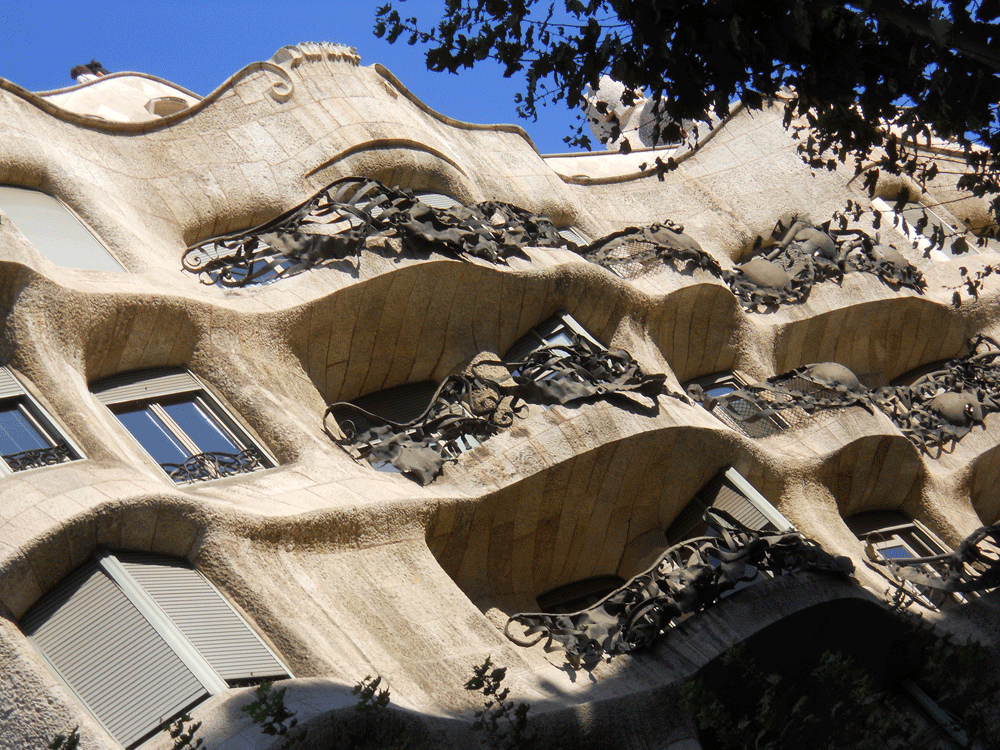
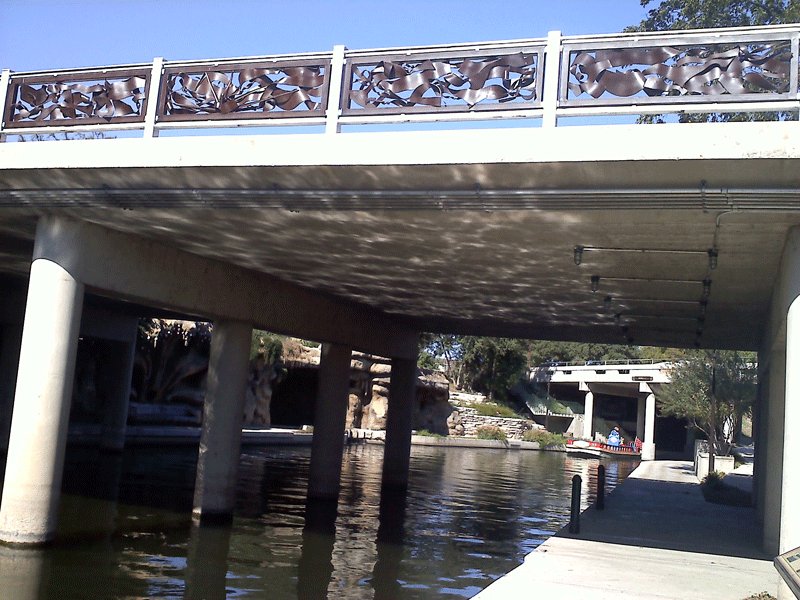
But I think the newest addition, a design inspired by balconies on a Gaudi apartment building in Barcelona, is by far the most stunning.

I already was a George Schroeder fan. Even though the stoplight is outrageously prolonged, I find myself driving south down New Braunfels, cutting across Funston and sitting at the intersection on Broadway to admire his entryway to Brackenridge Park. Its lines are so sensual and distracting, the poor car behind me generally is forced to honk.

I’ve become more of a Mission Reach kind of girl, but watching the installation of the railings on the Camden Street Bridge keeps drawing me back to that part of the river. That, and the fact there are no b-share stations south of Blue Star.

Steve Bennett of the Express-News wrote such a great story about the sculpture, I simply will defer to him:

“The whole design is based on the river,” says Schroeder…. Like a lot of Schroeder’s monumental public sculpture, such as “Passage” at the San Antonio Botanical Garden, “River Movement” was inspired partly by wanderlust.

“When I do these projects,” he says, “I try to make something that is drawn from my international travels. I try to bring something from that back to San Antonio.”

A longtime admirer of iconoclastic Spanish architect Antoni Gaudí‘s sinuous 1912 building Casa Milá, also known as La Pedrera (The Quarry) for its undulating limestone walls, Schroeder finally got a chance to see it in person during a trip to Barcelona…..

“The tangled-up metal (on the balustrades) looked very organic, an integral part of the building. So I kept that inspiration and drew on it for this project.”

My favorite part of Steve’s story is his assessment of the importance of this work:

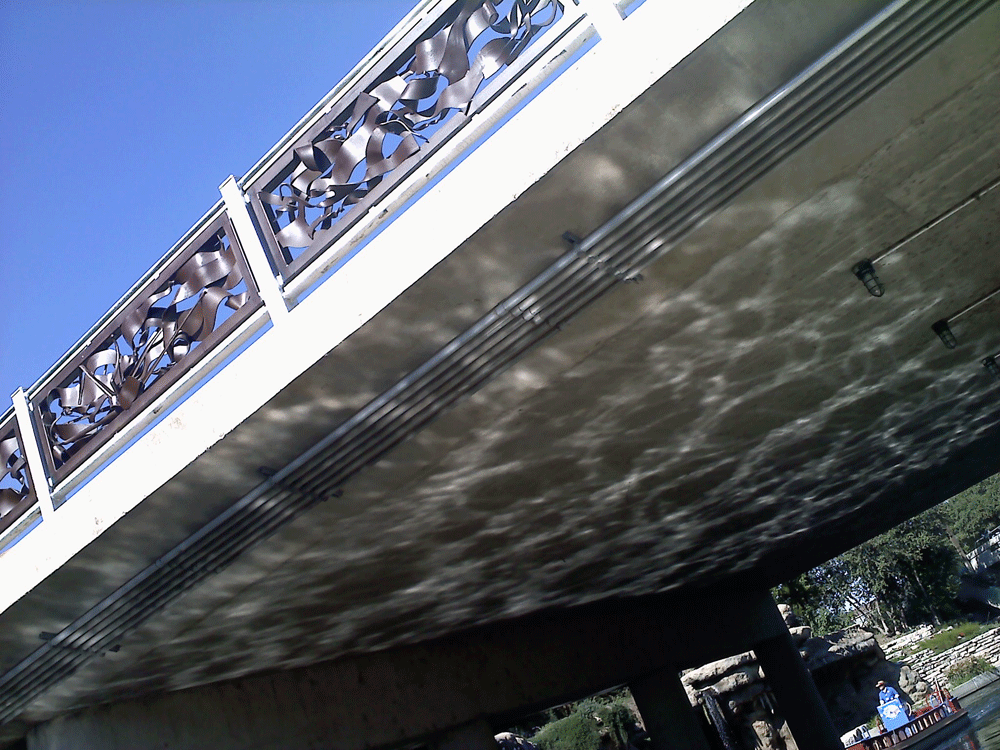
What he’s done is create another San Antonio landmark that will endure for decades, a work that mimics, in an abstract way, the ripples on the water and the breeze blowing through the plants on the banks, even the wakes of the tourist-laden barges that cruise by regularly.

And, my other favorite part: I had not realized there was more to come. The San Antonio River Foundation also is funding more of Schroeder’s work at Newell. 

Thanks.

And while you are in the neighborhood, don’t forget to look upward for the Jesus Moroles stellae….

November 11, 2011, Update: So often when I walk this part of the river, it is barely light. But yesterday morning, I waited for it to warm up a bit. The bright morning sun reflected from the rippling river onto the underside of the bridge makes Schroeder’s design inspiration even more obvious.