Postcard from Rome, Italy: Putting that saintly fashion foot forward

Away from San Antonio during Fiesta… when duchesses were bowing, weighed down by their glittering trains and flashing their fancy footwear, sometimes chanclas, from atop flowery floats… we encountered a rich array of elegant gowns in a fashion show in an unanticipated setting.

Chapels lining one side aisle of the Basilica of Santa Maria in Aracoeli hosted mannequins wearing some of the Virgin Mary’s most formal attire. Numerous outfits were complete with compatible cloaks and shoes and, of course, matching attire for Baby Jesus.

The basilica’s own Baby Jesus, Santo Bambino of Aracoeli, needed no additional clothes. Carved from olive wood from the Gethsemane Garden in Jerusalem, Santo Bambino always is cloaked in a much-bejeweled golden garment.

The original statue created by a Franciscan dated from the 15th century and was credited for numerous miraculous healings. At one point, Santo Bambino was carted around on house-calls to aid those too ill to visit personally.

An icon of such value attracts much interest. The French hijacked it in 1797, but it was later recovered. Thieves robbed the baby of numerous jewels in 1838, but the worst theft occurred in 1994. Santo Bambino vanished. Even thieves in prison penned public letters requesting their fellow tradesmen return the beloved Santo Bambino. Fresh olive wood was obtained from Jerusalem for the replacement now on display.

The original Santo Bambino might be missing, but, for the faithful, his powerful spirit remains with the reproduction in the basilica. Letters from around the world arrive addressed to Santo Bambino requesting mail-order miracles and are placed beside him to “read” at will. As newer ones arrive, the older requests are burned with incense.

As for the setting itself? No San Antonio ballroom can compare with the shimmering chandeliers and ornate décor found in the basilica.

Somewhere at the foundation of the enormous Basilica of Santa Maria of Aracoeli lies a Byzantine church dating from the 500s. The papacy took over the property in the 9th century, placing it under the control of Benedictines. Immense columns supporting the central nave were harvested from ancient Roman ruins. Franciscans provided much Romanesque and Gothic remodeling and expansion in the 1200s. Heavy gilding of the ceiling was completed in 1575 to thank the Virgin for her assistance in defeating the Turkish fleet at the Battle of Lepanto.

A monumental stairway, 124 steps, was added in 1348 for those praying for an end to the Black Plaque or seeking penance on their way up to the church (Okay, I confess. We took an easier approach through a side door.). In the Middle Ages, criminals were executed at the base of the stairway. In the 17th century, one of the royal princes who lived above took offense to international pilgrims sleeping on the steps and periodically rolled stone-filled barrels downward to chase them off.

Contemporary superstition claims the faithful who crawl up the stairway on their knees enhance their possibilities to win the national lottery. No point for us. We will never win any lottery. You have to pay to play.
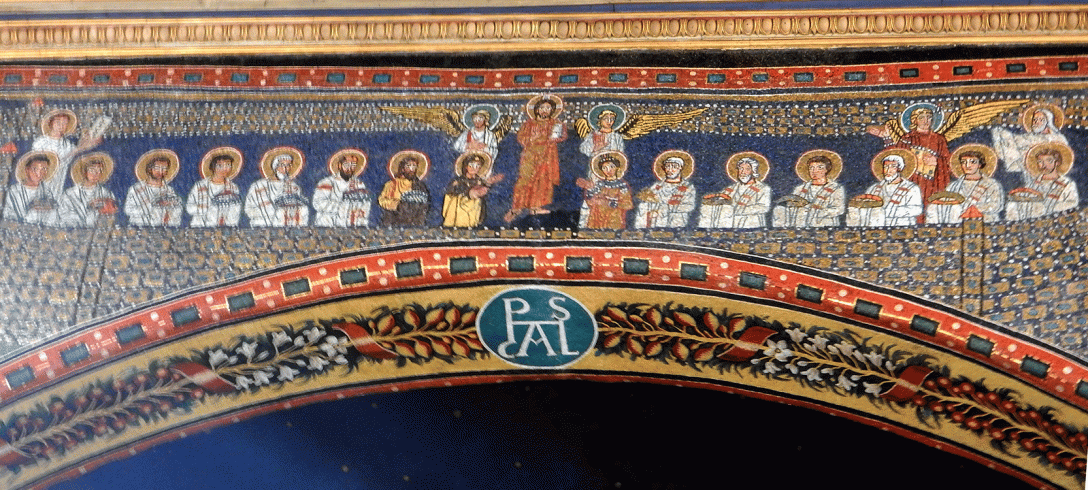
 

Postcard from Rome, Italy: Glittering mosaics crown basilica full of saintly remains

Pope Paschal I (?-824) was partial to preserving saintly remains; you were introduced to him earlier as the pope who found Santa Cecilia’s remains and moved them to Trastevere. A round slab in the Basilica of Santa Pressede purportedly covers a well where he deposited the remains of 2,000 early Christian martyrs.

Among the relics housed in the church are those of sisters, Saints Pressede and Pudenziana, known for sheltering and caring for persecuted Christians. The sponge Pressede used to cleanse the wounds of bleeding martyrs is believed entombed there as well.

Pope Paschal I openly welcomed monks exiled from Byzantium because of their opposition to practices endorsed by church leaders in Constantinople. He also extended invitations to dissatisfied Byzantine mosaic artists. The results of their refuge in Rome are most clearly visible in the apse and chapels of Santa Pressede.

A later addition to the church is housed In one of the basilica’s most ornate chapels – a portion of a black granite column reputed to be that to which Jesus was bound as he was flogged by Roman soldiers.

Postcard from Rome, Italy: ‘Innocent’ intrigue surrounding summer soirees at papal retreat

The following all should relate to the collection of ancient B.C. art housed in the National Etruscan Museum. Although many of the photos focus on the artifacts, I find myself totally distracted by the origin of their home, Villa Giulia.

Papal politics were a mess in 1550 when the crossed keys were handed over to Pope Julius III (1487-1555). He had served as governor of Rome twice and barely escaped execution when Clement VII (1478-1534) turned him over to imperialists as a hostage following the sack of Rome in 1527.

But the cardinals were not impressed by his credentials. Three factions emerged: those in favor of continuing the Council of Trent and its response to the rise of Protestantism; the French who were against it; and the powerful Farneses pushing one of their relatives. Pope Julius III represented a compromise accepted with reluctance.

While benefitting from the ascension of the Catholic Queen Mary (1516-1558) to the throne of England, the pope’s efforts to reconvene the Council of Trent proved controversial. And the papacy became entangled in the war of Parma. The international intrigue proved overwhelming. The frustrated pope retreated to focus on creating a pleasurable escape from the turmoil.

Villa Giulia is the result. A vacation home. A palace for entertaining. A palace for the arts. And a papal playground.

Vineyards, no longer in existence, cascaded down to the Tiber, and the host and guests could travel back and forth by boat from the Vatican. Loggias surrounding and overlooking reclining “gods” in the Nympheum provided al fresco opportunities for summer parties.

All leading to gossip. Rumors. Jealousy. Fake news, perhaps, about nepotism.

Innocenzo (1532-1577) was the pope’s major Achilles’ heel. While still a cardinal, Julius found the poor 17-year-old lad on the streets of Parma; had his brother adopt the unfortunate boy; and employed him as a caretaker for his pet monkey. When elevated to Pope, Julius immediately elevated the teenager to Cardinal. We are reserving judgment about the qualifications of Innocenzo for this post; although the wags of Rome did not.

After Pope Julius III’s death, Pope Paul IV (1476-1559) confiscated the villa. His predecessor’s incredible collection of sculpture assembled there was transported through the vineyards and floated by barges down the Tiber to the Vatican.

The government of Italy confiscated Villa Giulia from the Vatican in 1870, and, in 1889, dedicated it as the National Museum of Etruscan Art. A copy of a small Etruscan temple was inserted in the middle of a courtyard in 1891.

Finally, the art. But I’m not going to blog about that much because I know very little about the period (No snide remarks necessary about how little I know about the papacy or the history of Italy overall). You (assuming you follow this blog religiously) already have been introduced to the most famous couple in the museum reclining on their sarcophagus.

As you view the tender pair from Cerveteri enjoying a banquet atop their remains, squint. Try to visualize them in color. And try not to get distracted by imagining the sumptuous parties that occurred there during the palace’s early days.