Postcard from Naples, Italy: Praying to free poor souls from purgatory

Lucia (viewed through a protective mesh screen) is the most loved soul. The skull with the bridal veil, adorned with a precious crown, is kept next to a pair of skulls that, in the popular imagination, represent the servants of the young girl, a young princess who died very young immediately after the wedding. To this soul the popular tradition has dedicated a small altar electing her as protector of the brides and mediator for prayers and invocations.

from the website of Santa Maria delle Anime del Purgatorio ad Arco

What happens to an unfortunate Catholic soul who was good his or her entire life save some technicality, such as not being able to utter that last confession or receive the final last rite of extreme unction from a priest? Or who was left with an accumulation of unconfessed venial sins, such as losing patience, blurting out abusive language or hating one’s neighbor enough to wish evil upon him?

There is a spot for those departed, but if falls a short of heaven. Purgatory.

Purgatory, sometimes described as a purifying fire, need only be temporary – provided those on earth pray for them. In Naples, there are those faithful who devote themselves with fervor to freeing souls for their flights up to heaven.

Some refer to those practitioners as members of a cult of the dead. Results of their assistance in caring for the skulls of those who died lacking requisite sacraments regarded as keys to heaven were seen in an earlier post about Cimetero delle Fontanelle.

But Santa Maria delle Anime del Purgatorio ad Arco is not as remote as that cavernous home for skulls. Built in 1638, the church is in the heart of Naples. The church dedicated to the faithful praying for those in purgatory is a handsome one, but the hypogeum, an underground church with crypts, garners the attention of followers of the cult of pezzentelle, or souls in purgatory.

The ancient cult of the Purgatory Souls, guarded for centuries in the underground of the 17th-century Church of Santa Maria of the souls of Purgatory in Arco, arose spontaneously, at the beginning of 1600, when the new counter-reformation church proposed the care of the souls of the dead as one of the principal religious practices to establish, through prayers and masses in suffrage, a liturgical link between the living and the dead…. The living, as a means to atone for earthly sins, were concerned with fostering the ascent of souls to Paradise and assuring them of the coolness of the flames of Purgatory during the period of tribulation….

The relationship is established through the adoption of a skull, which according to tradition is the seat of the soul, which is chosen, cared for, looked after and hosted in special niches. The pezzentella soul (from the Latin petere: asking to obtain), anonymous or abandoned soul, invokes the refrisco, the alleviation of the sentence; and the person who adopted it, the person in life, asks for grace and assistance….

The grates that connect the street and underground enable voices, the cries, the prayers to reach at any time the skull, which enjoys the protection. A thought, a flower, a lit candle, support the hard fight for Paradise the souls of Purgatory generously welcome in the vast Underground of the church.

from the website of Santa Maria delle Anime del Purgatorio ad Arco

While the Catholic church unsuccessfully has tried to extinguish the practices of the cult-like faithful, it seems reassuring that, if purgatory exists, there are people out there working to free the unfortunate souls trapped in its flames.

So many things those nuns never taught me…. Many of Roman Catholicism’s more interesting quirks never made it across the ocean to little Star of the Sea Church in Virginia Beach.

Postcard from Sorrento, Italy: An Amalfi town overwhelmed by people like us

Our Lady of “Please Save Us and the Entire Amalfi Coast from this Latest Wave of Invaders”

Mythologically speaking, Sorrento was founded by a grandson of Ulysses and Circe, but the geographical features making it a natural fortress – a deep gorge and steep cliffs fronting the coast – placed it in high demand by all powers interested in staking out turf in the neighborhood for thousands of years.

And now the invaders are tourists. Obviously, we are among them. But visitors slipping in two by two is a far cry from the hoards cruise ships docking in nearby Naples deliver to Sorrento, viewed as the stepping stone for exploring the beauty of Italy’s Amalfi Coast. The pedestrian streets of Sorrento are lined with shoppes, as opposed to stores that would offer anything of interest to the city’s less than 17,000 residents.

The small-town streets are clean and orderly compared to the scene in Naples, but are swarming with, well, people like us. Sorrento is a place where we could enjoy a morning cappuccino in a small café for three times the price we would pay in Naples. The setting is dramatic, and the views of the Isle of Capri and Naples are beautiful. But wait, we had a wonderful view of the Isle of Capri from our apartment in Naples.

Sorrento is blessed with several handsome baroque churches, and my favorite part of the jaunt by boat over there from Naples was a visit to the Basilica Sant’Antonino. Little Saint Anthony of Sorrento (555-625) was a Benedictine monk who became a hermit. The citizens of Sorrento coaxed him into serving as abbot of their Saint Agrippinus Monastery. Saint Michael appeared to persuade him to take up their offer.

The most miraculous deed credited to Antonino during his lifetime involved a whale. A mother arrived pleading to him for help, as her son had been swallowed by a leviathan. Antonino was able to reach deep inside the creature’s mouth and pluck the boy out, safe and sound.

After his death, the grateful people of Sorrento built a crypt to house his remains and then erected a basilica above in his honor. His work was not yet done though. The saint is credited with protecting the city from a Moorish naval invasion, the bubonic plague and cholera. The walls of the crypt are lined with cases of silver milagros left by those requesting his intervention in healing various parts of the body and reliquaries of bones of other saints to multiply the potency found within. Retablos depicting some of Saint Antonino’s dramatic rescues of endangered sailors at sea are abundant.

Sorrento takes great pride in its limoncello, ceramics and lacework. We strongly recommend the perfect panini produced in the little kitchen at A’Marenna.

Oh, and the city appears taken with Sophia Loren, particularly after her mambo scene in Scandal in Sorrento.

Sophia Loren and Vittorio de Sica mambo in 1955 film Scandal in Sorrento

We enjoyed dipping our toes into the Amalfi scene at Sorrento, but by late afternoon found ourselves eager to return to the bustling chaos of Naples.

Postcard from Naples, Italy: The church of Andy Warhol

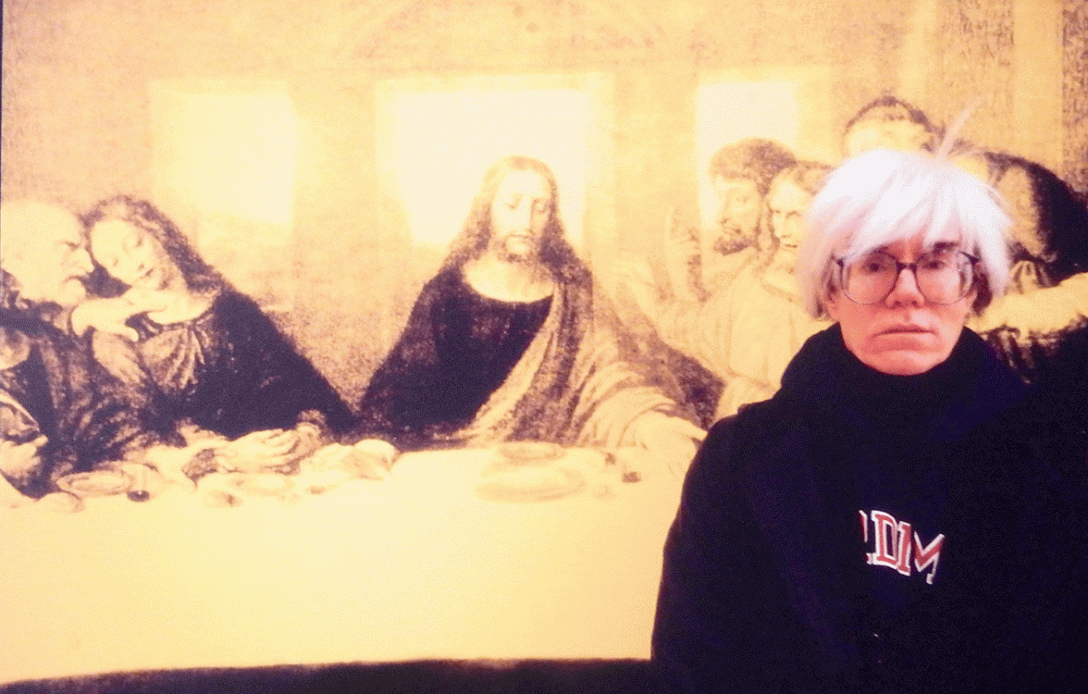
In 1984, gallerist Alexandre Iolas commissioned Warhol to create a group of works based on Leonardo Da Vinci’s Last Supper (1495-97) for an exhibition space in the Palazzo Stelline in Milan, located across the street from Santa Maria delle Grazie, home of Leonardo’s masterpiece. Warhol exceeded the demands of the commission and produced nearly 100 variations on the theme. Indeed, the extent of the series indicates an almost obsessive investment in the subject matter, which takes on an added significance in light of the revelation of the secret religious life revealed after Warhol’s death, which occurred only a month after the opening of the Milan exhibition in January 1987.

“Andy Warhol: The Last Supper” from Past Exhibitions of the Guggenheim

Encountered an Andy Warhol exhibition our first weekend wandering around Naples. The setting seemed so unlikely. The Basilica di Santa Maria Maggiore alla Pietrasanta, constructed atop the remains of a Temple of Diana by a Bishop of Naples in the year 525 and purportedly the first sanctuary dedicated to the Virgin Mary.

Of course, that church was remodeled numerous times, and I really am unsure how it became an art venue. But Pop art is occupying the sanctuary through February 23: “The True Essence of Warhol.” The exhibition is presented by the Arthemisia Association.

The pairing of pop culture and religious altars is unusual. A neon “Warhol e il Brand” crosses in front of a painting of the Virgin Mary. “Warhol e l’Italia” glowing in front of a crucifixion. Mick and Keith staring down from niches?

Church is not what my memory associates with Andy Warhol (1928-1987). My memories place him more in the throbbing celebrity melee of the Studio 54 disco scene. Or hanging with the Rolling Stones.

His art was sensational via his calculated and stated commercial associations.

Mr. Warhol’s keenest talents were for attracting publicity, for uttering the unforgettable quote and for finding the single visual image that would most shock and endure. That his art could attract and maintain the public interest made him among the most influential and widely emulated artists of his time.

“Andy Warhol, Pop Artist, Dies,” Douglas C. McGill, The New York Times, February 23, 1987

We played around in this church of Warhol….


But it was not until several months later I learned that Andy Warhol’s Catholic upbringing was lurking close to the surface of his wild partying veneer. He was frequently spotted on Sundays in a pew of St. Vincent Ferrer on the Upper East Side of New York.

People are complicated.

I always thought I’d like my own tombstone to be blank. No epitaph, and name. Well, actually, I’d like it to say “figment.”

Andy Warhol

It does not. His headstone in Saint John the Baptist Byzantine Catholic Cemetery in Pittsburgh bears standard name and dates, and he rests amongst his Warhola relatives. His memorial mass was held in Saint Patrick’s Cathedral in New York City.