Postcard from Lisboa, Portugal: Too Many Tiles and a Few Juicy Royal Tidbits

The influence of the Moors and world exploration opening doors to the art forms of India and the Orient are evident in the tile designs augmenting architecture throughout Portugal. The photographs here are from Museu Nacional do Azulejo, the National Tile Museum.

The home of the tiles is the Convent and Church of Madre de Deus, founded in 1509 by Queen Dona Leonor (1458-1525). The gilded church and large collection of reliquaries containing remnants of saints seem fit for a queen, and the queen did indeed spend her retirement years there praying for the poor and presumably for the souls of deceased members of the royal family who played parts in the lethal jockeying for political power and rights to the throne.

This slideshow requires JavaScript.

Tile overload? Sorry, I have no power to resist them.

But, here, pause to take in some of the court conniving surrounding the family of Queen Leonor.

Leonor was only 12 years old when she wed Prince Joao (John) (1455-1495). She became queen consort when her husband rose to the throne as King John II in 1481.

Perhaps wisely so, King John II perceived many plots and conspiracies swirling about during the early years of his reign, and relatives of his wife were among the prime suspects. The King had her sister’s husband executed for treason and personally plunged in the sword ending the life of her older brother. The Bishop of Evora was imprisoned, where he succumbed to poison.

Their son Alonso (1475-1491) married into the royal family of neighboring Castille. Unfortunately, his in-laws, King Ferdinand II and Queen Isabella, only had one feeble and frail son. They viewed Alonso’s marriage into the family as a potential threat to the sovereignty of Spain. Prince Alonso died under suspicious circumstances while out riding, contributing yet one more thorn to the relationship between the countries sharing the Iberian Peninsula.

This left the crown of Portugal without an heir apparent, and King John II lobbied hard to propel his illegitimate son into that role. Queen Leonor did not welcome those efforts and even appealed to the Pope for intervention.

King John II died unexpectedly early at only 40 years of age, quite possibly the victim of one of the poisonous plots he feared. The crown passed on to the Queen’s brother, Manuel I (1469-1521), as explorations were launching Portugal’s golden age.



Postcard from Lisboa, Portugal: Feira Livro

This is the 84th edition of the Lisboa Book Fair, so it has had ample time to grow and mature. We watched as the rows of containers were lined up along both sides of sloping King Edward VII Park. They looked sterile, but what a change when we went back and the containers had been customized. Every single one looked different, depending on the bookstore or publisher occupying it.

Not sure how jam-packed the Book Fair is on weekends, but we strolled through on a Monday. There are 250 book vendors represented at the event running more than two weeks. Tented areas along the way provide space for small readings and autograph sessions.

Thirty food and beverage booths are interspersed among the book vendors, again all different. In between rows of booths are seating areas, each distinctively designed – some tables and chairs for adults; some pint-size reading or play “rooms” for children; and some laid out like comfortable lounges with living room furniture resembling a Copenhagen showroom.

How pleasant it looked to pause to peruse purchases over an espresso or glass of wine. Of course, we didn’t buy anything; naturally, most books are in Portuguese.

This slideshow requires JavaScript.

San Antonio, headed to its third edition of its Book Festival, has plenty of time and room to grow. The San Antonio Public Library Foundation already squeezes an incredible amount into one day, and, frankly, it’s so accessible because of the manageable size and close proximity of the venues.

One day, we’ll look back at these early San Antonio Book Festivals nostalgically, the same way old-timers reflect on the neighborhood intimacy of the first years of the King William Fair. Even now, the agenda is so crowded, decisions about which author sessions to attend are wrenching.

But, best of all, most of the featured books and readings at the San Antonio Book Festival are in a language I understand. Looking forward to the 2015 edition.

Postcard from Sintra, Portugal: The Opulence of the Pena Palace

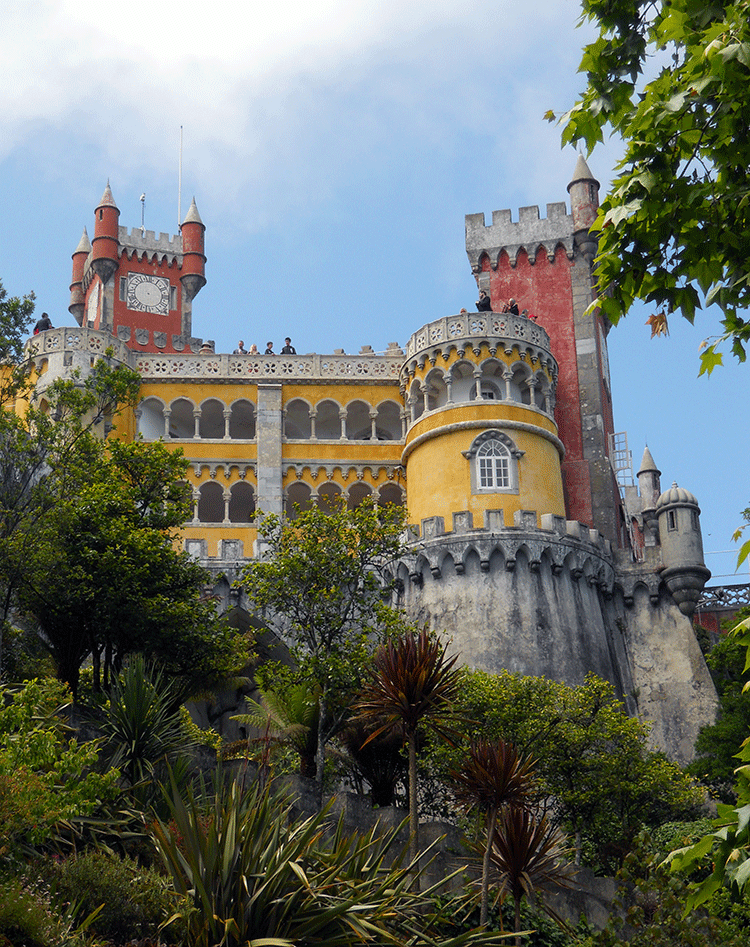
Climbing up higher than the old Moorish Castle, one reaches a site where humble monks seeking an isolated retreat free from distractions established a monastery. Following the return of Vasco da Gama, King Manuel I (1469-1521) constructed a stone palace astride the hilltop as part of his celebration of Portugal’s vast new riches.

From 1840 to 1885, however, King Ferdinand II (1816-1885) transformed the Pena Palace into an overwhelming, over-embellished symbol of the aristocratic follies of European royalty (This was not the sole palace.) – a stunningly magical mélange of ornate Gothic, Renaissance, Moorish and Manueline architectural details.

This slideshow requires JavaScript.

Crumbling colonial power increasingly led to economic distress in the country, and King Carlos (1863-1908) resorted to dissolving the Parliament and assigning dictatorial powers to his prime minister. Discontent mounted, and brazen assassins fired into the open royal carriage as the King and his family traversed one of Lisboa’s main plazas. King Carlos and his eldest son were killed.

His second-born son, Manuel (1889-1932), succeeded him, only to be forced to flee to England in 1910. Manuel II was Portugal’s last king.

Amazingly, the leaders of the new republic preserved the palace and its lavish furnishings virtually intact.