The magic of the first carpet had our attention. And the second. Brilliant colors, traditional patterns passed from wrinkled hands to nimble young fingers generation after generation in villages in the interior of Mexico.
Santiago Borja’s carpet appears traditional at its heart but melts into modernism at its edges. Weavers from the workshop of Jeronimo Hernandez in Teotitlan del Valle, Oaxaca, completed its execution.
But then something happened on the next wall. The scarf escaping from the flat surface, its fringe fluttering free as though a butterfly freed from its cocoon…
This slideshow requires JavaScript.
…a phrase too obviously transitioning to the title of the exhibition at the Museo Textil de Oaxaca – Cocoon Me from My Feet Up: Traditional and Contemporary Carpets. Curator OlgaMargarita Davila assembled work by 18 artists from four countries “to connect ourselves with the meaning of the fabric we inhabit: our body.”
Bodies resembling dancing Guatemalan worry dolls bob along the top and bottom of a linear weaving by Susan Martin Maffei whose website explains:
Crocheted 3 dimensional trims, quipus and found objects enhance the narrative visuals of many works, influenced by textile forms and embellishments of the many ancient cultures I have explored.
An “unwrapped” piece caught my eye, but then the artist almost cheated to make me a fan – a postcard. He created a postcard to the curator to accompany one of his pieces.
….there is such a contribution to be made by adapting examples from the history of our chosen medium and quietly exploring a simple form or image through line, grid-form or in separate units, repeating and developing it again and again.
The sidewalks and plazas in the historic center of Santiago de Queretaro were overflowing with pedestrians on a recent Sunday night, evidently a typical Sunday evening. Our host, Clyde Ellis, and his neighbor led us past a plaza where families were lined up to see an exhibition of National Geographic photographs, through the plaza with the dancing waters and past the one where a younger set was gathering for contemporary pop.
Although stopping frequently to greet other neighbors encountered along the way, they were intent on the goal – Destination Danzón. And, having lingered at great length over a late lunch, we were late.
This slideshow requires JavaScript.
Banda de Musica de Gobierno del Estado already was swinging into the first set of the Tradicional Serenata Dominical, and dancers were sashaying around the plaza. Selections included “New York” and Glenn Miller’s “De Buen Humor,” or “In the Mood.”
Cha-cha-cha transported me instantly back to the days of Sunday tea dances in Virginia Beach. The tea dances, inappropriately named as brown bags clothed bottles of bourbon and gin on virtually every table, were held outdoors across Atlantic Avenue from the old Cavalier Hotel. The huge round dance floor was roofless and surrounded by a double-decked gallery perched directly above the beach, so close to the ocean her hurricane-driven waves periodically would drag almost the entire structure out to sea.
I would watch my parents and their friends cha-cha-cha-ing around the polished wood dance floor to the big band sound of bands such as the Lester Lanin Orchestra. Cuban music was king, as the island was a popular vacation destination for ships cruising out of Norfolk.
One Sunday in particular came to my mind. I must have had new clothes, never before worn by my older sisters – a rarity. A starchy crinoline belled out the skirt of my smocked, puffed-sleeve dress, and lacy white anklets emerged from the top of shiny black patent leather Mary Jane shoes.
Longing to join the glamorous adults twirling on the dance floor, I remember dancing with one of the columns supporting the upper deck of the gallery. The mother of an older man – probably 8 years old and the only other child there – persuaded her son to ask me to dance.
The boy commanded a rather spirited lead at a pace restrained only marginally by the beat of the music. For a grand finale, he spun me around under his arm so fast I twirled out of control like a top, the slick soles of my Mary Janes flying out from under me as I landed plop on my bottom amidst raucous laughter from onlookers.
The dancers of Queretaro were well beyond my league as well. They greeted each number enthusiastically, although the band held out playing the even first danzón until the second set.
The danzón originated in Cuba but was exported to Vera Cruz, where it flourished and spread. Dancers pair off on the floor but refrain from taking the first steps until an orchestral cue on the fourth beat of bar four of the paseo, a cue much too subtle for me to catch until after the banda had played several. Tunes on the programa in Queretaro included “Siboney” and Gonzalo Bravo’s “La Negra,” and the evening closed with a spirited marcha, “Queretaro.”
Did we join the dancing Queretanos?
I am positive I could have danced with a lamppost on the plaza all night without the mister even being tempted to cut in to salvage my reputation.
But just as well. Despite awkwardly suffering through a season of Mrs. Sadler’s cotillion, my dancing skills have improved little through the years.
A six-year-old piled up in a crinoline pouf on the floor might be cute, but the woman she evolved into a half century or so later would not.
Note Added on March 24, 2012: Just noticed that the Instituto Cultural de Mexico in HemisFair Park is exhibiting photographs by Cristina Kahlo, “Tiempo de Danzón,” through the end of April.
Note Added on March 31, 2012: And a friend just emailed me that Salon Mexico if offering a danzón lesson from 7 to 10:30 p.m. on Friday, May 11, at the University of Incarnate Word.
Keynote speaker Barbara Kingsolver and an intensive writing workshop led by C.M. Mayo drew my daughter Kate and me to the San Miguel International Writers’ Conference this past February. The conference sessions were so great, we did not even skip out once to wander the streets of San Miguel de Allende. Given the allure of San Miguel, that’s amazing; although a visit a few months earlier helped keep us focused.
As I walked past Sandra Cisneros‘ house on the river this morning, I thought: Can I really justify traveling all the way to San Miguel to hear keynote talks by someone who lives right here in San Antonio?
I think the answer is a definite maybe. A five-day concentrated dose of writing workshops is an incredible experience.
Plus, the writers’ conference is to blame for this blog. I am hoping they are planning on prescribing an antidote, a session on how to keep prolific blogging from interfering with working on your novel.
Exploring Sandra Cisneros’ website led me to her memories of button boxes. Never figured out what happened to Nana’s button tins. I wanted to inherit them so badly. They were magical. Seemed to contain buttons from two generations back. Buttons so complex to assemble that there is no wonder there were buttonmaker unions. I’d sit for hours creating button collages in her sewing room overlooking the giant fig tree in the backyard; yet, to this day, have absolutely no interest in replacing a commonplace button on a shirt.
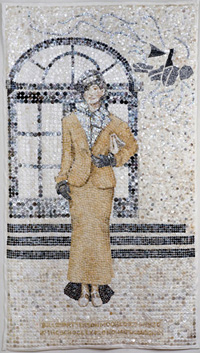
Marilyn Lanfear's "Aunt Billie"
Note Added on September 11: Which, in turn, led me to the consummate button artist, San Antonio Art League’s Artist of the Year – Marilyn Lanfear. She is being honored with an exhibit opening on Sunday, September 12, from 3 to 5 p.m.
“Billie Patterson Moore died in the school explosion in New London TX”
by Marilyn Lanfear
Mother-of-pearl and bone buttons on linen,
2005-07, 54” x 95.25”
Update on October 20: Read about Marilyn Lanfear’s exhibit at Glasstire
Update on November 29: Marilyn Lanfear’s exhibit, “What Is Lost; What Is Found; What Is Remembered,” opens at Blue Star on Thursday, December 9. She refers to herself as “a storyteller” who creates:
a visual language that depends on and invites elaboration. I want the viewers to have associative memories and make my history into theirs.


 Postcards from Barton Springs
