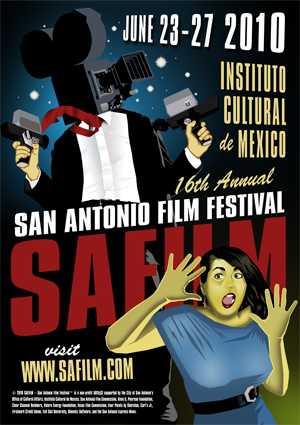
Cinematic Overload Ahead

poster designed by Rigoberto Luna

An admission-free screening of films on Main Plaza from 8 to 10 p.m. on Saturday, June 19, will launch the 16th annual San Antonio Film Festival.    

The first of seven films of varying length to be shown on the outdoor screen that night is “Recuerdo,” the second video piece by San Antonio artist Vincent Valdez.  Produced by the Federal Art Project and the Southwest School of Art and Craft with production supervision by Luis Guizar, the work consists of a San Antonio cityscape and portraits of San Antonians from various backgrounds.  

The film festival will continue from June 23 to 27 at Instituto Cultural de México in HemisFair Park , showcasing independent filmmakers and featuring more than 120 films on three screens over the five-day span.   The offerings come from all over the map and include all types of filmsTickets range from $10 to a $69 package.  

Running less than two minutes, Yoni Goodman’s Closed Zone is among the shortest of the shorts.  

Having spent much time recently with Lynnell Burkett discussing commas (actually the common colon proved our most challenging deviation about punctuation) as we try to get Last Farm Standing on Buttermilk Hill to press, I was drawn to Ken Kimmelman’s animated film, Thomas Comma.   Based on a story by poet Martha Baird, the film is the adventure of a lonely comma, drawn by hand and then “painted” on computer.  According to Baird:  

We’re all of us like commas looking for the right sentence.  

Farmers Spared Towering Oaks from the Bulldozers of Urbanization

After an aquifer-filling 24 hours, the clouds parted just in time for this morning’s opening ceremonies for Phil Hardberger Park. 

Former Mayor Hardberger does not take the responsibility of having the 300-acre park named in his honor lightly.  Since leaving office, he has assumed the presidency of the Phil Hardberger Park Conservancy; along with his wife Linda, donated $100,000 from their private foundation; found the conservancy a home in his former office space in the Milam Building; and, perhaps most importantly for the future of the park, installed the powerhouse behind several former mayors – Betty Sutherland – as the conservancy’s executive director.

The opening provided a break from editing the edits in a book about the farmers, Max and Minnie Voelcker, who lived on the land now Hardberger Park.  Editor Lynnell Burkett and I agree about the placement of the oft-cursed comma (refer to earlier ‘ode’) surprisingly more frequently than that of the devilish colon.  

During this morning’s ceremonies, the former mayor said the parkland will endure for centuries to come, long after those who had anything to do with it are forgotten.  Already, Voelcker is far from being a household name, even for those living near the park. 

Although the Voelckers ran cattle on their land once dairy-farming became unprofitable for small operators; they always considered themselves farmers.  The stories of their farm and all the dairies that flourished in this part of San Antonio once known as Buttermilk Hill are endangered.  A May 14 editorial in the San Antonio Express-News provided evidence some of the few who know the Voelcker name now term the land’s historical usage as “ranch.”

While Max and Minnie were simple farmers, their legacy stands in the towering oak trees they carefully preserved and the foundation they endowed to support medical research of benefit to many, The Max and Minnie Tomerlin Voelcker Fund.  But, having spent months and months with their papers and photos encircling my desk, I want others to know these stubborn farmers who so tenaciously clung to their land despite the immense pressures of urbanization.

So back to the edits.  Let’s get The Last Farm Standing on Buttermilk Hill on the press, before everyone forgets that “on this farm there was a cow.”

Ode to the Comma

I am used to editing other people’s work, which means I determine the punctuation rules applied.  Through the years, I decided consistency in application trumps any changes in grammar rules with which I disagree – primarily in regard to the comma. 

My two years in high school under the strict tutelage of Mrs. Masterson ingrained her comma rules in my writing, and no arbitrary changes in fashion can alter them.  I tend to prefer my commas in tidy pairs, married for life, no matter that The New Yorker now leaves one hanging alone like a recent divorcee.

But what happens when I am not the editor?  As I prepare to turn the manuscript for The Last Farm Standing on Buttermilk Hill over to Lynnell Burkett for editing, I realize my comma standards could be endangered species.   She taught journalism for years; she edited the editorial page at the San Antonio Light and Express-News.  I will have no leg on which to stand when Lynnell brandishes the most recent version of the Associated Press Stylebook.  Lynnell probably has never even heard of Mrs. Masterson of Norfolk Academy.

I decided, prior to suffering the loss of any of my commas or the insertion of unwanted ones, to pen an ode to the comma.  Checking online to make sure no one else had devoted effort to praise this punctuation point, I naturally found someone had.   

“The Grammar Girl,” whose link appears broken (found it), conducted a poetry contest in honor of National Punctuation Day (Yes, you were not alone in missing the celebration of this and the related baking contest on September 24).  Fortunately, Textbroker Blog preserved the winning entries in Grammar Girl’s contest, including the following:

Ode to the Comma

The female body part of punctuation,
So tiny, yet able to arouse such aggravation.
The comma slips in under the quotation,
Tells you when to pause for reflection,
Then plunge ahead to the period’s conclusion.
Neglect it at your peril: accusations,
law suits, wars. Nations
fall. Pretend it doesn’t exist at all? Risk condemnation.
Treat it right for absolution.
That’s right, put it there: Yes, oh, yes . . . satisfaction.

– Stacey Harwood
Stacey Harwood is a policy analyst with the New York State Department of Public Service. She is a freelance writer and managing editor of The Best American Poetry blog.

Lynnell, I am warning you now.  I might not be able to muster a strong case against the AP Stylebook, but, touch my commas, and the ghost of Mrs. Masterson could render your nights sleepless.

Update on Wednesday, February 29, 2012: On, no. This post provides indisputable evidence. I am a pilkunnussija.

In Nine Foreign Words English Definitely Needs, Cole Gamble and Cathal Logue define this useful Finnish word as:

A person who believes it is their destiny to stamp out all spelling and punctuation mistakes at the cost of popularity, self-esteem and mental well-being.

I feel no need to supplement this definition with their literal translation of the compound word, but I wish they had included a pronunciation guide.

In the same column, the authors also reference the existence of the Apostrophe Protection Society.

Note Added on August 28, 2012: Stumbled across this profile of Patty Masterson….

Note Added on October 23, 2012: Tom Gething interviews the endangered semicolon….