The sex life of garlic

Face it. We’ve been eating clones. And not just recent clones, but clones of clones of clones. Generations of us have been eating generation upon generation of clones for possibly thousands of years.

Bob Anderson, Texas’ “garlicmeister,” dropped hints about the importance of the sex life of garlic in a phone interview I had with him for the April-May issue of San Antonio Taste Magazine.

Little did I know that great garlic requires some sex in the wild, or at least some wild sex in the last few decades. But finding proper propagating partners for garlic was impossible in this part of the world until Gorbachev and GW Bush officially thawed the Cold War at Malta in 1989.

Once the two leaders decided to finally melt the ice, the door opened to Kyrgyzstan, Tajikistan, Turkmenistan and Uzbekistan, the only places where garlic still grew wild, freely engaging in unbridled cross-pollination.

I gleaned this from reading Phillip Simon’s research for the USDA. Simon went on the 1989 expedition to what I call the “Four Stans” (because I clumsily stumble over their full names) to collect all kinds of new hardneck garlics capable of producing “true garlic seed,” unlike the Dolly-like clones we have been consuming.

Anderson passionately gushes about some of the distinctive flavors of the resulting children of these newly available types of garlic on page after page of his website.

The above information represents only a few of the titillating facts I learned about garlic for San Antonio Taste.
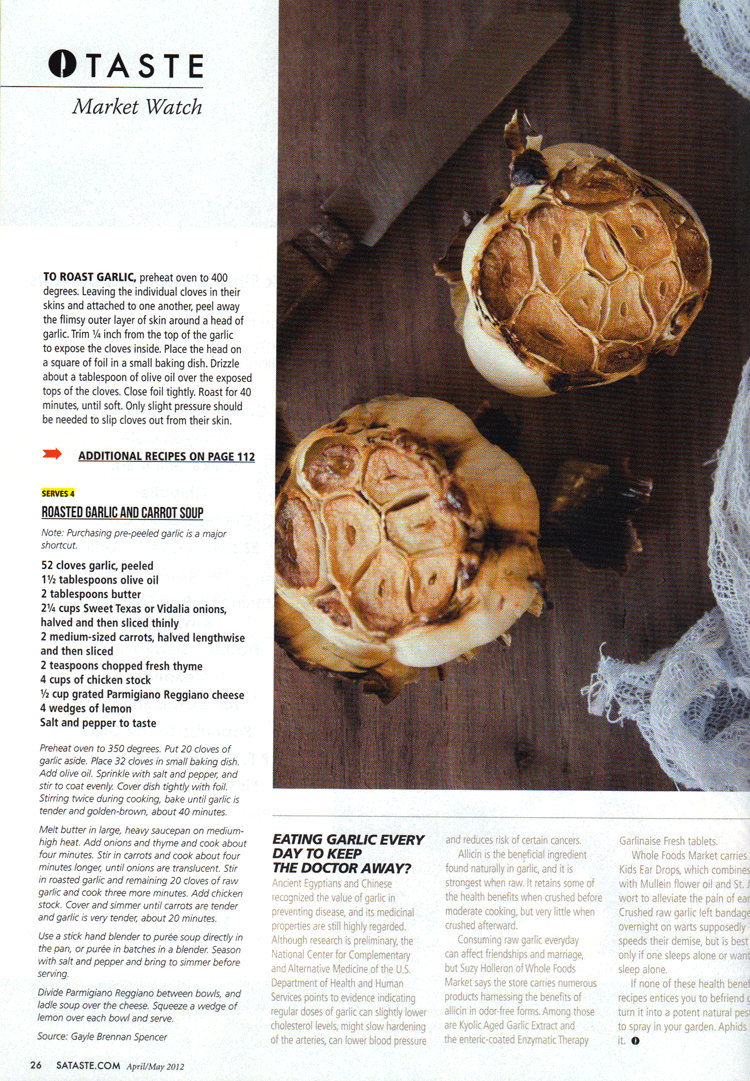
garlic goes topless

I’m sure my feature on garlic would have been the magazine’s cover story if the garlic had not posed topless. The editors probably feared highlighting such a steamy topic would mean some outlets would require a brown paper outer wrapper or only be willing to sell the magazine from under the counter.

Note added on April 10, 2012: Totally missed that April is National Garlic Month.

Grandma’s rusks refuse to be rushed…

This description of a treasured recipe handed down to husband Lamar was published in the 2012 February-March issue of San Antonio Taste Magazine as part of a feature article I wrote on artisan breads:

This slideshow requires JavaScript.

Grandma – my husband Lamar’s grandmother, Virginia Lamar Hornor (1895-1988) – always claimed the secret to her rusks was her ancient gas Chamberlain stove. The recipe she used was handed down through the Lamar family as they migrated from Georgia to Mexico to try to earn a living in the decades after the Civil War.

The best guess for the origins of this rustic bread is that shortages of white flour during the war led to a more creative use of graham flour, a version of whole wheat. While born out of necessity, the recipe remains a family favorite for its taste, probably boosted by a heavy dash of sentimentality.

To me, and perhaps to Lamar’s mother as well who declined to tackle it, the recipe is hardly one at all. What is “enough” graham flour? Four cups? Six cups? What kind of “sponge?” How much white flour is “sufficient?”

But Lamar gamely picked up the tradition where Grandma left off. Through the years, he has developed some rather picky (my word) rules about preparation and ingredients; although I admit they enhance the flavor.

A yeast cake yields better results than dry yeast, and we finally have been able to find the cakes in the refrigerator section of Central Market. We have switched to King Arthur Premium 100% Whole Wheat Flour because its texture and flavor more closely mimics the harder, if not impossible, to find graham than standard, more finely ground whole wheat flours. And it must be freshly purchased; no matter if the canister is already full.

The nutmeg must be freshly grated, again for texture and taste. Early efforts to grate the hard kernel almost always resulted in blood, but I recently purchased a new one at Melissa Guerra’s at Pearl that offers ample protection for the fingers.

All mixing and kneading is done by hand because the only way to determine when the proportions are correct is by feel.

Warning: Rusks refuse to rise when rushed. Even when preparing for an evening meal, they should be covered and set out the night before for the first rise.

How this banker by day, baker by night knows how much flour or water to add when defies my understanding. I’ve decided it is an inbred bread sense, similar to the way he plays the guitar by ear. I don’t have it, but should you, this recipe could become a treasured one for your family as well.

Are analogies full of holes, or are there just too many holes in my head?

As someone who writes, this is a confession I should probably not make. But here it is: I have major problems with analogies.  

I don’t mean the kind on verbal college admission tests, such as this:

Butterfly is to caterpillar as frog is to:

A. fish     B. amphibian     C. tadpole     D. toad

I can follow that logic easily. And I have learned not to get overly distracted by the imagery in commonplace idioms such as “raining cats and dogs.” Well, almost.

But I am talking about speakers who use long-winded analogies. By the time the speaker returns to the original point, they have lost me completely. I am concentrating solely on the analogy.

And I am referring to advertising as well. Generally, I am not subjected to much television advertising. The fast-forward button is extremely effective in eliminating it.

But, while working out at the gym, I have no such option. Which brings me to Swiss cheese, and the holes in it.

Some branch of Humana, I’d tell you which but it escapes me, is running an adverstisement focusing on three wedges of Swiss cheese. Some man keeps telling me to buy the cheese on the left, representing some Humana product with no holes in its coverage. But that cheese looks like flavorless baby Swiss cheese. I really prefer the cheese on the right with big holes on it. For some reason, I have always thought holey cheese tasted better than namby-pamby baby Swiss. I know logically the holes themselves have no flavor, but the cheese around them does.

Surely Humana has focus groups, so I guess I’m the only one who can’t fathom the wisdom of the analogy. All they have accomplished is sending me to the refrigerator to slice some Jarlsberg and exam its holes.

Maybe that is the whole point. Maybe the advertisement actually is extremely clever product placement by the Dairy Council?