
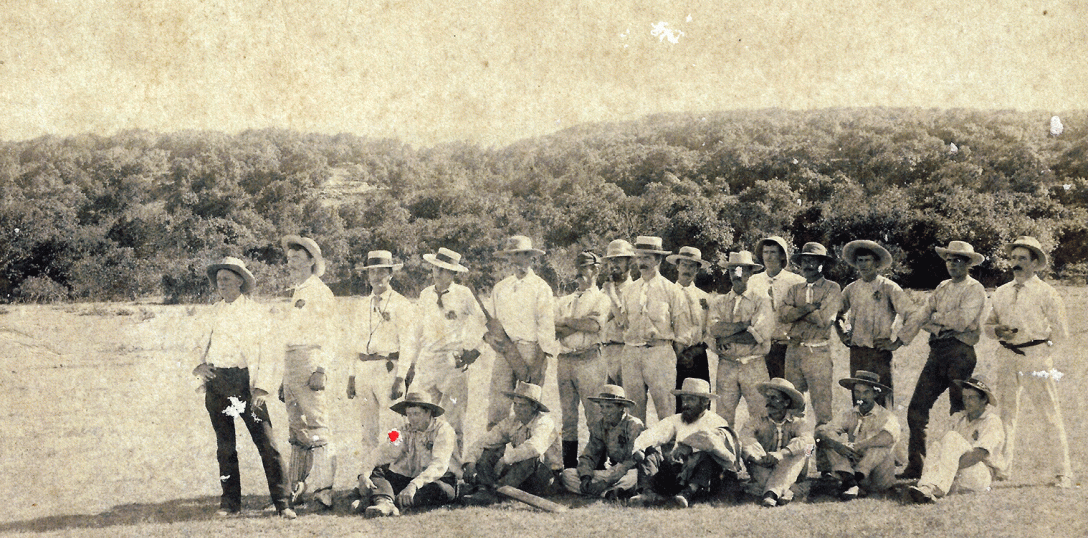
Cricket players on the sideline in the Texas Hill Country
When the family of John Howard Howard (1834-1894), obviously serious about being Howards, emigrated from England to Texas about 1885, they brought many of their British customs with them. The family of ten lived in Galveston briefly before settling into what they called their “cottage” on the more than 300-acre Ten Oak Hill Ranche (Yes, that’s the way they spelled it.). Their property was on the Cibolo next to the Herff family ranch, south of Boerne on what is now the Old San Antonio Road.
The Howards found there were enough British ex-pats living in the Hill Country to scare up cricket and polo matches. A picnic out in the countryside under the trees was civilized to the point that Fanny D’Argent Howard (1841-1919) poured hot tea into china cups with saucers. Daughter Eleanor Pratt Howard (Burt) (1876-1975) retained refined manners to ride sidesaddle.
John Howard Howard left Fanny a widow in 1894, which made him the first resident of the family cemetery which was the subject of a blog several years ago. With his death, the journals for the Ten Oak Hill Ranche indicate Fitz-Alan Forester Howard (1878-1956) took over the business end of running the “ranche,” at least until he married the Mister’s great aunt, Minnie Knox Spencer (1883-1972) in the mid-teens.
A box of photographs made it from Minnie to the Mister’s father, George Hutchings Spencer, and eventually to us, and self-quarantine-times led me to tackle it. I was hoping for photos of Minnie, the lover of goats more than people whom I was deprived of meeting by not entering the family until three years after her death. But, alas, no Minnie photos.
At least that is my best guess. Aside from the formal portraits taken prior to the Howards’ departure from England, almost none of the subjects are identified. All eight children are represented by headstones (if not actual remains) in the Howard Cemetery though, so I undertook to try to determine who was who and encountered several family tragedies along the way.


The youngest of the Howard clan, Marion Kathleen (1880-1899), joined her father way too soon. Marion was enrolled in classes in Galveston Business College in 1899. Two weeks after her 19th birthday, a treacherous undercurrent off an old jetty at the foot of Broadway dragged Marion and two other young women to their deaths.
While John (Jack) Simpson Howard (1871-1913) had tempted fate by signing up with the Rough Riders to join Teddy Roosevelt in the charge of San Juan Hill in Cuba, it was another brother who first fell while in the service. West Point-trained, Thomas Ferrers Howard (1874-1903) transferred from the 2nd Cavalry to the 7th in June 1898, possibly just in time to participate in the Battle of San Juan Hill on July 1. He was retired as a Lieutenant in September 1899 due to disabilities incurred in the line of duty. He remained in St. Louis, Missouri, until his death at age 28, possibly from those injuries.
But back to Jack. The Customs Service of the Department of Treasury hired Jack as a mounted inspector scouting the Rio Grande for smugglers of livestock. In West Texas, he met and married Mary Mason Kilpatrick (1882-1970) in 1907. The couple had two young daughters in Candelaria. Mary must have lived in constant fear every time Jack rode off to work based on the dangerous entanglements confronting him she described in an April 2013 letter to her brother-in-law, (Fitz-)Alan Howard. Bandits from across the border would steal cattle and alter their brands in remote mountain areas.
In February of 1913, Jack, a former Texas Ranger and a brand inspector for the Cattlemen’s Association captured Francisco “Chico” Cano near Pilares. Cano and his gang were well known as smugglers of horses and mules. Jack was in front as the men and their prisoner rode single file through a deep ravine. Protected by boulders above, five or six men, including two of Cano’s brothers, ambushed the men, shooting Jack and his horse from under him. Cano fled with his rescuers, leaving behind the three wounded officials. Help did not arrive for 15 hours. Jack lingered from his wounds for more than two days in Pilares, allowing Mary time to be by his side. The San Antonio Express reported the sniper who shot Jack had used a soft-nosed bullet, which split after striking him, causing extensive internal damage in his lungs and throat. The internal hemorrhaging could not be stopped.
Other family members fared better. Frances Edith Howard (1866-1952) remained single, the primary occupant of Ten Oak Hill Cottage. James Hammet Howard (1867-1956) managed mines in the state of Jalisco, Mexico, where he married Maria Ignacia Martinez (1876-1953). Brother William D’Argent Howard (1869-1953) found Guadalajara to his liking as well, investing in two houses there, and serving as Assistant General Manager of Amparo Mining Company under James. Upon his retirement, he joined Edith at Ten Oak Hill Cottage.
While visiting her brothers in Guadalajara, Eleanor Pratt Howard was introduced to a New York-born businessman, John Lucius Burt (1868-1955). Up until his death, the couple lived in Guadalajara, San Antonio and Los Angeles. Eleanor outlived all her siblings, dying in Washington, D.C. in 1975. Perhaps she moved there to be close to her niece. Mary Ignacia Howard (1902-1988) was an opera singer who married a Russian-born concert pianist and composer, Basil Peter Toutorsky (1896-1989). The couple operated a music academy in their landmark Dupont Circle mansion, recently acquired by the Republic of Congo for use as its embassy.
Ten Oak Hill Cottage and the Howard Cemetery are now surrounded by mini-storage units of Ten Oaks Storage, 131 Old San Antonio Road. A portion of the former Ten Oak Hill Ranche is part of the Cibolo Preserve.
Note: This post will be updated if any relatives surface with better clues for identifying the Howard siblings.


 Postcards from Barton Springs