Footnoting historic fiction too cumbersome for me to handle

The historical novel requires an extra set of choices – what sources to consult, what shape to cut from the big picture – what to do when the evidence is missing or contradictory. Most of these choices are invisible to the reader. You must be able to justify your decisions to the well-informed. But you will not satisfy everyone. The historian will always wonder why you left certain things out, while the literary critic will wonder why you put them in. “Because I could” is not a good reason.

“Can These Bones Live?,”  Dame Hilary Mantel, Reith Lecture, BBC Radio, June 24, 2017, The Spectator

How to handle historic fiction. I’ve received all kinds of advice and foolishly continue to reject most of it as too cumbersome.

Recently, a published author told me I needed to classify my novel about Hedda Burgemeister, the woman who shot Otto Koehler more than a century ago in San Antonio, as creative nonfiction. Her approach to citing references, accepted for print as mine might not be, is that, as the lead characters once lived, everything in the book must be footnoted. Meticulously. She also added that everyone’s names must be changed – both to protect the innocent and to protect oneself from lawsuits.

Well, the names in An Ostrich Plume Hat need to stay put because of the very fact they belonged to real people. But I admit, this is just one of Gayle’s new rules.

As for footnotes? I recently completed a manuscript about the Coker Settlement – nonfiction – with hundreds upon hundreds of numbered, well-documented endnotes. It almost killed me. And I’m quite far into writing this unfootnoted novel upon which I have been working for more than a decade as time allowed.

Last week, my solution hit me. Will Cuppy. A few years ago, blogger Bluebird Blvd introduced me to his The Decline and Fall of Practically Everybody. Cuppy wrote about real people. With great artistic license taken. He footnoted his text, but certainly not according to the Chicago Manual for Style. In fact, Cuppy’s footnotes are a pleasure to read and contain some of his most amusing lines.

So I have decided to tread water instead of drowning in footnotes. I’m electing to float somewhere between Cuppy and the Chicago Manual.

I’m creating Gayle’s own rules for documenting historic fiction with unnumbered endnotes. This requires me to honestly identify what is true, what is unknown and what is invented for the sake of the story. This is particularly important in cases where I violate Dame Mantel’s “Because I could” mantra from above.

As of now, Gayle’s rules for endnotes are somewhat fluid, evolving as I strive for consistency. I want to establish credibility with the reader.

Chapter Three’s endnotes include this:

Please pay attention to spare me from typing portions of the following over and over: Resemblance to actual persons, no longer living, locales and events is far from coincidental. For the majority of characters, almost everything included about them was reported in print during their lifetimes. If some of these so-called facts are gleaned from fake news, please direct libelous claims to the appropriate publishers of more than a century ago.

I hope you will go review and evaluate my approach to documenting the first three chapters.

Let me know if you think Gayle’s rules will fly. I need advice and value yours, but please don’t be offended if I am too damn hardheaded to listen to it.

Struggling and longing to be ‘fictionalized’

deer


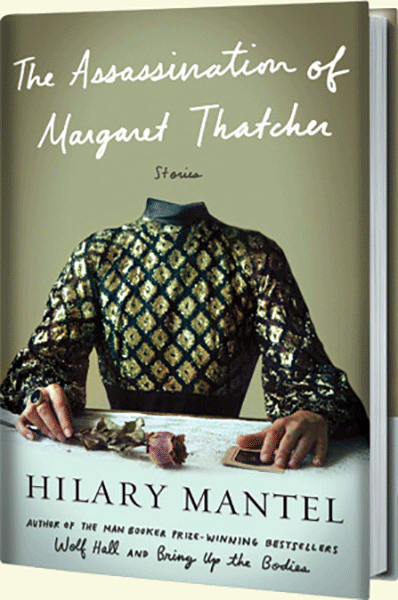
So can identify with the whining of the main character in “How Shall I Know You,” a short story in Hilary Mantel‘s The Assassination of Margaret Thatcher.

The woman is an author who has been “struggling with a biography” for several years.

As a biographer I was more than usually inefficient in untangling my subject’s accursed genealogy. I mixed up Aunt Virginie with the one who married the Mexican, and spent a whole hour with a churning stomach, thinking that all my dates were wrong and believing that my whole Chapter Two would have to be reworked.

Why, I can out-whine her any day. I have a whole cemetery I’m trying to untangle, and I’m sure I’m at least three years into it. And it is filled with a multitude of Smiths and Joneses and Cokers, many of whom inconsiderately passed down the same first names over and over. The Joneses prove particularly difficult, as they originate from two completely unrelated lines, or unrelated for quite a while before the Texas Revolution and not again until some time later.

And she only spent “a whole hour” thinking everything was awry? That’s nothing.

The author in the short story finds writing the truth, when it has to be uncovered, difficult.

I seemed to be pining for those three short early novels, and their brittle personnel. I felt a wish to be fictionalized.

Making up things does seem much easier than digging up facts long-buried. Often I want to just linger in the tub imagining different lives among all of those Coker descendants. The writer in “How Shall I Know You” does just that. She starts typing up exciting invented versions of the lives of Aunt Virginie and the Mexican, completely avoiding the facts associated with the original subject of the biography.

But, unfortunately, you just can’t make this stuff up.

And, I know I don’t need to.

The Coker Cemetery is fertile with true tales that should be passed on to the descendants of the residents resting there.

I’ve made it through the Texas Revolution, the arrival of German and Hungarian settlers and the Civil War. I’m getting there. Slowly.

Each nugget I discover is rewarding. In addition to the everyday stories of hardworking dairy farmers, there is a surprising bit of murder and mayhem to entertain me.

All I need is patience. And an extremely large dose of it.

the-assassination-of-margaret-thatcherWait a minute. Wolf Hall. Bring Up the Bodies.

The author of the author in the short story is the ultimate award-winning, best-selling researcher.

All whining privileges on my part are hereby revoked.

Twitteral translations: Does a rose in a tweet smell as sweet?

@OedipusGothplex 2bornt2b? Can one tweet beyond the mental coil?

Tweet based on William Shakespeare’s Hamlet as translated in Twitterature

All that time wasted in high school. Struggling through the purgatory of Milton’s Paradise Lost. And those Shakespeare plays, one after another. All those sexual innuendos eighth graders would love if they were not penned in an obscure archaic tongue.

Top those off with Melville’s Moby Dick. Actually, I was pretty impressed with Melville. In fact, he was such a good writer, he even managed to make whale hunting fascinating. But, he did go on and on. And on and on. Completion would have interfered with my telephone time, of utmost importance at that stage in life. Midway through I was desperate. I finally invoked the every-fifth-chapter approach. Amazingly, employing this arbitrary and brutal form of editing allowed me to follow the plot enough to regurgitate meaty, quasi-intelligent answers to Mrs. Masterson’s dreadfully detail-demanding discussion questions.

Why, oh why, wasn’t Twitterature available then? So concise, condensed to a point no slicing-and-dicing editor at Readers’s Digest could have imagined. Written in language high school students can comprehend.

cards@AliceInTheSkyWithDiamonds This land is terrorized by the Queen of Hearts. She’s a card. Wouldn’t it be funny if I just destroyed her army by shuffling them?

Tweet based on Lewis Carroll’s Alice’s Adventures in Wonderland as translated in Twitterature

For the old-fashioned, tweets come across as texts on your cellphones. Each tweet an author chirps – including the identifying “from” name as in @OediupusGothplex – cannot contain more than 140 characters. And that’s counting punctuation and spaces. This extreme brevity means they can be scrolled through rapidly, unlike the unabridged Moby Dick.

@EarlyBloomer69 All his intello friends are coming over all the time. Borrrrrring. All they do is talk about books.

Tweet based on D.H. Lawrence’s Lady Chatterley’s Lover as translated in Twitterature

Imagine, each assigned tome compressed into a mere 20 tweets or less. The book’s editor at Viking/Penguin, Will Hammond wrote:

Say the word Twitter to a book lover and they will probably roll their eyes at you and sigh. Some of the greatest works of literature… are long, sometimes difficult and often challenging. Twitter is the opposite: a free-for-all of voices clamouring for a split-second’s attention with zero quality control. This is what makes Twitterature so funny: huge books made ridiculously small; great stories told in silly voices. Like all good pastiche, Twitterature skewers the original work with pin-point accuracy – mocking its grandiosity, exposing absurd coincidences of plotting, parodying its subject’s ticks, slips and oddities.

twitteratureTwitterature is not new. It was written by two University of Chicago students, @AcimanandRensin, or Alexander Aciman and Emmett Rensin, in 2009. The book was written so long ago even @AcimanandRensin no longer tweets about it.

But I’m a little slow in discovering it, probably because I didn’t start tweeting for clients until three years ago. A fellow blogger tweeted about the book from London only this morning. And, now, able to comprehend tweet-speak at this late point in my career, I am appreciative of the humor. Coupled with Will Cuppy’s versions of history found in The Decline and Fall of Practically Everybody to which Bluebird led me, my academic path and my grade-point average would have been impacted radically.

@TheRealDesperateHousewife My life is awful. I’m going shopping. I want to buy a whole bunch on credit that I can’t afford, and then declare bankruptcy.

Tweet based on Gustave Flaubert’s Madame Bovary as translated in Twitterature

Can’t believe I waded through the whole thing in French. A Twitteral translation would have made it so easy.

You might wonder, if I’m so social-media proficient now, why am I blogging about Twitterature instead of tweeting? Restricting my fingers to 140 characters is work. Blogging allows me the recreational therapy of being loose-finger-tipped. The above paragraphs would add up to way more tweets than Twitterature‘s entire version of Moby Dick.

The authors of Twitterature were considerate enough of those unaccustomed to the tweet language to generally write in complete words and sentences with few of the widely accepted Twitter shortcuts, and they actually grasp the literature they harpoon. According to Hammond:

…what makes this little collection particularly enjoyable, is that the joke falls just as heavily (well, probably more so) on Twitter. In a face-off between Shakespeare’s Macbeth and his Twitter avatar ‘BigMac’, it’s fairly clear who comes off looking worse. So, in a curious way, Twitterature is just as much a celebration of the classics as it is a mockery of them.

Do you think @AcimanandRensin composed the entire volume of Twitterature on their cellphones?