‘Nothing Happened’ a Good Omen

Writing historical fiction about a time prior to your birth is tricky.  I spend a lot of time rummaging through newspapers from the 19-teens, trying to understand as much as possible about what life was like during this period from which no reliable witnesses remain.  A few months ago, one of the characters in my never-ending novel borrowed several biting definitions from Ambrose Bierce’s The Devil’s Dictionary (1911) to compose a letter to a friend. 

So I loved it when Jake Silverstein started talking about his quixotic quest to discover what happened to Bierce during a recent reading from his “chronicle in fact and fiction,” Nothing Happened and Then It Did, at The Twig Book Shop.  This search for a sensational storyline, among others in his book with chapters alternating between fact and fiction, did not end as Silverstein had hoped.  During her introduction of Silverstein at The Twig, Jan Jarboe Russell described the book’s theme as “thwarted ambition,” even though its author, editor of Texas Monthly, seemingly would be unacquainted with failure.

Silverstein’s early approach to finding topics magazine editors would deem worthy of publishing was unusual:

One day I unfolded a map of Mexico and looked for a place to live…. I had the notion that it would be good, both financiallly and journalistically, to live someplace where there was nothing happening.  That way, when something did happen, there would be no one but me to write about it.

In Nothing Happened, the author wandered from one potential feature story to another, with none materializing as planned.  But his book itself stands as proof; the stories were there all along. 

There is always a story (Although readers of my blog might suggest I rethink this theory.).  The story might not meet a writer’s preconceptions, but it is there nevertheless, an omen as defined by Bierce:

OMEN, n. A sign that something will happen if nothing happens.

The story sometimes is merely dormant, waiting to be awakened by an author, who is, as Silverstein wrote in his introduction, willing to permit:

…the real to mingle with the imagined, as it does in the deserted labyrinth of the mind.

Silverstein’s first book is a good omen (as defined by Merriam-Webster not Bierce) of writings yet to come and for Texas Monthly, where he can bedevil reporters with assignments to uncover memorable stories where, at first glance, there are seemingly none.   Don’t let any of them remain untold, like Bierce’s death, “reductus in pulvis” (pulverem) (RIP as defined in The Devil’s Dictionary).

Note Added on June 1Interview with Jake Silverstein

Barbara Ras’ ‘Elephant’ in ‘New Yorker’

Barbara Ras, director of Trinity University Press, has one of her poems featured in the March 15 issue of The New Yorker:

Washing the Elephant

by Barbara Ras, March 15, 2010

Isn’t it always the heart that wants to wash
the elephant, begging the body to do it
with soap and water, a ladder, hands,
in tree shade big enough for the vast savannas
of your sadness, the strangler fig of your guilt,
the cratered full moon’s light fuelling
the windy spooling memory of elephant?

What if Father Quinn had said, “Of course you’ll recognize
your parents in Heaven,” instead of
“Being one with God will make your mother and father
pointless.” That was back when I was young enough
to love them absolutely though still fear for their place
in Heaven, imagining their souls like sponges full
of something resembling street water after rain.

Still my mother sent me every Saturday to confess,
to wring the sins out of my small baffled soul, and I made up lies
about lying, disobeying, chewing gum in church, to offer them
as carefully as I handed over the knotted handkerchief of coins
to the grocer when my mother sent me for a loaf of Wonder,
Land of Lakes, and two Camels.

If guilt is the damage of childhood, then eros is the fall of adolescence.
Or the fall begins there, and never ends, desire after desire parading
through a lifetime like the Ringling Brothers elephants
made to walk through the Queens-Midtown Tunnel
and down Thirty-fourth Street to the Garden.
So much of our desire like their bulky, shadowy walking
after midnight, exiled from the wild and destined
for a circus with its tawdry gaudiness, its unspoken pathos.

It takes more than half a century to figure out who they were,
the few real loves-of-your-life, and how much of the rest—
the mad breaking-heart stickiness—falls away, slowly,
unnoticed, the way you lose your taste for things
like popsicles unthinkingly.
And though dailiness may have no place
for the ones who have etched themselves in the laugh lines
and frown lines on the face that’s harder and harder
to claim as your own, often one love-of-your-life
will appear in a dream, arriving
with the weight and certitude of an elephant,
and it’s always the heart that wants to go out and wash
the huge mysteriousness of what they meant, those memories
that have only memories to feed them, and only you to keep them clean.

Barbara, who will publish a collection of poems, The Last Skin, later this month, also had a poem appear in The New Yorker in 2006.  She will be one of the more than 20 writers in the spotlight for Wordworkers, an exhibit opening at Bihl Haus Arts from 5:30 to 8:30 p.m. on Friday, March 19.   During the opening, poets photographed by Melanie Rush Davis “will scrawl their poetry on gallery walls.” 

Other featured writers include Carmen Tafolla, Marian Haddad, Naomi Shihab Nye, Sandra Cisneros, Nan Cuba, Rosemary Catacalos, Jenny Browne, John Phillip Santos and Bryce Milligan.  As the exhibition at Bihl Haus continues, there will be a reading and small press book fair from 1 to 4 p.m. on Saturday, March 27, and a poetry reading by Jim LaVilla-Havelin from 7 to 9 p.m. on Thursday, April 8.  Bihl Haus Arts is located at 2803 Fredericksburg Road.

Barbara’s “Washing the Elephant” brought forth memories of the weekly visits to the confessional that forced me, as well, to make up imaginary sins to tell the rigid Father Habit at Star of the Sea.

Note Added on May 9Review of “Washing the Elephant” and Ras’ The Last Skin

Update on November 5:  Barbara Ras will discuss The Last Skin at The Twig Book Shop at Pearl Brewery from 3 to 5 p.m. on Sunday, November 14.

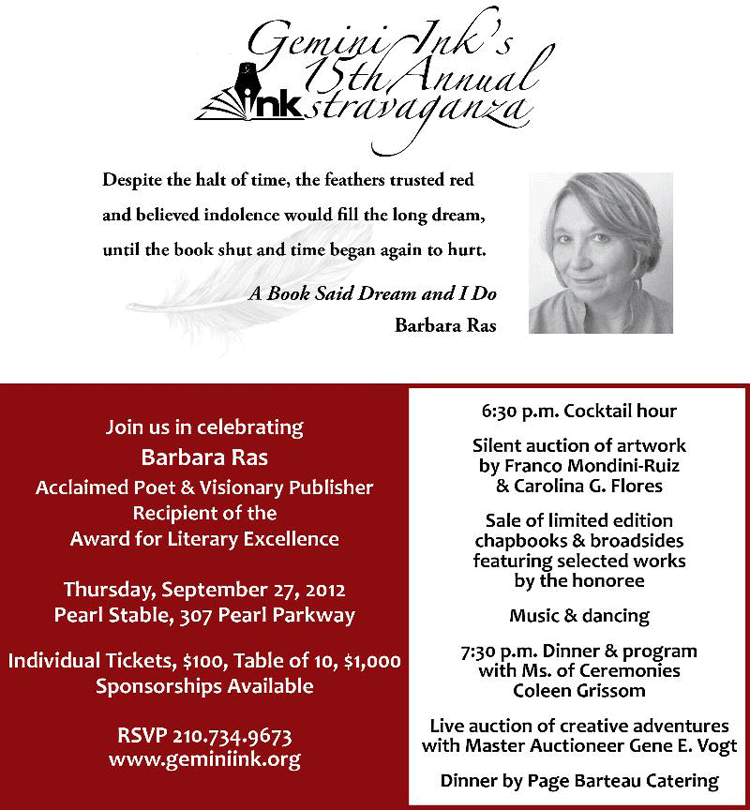
Update on September 11, 2012: Gemini Ink is honoring Barbara Ras at its 15th Annual Inkstravaganza at Pearl on Thursday, September 27, and one should never miss an opportunity to hear the utterances emitted by Coleen Grissom.