The Tragic Rule of Maximilian and Carlota in Mexico

Empress Carlota and Emperor Maximilian of Mexico, circa 1864, from the Lusher Collection and included in exhibit at the Witte Museum February 1 through March 30

City of Mexico, Thursday, Jan. 10, 3 p.m., 1867 – Yesterday morning Col. Paulino Gomez Lanadrid, commanding 700 reinforcements of Imperial troops sent to succor the besieged garrison at Cuernavaca, was killed near that place during an attack by a body of Liberals, who were lying in ambuscade….

More than 500 families, mostly Mochos and French, will leave here on the 20th with 4,000 French troops….

Maximilian is waiting for the last French soldier to leave. The shadow of the last of the expeditionary corps will not be lost sight of by the Archduke, who is now residing in a humble house between here and the Castle of Chapultepec.

The New York Times

And so, Maximilian, the falling emperor of Mexico, awaited his fate.

"Execution of Emperor Maximilian of Mexico" by Edouard Manet, 1868
“Execution of Emperor Maximilian of Mexico” by Edouard Manet, 1868 (not part of exhibit at the Witte)

The French installation of the Archduke Maximilian and his Belgian-born wife Charlotte to reign over the politically unstable Mexico of 1864 was bound not to end well. But the story is a rich one of international intrigue on both sides of the Atlantic.

m-and-c-galley-coverAs Trinity University Press prepares to release Maximilian and Carlota: Europe’s Last Empire in Mexico by Mary Margaret McAllen, the Witte Museum is opening a companion exhibit, “Maximilian and Carlota: Last Empire in Mexico,” focusing on the fascinating lives of the ill-fated royal couple. The exhibit of portraits, photographs and artifacts opens on February 1, while the author will read from her book and be available to sign copies during a reception from 4 to 6 p.m. on Saturday, February 8, at The Twig Book Shop.

Fell in love a few year’s ago with C.M. Mayo’s masterful novel, The Last Prince of the Mexico Empire, focusing on a child caught up in the political turmoil – Principe Agustin de Iturbide y Green. A Library Journal review in 2009 perhaps summarizes the complexities involved most succinctly:

Once upon a time, there was a little half-American boy who briefly became heir to the Mexican throne—until his distraught parents sued the doomed Emperor Maximilian for his return.

I highly recommend Mayo’s book, and am looking forward to reading McAllen’s. And if these and the exhibit leave you thirsting for even more glimpses into the lives of Maximilian and Carlota, Mayo maintains an ongoing blog Maximilian ~ Carlota, described as “resources for researchers of the tumultuous period of Mexican history known as the Second Empire, or ‘French Intervention.'”

I’m hoping one of the two authors will suddenly contact me with a sliver of information (a very unlikely record to stumble upon, so am certainly not holding my breath) about a San Antonio connection to the royal rulers. Among the Austro-Hungarians enlisted to serve in support of their reign in Mexico was Baron George Ritter von Tomasini (1818-1912). As the Second Empire of Mexico collapsed, Tomasini and his wife made their way to New Orleans and to San Antonio by 1872. Here, they joined the community of dairy farmers at the Coker Settlement, about which I am writing a book for the Coker Cemetery Association. Geographically, the heart of the Tomasini farm was located where the cluster of shops and restaurants known as The Alley on Bitters are found today.

Eva and George Tomasini, photo from www.thealleyonbitters.com
Eva and George Tomasini, photo from http://www.thealleyonbitters.com

February 3, 2014, Update: Read Steve Bennett’s review of McAllen’s book in the San Antonio Express-News

March 19, 2014, Update: David Martin Davies will moderate a discussion with McAllen from 10 to 10:45 a.m. in the Story Room on the 3rd floor of the Central Library during the San Antonio Book Festival on Saturday, April 5.

January 5, 2016, Update: C.M. Mayo has posted a podcast of a conversation with McAllen recorded in The Twig in October 2015.

An Intimidating Week to Release a Book

The week started off with the head of Trinity Press, Barbara Ras, reading from The Last Skin at The Twig Book Shop.  Then there was the San Antonio Public Library Foundation’s spectacular Copyright Texas Dinner last night featuring the dynamic Carl Hiaasen.  His Star Island is populated with celebrities and paparazzi; there are drugs, sex and the excitement of a kidnapping.  Hiaasen’s book even has a sensational trailer. 

The stimulating journals of Anita Brenner, a young American Bohemian living in Mexico City amongst artists such as Frida and Diego, will be unveiled at the Instituto de Mexico in HemisFair Park at 6 p.m. on Thursday, November 18, and then Saturday brings David Sedaris to town.

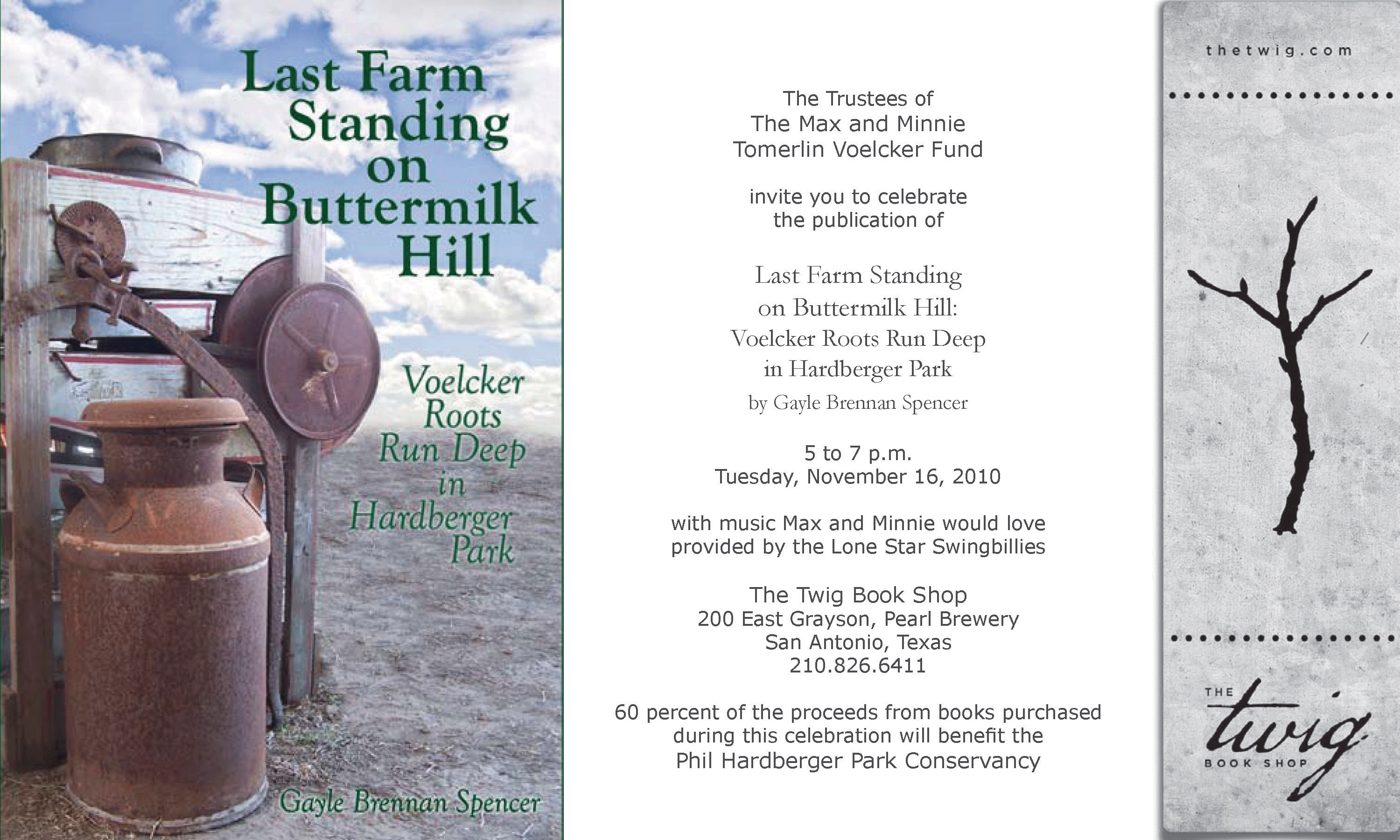
With so many important literary events this week, how can I possibly convince you to come out to The Twig at 5 p.m. tonight to celebrate the publishing of Last Farm Standing on Buttermilk Hill: Voelcker Roots Run Deep in Hardberger Park – a book with no drugs, sex or celebrities? 

Think of it as an intervention.  How could you leave me there alone with a case of wine?  And how about the music of Hank Harrison and the Lone Star Swingbillies in full cowboy regalia and the opportunity to support the Phil Hardberger Park Conservancy? 

Minnie Tomerlin Voelcker certainly was no Cherry Pye, but that’s not a bad thing.  She was homegrown and reflects a part of our agricultural heritage we tend to forget. 

Hope to see you tonight at 5, or better call a cab for me.

Update on November 17:  Thanks to everyone who protected me by coming to share the wine!

The Max and Minnie Tomerlin Voelcker Fund is donating 60 percent of the cover price of books sold during the November 16 celebration at The Twig Book Store to the Phil Hardberger Park Conservancy, which kept the former mayor smiling. (photo by Kathy Babb)

Update on November 27:  “Urban Spotlight” blogger focuses on the celebration at The Twig….

Once upon a time, northern San Antonio was a land of dairies….

The Trustees of the Max and Minnie Tomerlin Voelcker Fund are hosting a celebration of the publication of The Last Farm Standing on Buttermilk Hill: Voelcker Roots Run Deep in Hardberger Park from 5 to 7 p.m. on Tuesday, November 16, at The Twig Book Shop, 200 East Grayson at Pearl Brewery.  Music Max and Minnie would have loved will be provided by the Lone Star Swingbillies.  During the event, 60 percent of any sales of the book will benefit the Phil Hardberger Park Conservancy.

Char Miller, W.M. Keck Professor of Environmental Analysis at Pomona College of Claremont, California, and author of Deep in the Heart of San Antonio: Land and Life in South Texas, wrote: “Few San Antonians remember Buttermilk Hill, but Gayle Spencer has recovered its significance through an intimate portrait of the dairy-farm families who once inhabited the rolling North Side terrain.  Only the Voelckers held out against encroaching sprawl, and the result is Hardberger Park, a verdant vestige of the city’s bucolic past.”

After the Texas Revolution, land grants from the Republic of Texas attracted new settlers to the outskirts of San Antonio.  The grandparents of Max and Minnie Tomerlin Voelcker were among those drawn by “gold” to a community known as the Coker Settlement, just north of today’s Loop 410 but, at the time, a full day’s round-trip by wagon on bumpy dirt roads. Unlike that of California, their gold was, first, the opportunity to produce golden butter and, later, the value of the land itself.

By the late 1800s, so many dairies dotted the countryside that the area became known as Buttermilk Hill.  Last Farm Standing on Buttermilk Hill traces the early migration to this community and the daily challenges faced by those who farmed the land.  Dairy farming involved rising before dawn to churn milk drawn the night before into butter, answering the twice-daily calls from cows in need of milking and driving long distances to deliver cream and butter to city-dwellers.  Life was not easy, and nature did not always cooperate.

Max and Minnie both were born on Buttermilk Hill and learned to milk cows almost as soon as they could walk.  With farming in their blood, they naturally married from within the Coker settlement.

As dairy farming became big business in Texas, small dairies no longer could compete.  But by then, the land itself was so valuable protracted court battles embroiled the Voelckers and their siblings, leaving permanent scars. San Antonio swallowed up one farm after another, until the Voelcker farm, part of which is Phil Hardberger Park, was the last one standing on Buttermilk Hill.

Update on November 9:  Unused, there are no remnants of cream glopped onto the back of this wonderful milk bottle cap Carolene dropped by my house.  She says (see her comment below) the Twilite Dairy was located out Blanco Road about a mile past Voelcker Lane.  That dairy on Buttermilk Hill, which no longer stands, had been owned by Josephine and Onis Lester Harrison (1910-1954), the son of Nancy Cordelia Tomerlin Harrison (1889-1962),  Minnie Voelcker’s half-sister.

Update on November 14Ed Conroy’s review in the Express-News is better written than the book itself.