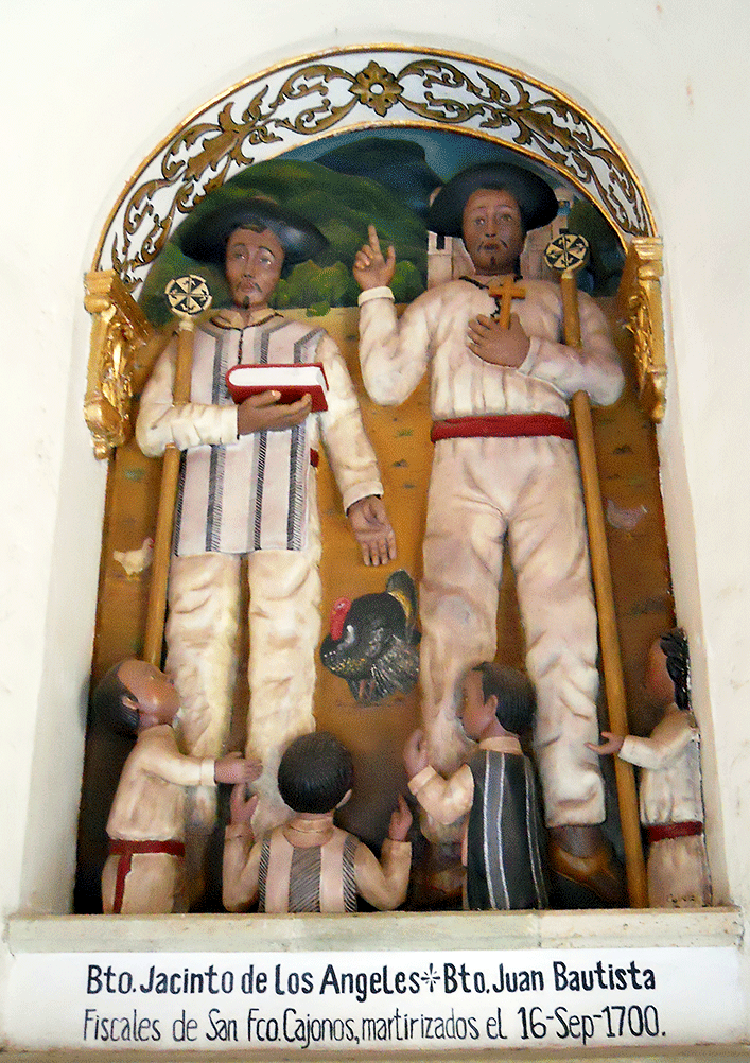
Holy card from Oaxaca, Mexico: Zapotecans in line for sainthood

DSCN2359

A long list is found on one of the walls of La Compania de Jesus Church in Oaxaca. A list of those waiting. Those whose lives in Mexico were so full of sacrifice Rome surely will notice and promote them on the road to sainthood.

I’m pulling for the child martyrs of Tlaxcala, the land of corn tortillas. Poor Christobalito, Antonio and Juan were, after all, children. Antonio and Juan were clubbed to death, but Christobalito’s own father, a confirmed pagan, condemned him to be beaten with clubs and then set ablaze for his faith. The trio was beatified by Pope John Paul II in 1990, but they hardly seem on the fast-track. They have been waiting in line a really, really, really long time. Ever since the late 1520s.

But in Oaxaca, a pair of Zapotecs stand out, although newcomers to the waiting list by comparison to the ninos above.

Back in 1700, Dominican priests in Oaxaca would commission converts to serve as “attorneys general,” assigned to police the purity and practices of those living in rural areas. Jacinto de los Angeles and Juan Bautista of San Francisco Cajonos, “the town in the clouds,” were so honored. Overhearing those worshipping the harvest god, Huitzilopochtli, talking about a clandestine evening gathering in his honor, the attorneys reported back to the Dominican friars. Intervention was planned, and Jacinto and Juan led a group to break up the idolatrous meet, seizing the men’s musical instruments.

Unfortunately for Jacinto and Juan, their Zapotec brethren did not take kindly to what they viewed as tattle-tale turncoat interference. A mob seized the two from the sheltering confines of the convent. The pair refused to recant their faith, even under torture.

They survived being thrown off Tanga Hill in the village of San Pedro, but clubs still were viewed as a popular way to deal with Christians anyway. The mob clubbed them and cut them with knives before cutting open their chests and feeding their hearts to the dogs. (I don’t make these things up. Read the Vatican’s version here.)

Whatever parts were left were gathered later by the faithful, who put them in the church of Villa Alta until 1889. The remains were moved to a chapel in the Cathedral of Oaxaca, a chapel almost always locked for their protection.

DSCN1067

A bad thing happened to what should be set aside as their day. Jacinto and Juan attained martyrdom on September 16, but, unfortunately, 110 years later Father Hidalgo absconded with their day on the calendar. His cry for independence from Spain changed what would be their feast day to Mexican Independence Day, a celebration far overshadowing their sacrifices.

But an exhausted-looking but determined Pope John Paul II rescued them from obscurity, beatifying them in 2002 as examples “of how, without regarding one’s ancestral customs as myths, one can reach God without renouncing one’s own culture but letting oneself be enlightened by the light of Christ, which renews the religious spirit of the best popular traditions.”

While their hearts probably wouldn’t be fed to the dogs, one wonders what kind of reception church spies would receive in someplace like San Juan Chamula today. “Hey, they are sacrificing chickens in your church.” “Hey, do you know that elder over there has four wives?” They would be so expelled from town.

But, the good part of this story is how Jacinto and Juan are revered in their hometown. Their stories didn’t rise up on the Vatican radar without help. A trio of maize and chickpea farmers championed their cause at the grassroots level. According to a story by Stephen Henderson in the Los Angeles Times, they researched the story at City Hall and then chronicled the testimonies of more than 30 locals who claimed prayers to Jacinto and Juan were answered with miracles. This represents 1/10 of the entire town.

The task took decades of dedication, but it paid off. A group of Cajonos proudly accompanied the glass-encased heartless remains of Jacinto and Juan to Mexico City for the papal ceremonies taking them one step closer to sainthood. Plus, the pair was given a new feast day of their own – September 18.


The Pope-blessed glass-encased relics can still be glimpsed sitting on the altar in that side chapel in the Cathedral of Oaxaca, a destination for Zapotecan pilgrims.

Postcard from San Juan Chamula, Chiapas, Mexico: Coke is for Everyone, Dead or Alive

Teaching “the world to sing in perfect harmony” might be great in many markets, even in Mexico.

But some niche markets are tougher to crack than others.

Take the residents of San Juan Chamula. Chamulans are so fiercely independent, they virtually are independent. Outsiders pay a toll to even enter the town.

Residents’ primary language is Tzotzil Mayan, and San Juan Chamula has its own laws (think legalized polygamy), syncretic religion (converts to Protestantism banished), police force and system of justice. Beribboned-hatted male judges solemnly gather on Sundays, perched prominently on a public plaza overlooking the market in front of the church. Disputes can be brought forward throughout the morning. At noon, court is adjourned with much pomp and ceremony, which, to an outsider, resembles one long game of musical chairs.

The Catholic Church seemingly has ceded the church to the shamans, or curanderos. Outsiders are, again, charged a fee to enter and are informed there is a strict ban on photography inside. Or, perhaps, you would like to go face those judges convened above the plaza?

San Juan, San Pedro and San Sebastian are among the most revered saints, but some of the statues of saints lining the walls have fared better than others under the stewardship of the leaders of the town’s unorthodox religious practices. Some, perhaps including even San Sebastian, were in the doghouse for a long time.

This slideshow requires JavaScript.

San Sebastian’s church on the outskirts of town burned a century or so ago, and the faithful logically questioned how much faith should be put in saints who fail to prevent the church that houses them from burning. So in punishment, the hands of the surviving statues were chopped off. The handless saints were brought into the church, but sentenced to spend years shamefully facing the wall. Their time in limbo has ended. They don’t get many tributes, but the saints whose potency was questioned are allowed to face the center of the church again and have robes with flowing sleeves disguising the earlier maiming and necklaces with mirrors to deflect evil spirits.

This church has no pews. The floor is blanketed with fresh pine needles, slippery on the marble floor underfoot. Fresh is key because worshippers line and light up rows of slender candles on the floor (Perhaps dry pine needles sparked the earlier fire?). The scent from the crushed needles mingles with smoking copal incense filling the interior. A primitive-sounding band plays somewhere deep inside, where a priest traditionally would preside.

Chanting shamans are performing cleansing ceremonies for groups of families perched in front of the appropriate saints. When not chanting or passing a live chicken over the subject, the shamans might be spitting on the floor, spitting around the subject to physically expel potential evil lurking within. In cases of severe need, the chicken is sacrificed by snapped neck. The shamans must be powerful because the hen I witnessed did not utter one clucked objection to the ceremony. Perhaps in part due to this cooperation, she was allowed to live.

Drinking posh, a strong cane liquor, is encouraged to loosen up one’s inhibitions that might prohibit communication of your soul with the saints (I know some of my friends might suddenly be thinking this is their kind of church.). Some of the townspeople seemed to take this particular practice to heart, appearing to have gotten an early morning start on their personal supplies of moonshine.

And then, there’s Coca-Cola.

One would think a people who have rejected so many standards held by outsiders would not consider taking even one sip of a Coca-Cola. But expelling evil spirits from the body is key. Spitting helps, but burping is best. And what is better at inducing burping than a few shots of rapidly consumed Coke. Posh alone cannot produce such splendid resonating results as Coke.

But, what marketing genius convinced the Chamulans a half-century ago to incorporate Coke into not only their Sunday church going regimen, but everyday life? I mean, Chamulans need to continually maintain their guard against those invasive evil spirits, burping them out on a regular basis.

And, whoever the lucky holder of the local bottling franchise is, really struck a home run with this. The market is larger than just the living. On Dia de los Muertos, even the dead are served Cokes to quench their parched throats from so much time spent underground and to burp away any evil spirits hanging around the cemetery.

Just think how large Coca-Cola’s market share would soar if this practice spread to the dead everywhere.

Coke should just forget trying to teach the world to sing. Teach the world to burp.

Coke is for everyone. Dead or alive. Para todos.

Note about the traditional hats worn by Chamulan men: While I have no photographs of the men holding court in San Juan Chamula, I am including a photo of an antique Chamulan hat we purchased in San Cristobal de las Casas more than 30 years ago. The contemporary hats men sport now appear unnaturally bright white. How can they keep them so clean? While the distinctive sombreros are still woven in a similar style, they are, surprisingly, woven from spools of white plastic instead of natural materials.