Justin Boyd: Squeezing a year’s worth of river meanderings neatly into a box

Sergio Gonzales and Randy Allee of KLRN on location filming Justin Boyd
Sergio Gonzales and Randy Allee of KLRN on location filming Justin Boyd

The river is an amazing resource.

Justin Boyd

How do you take the essence of something as sweeping as the Mission Reach of the San Antonio River and compress it into a to-go size box?

Artist Justin Boyd does this in a multimedia format incorporating sound and video recordings and natural and manmade found objects in “Days and Days,” an exhibit on display through February 10 at the Southwest School of Art.

Although not as immense as trying to condense a broad landscape into a small box in a gallery, I struggled with adjusting my writing style to a television format in collaborating with the crew at KLRN-TV for this piece for ARTS. Whittling and weaving Justin’s dialogue into a story presented difficult and complicated choices for me, and, in turn, for David Bibbs at KLRN.

Here’s the result on ARTS | January 18, 2013 on PBS.

Although our paths never had crossed, Justin and I walk the same stretch of river often. But he has added new layers to my thoughts – the river representing time and its passage – as I meander southward along the river’s banks.

While celebrating the restoration of the Mission Reach as part of the San Antonio Improvements Project, Justin’s art is conscious of the litter man continually discards:

The impact we have as humans on the landscape…. This impact is so heavy…. Manmade objects are sitting right next to natural objects….

When you are down here everyday, you can’t help but reflect on how we are affecting our landscape.

January 28, 2013, Update:

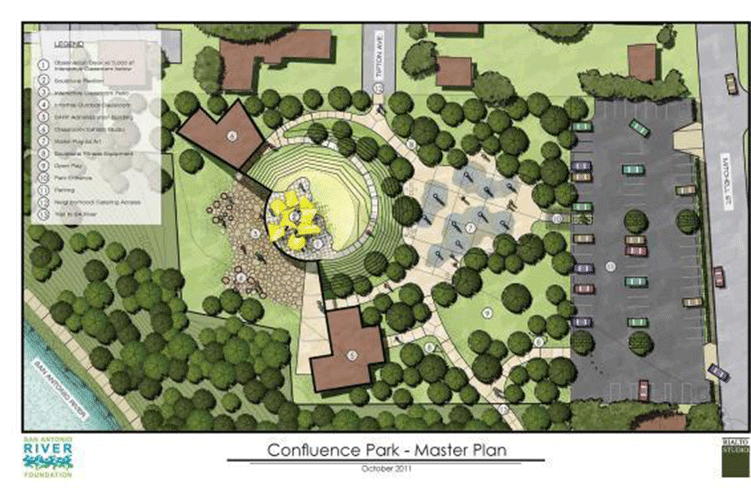
The photo above was shot at the point where the waters of San Pedro Creek (left) join the San Antonio River. The San Antonio River Foundation recently announced, according to the San Antonio Express-News, the commission of a pair of designers from the firm of Ball-Nogues Studio to design amenities for this point, to be known as Confluence Park:

With vague hopes of developing “some type of gathering place for the community,” the foundation spent about $300,000 on the park site several years ago and deeded it to SARA, said foundation executive director Estela Avery, wife of James Avery.

Plans gathered steam late last year, after Ball-Nogues Studio was invited to offer designs. The award-winning studio has created installations around the world that meld art and function, including works in California, New York, France, Italy and Hong Kong.

In recent months, designers Benjamin Ball and Gaston Nogues have collaborated with local water experts, botanists and others to create tentative concepts for the site at 310  W. Mitchell St.

“We’re working with an idea for a pavilion that will be enshrouded in vegetation, that’s also three windmills,” Ball said.

“We also have some features we’re calling ribbons, which are a man-made geology for the site. We’re trying to create some sense of discovery when you’re moving through the site so that you’re creating different vistas, different moments,” he said.

Added Nogues, “There’s going to be quite an extensive rainwater catchment system, which is going to mimic a cistern.”

Nogues appreciates the river restoration, noting that the Los Angeles River “suffered a similar fate” as the San Antonio River when its natural channel was lined with concrete decades ago. Most concrete has been removed here in the past few years during the river’s ecosystem restoration.

“It’s really an inspiration for what the Los Angeles River could become as  well,” Nogues said.

Foundation interim project manager Stuart Allen said design details are pending, but the park’s purpose is firm.

“We want this park to be a really unusual destination,” Allen said.

“It’s going to be a park geared toward teaching about ecosystems, sustainable living, water transport mechanisms and watersheds. The park will be designed around forms that collect water and direct them to an underground cistern. The water will be recirculated back into the park.”
confluence-parkl

Fundraising received a major boost from a gift of $1 million for an educational endowment fund from James and Estela Avery.

January 31, 2013, Update: Nancy Cook-Monroe writes about Confluence Park and the announcement of the Avery gift to the River Foundation:

This one, with a water catchment system, solar panels and windmills, will be all about teaching sustainability, stewardship and environmental science. Its centerpiece will be an artistically designed educational pavilion. Other elements will be laced with double meanings, such as a “foraging fence.”

“It doesn’t keep neighbors out but invites them to enjoy decorative and  edible plants,” said planning architect Gaston Nogues of Ball-Nogues Studio in Los Angeles.


River Improvements Continue Snaking Their Way South

A year ago, the stretch of river off of Mitchell by Boneshakers and the perch where G&G Bistro sometimes parks its food truck resembled a lunar landscape. Today, its stunning wildflowers would inspire an Onderdonk to pick up a brush.

Took a tour, a bit unofficial, of the next phase of the Mission Reach, scheduled to open in mid-June. With no landscaping yet, it appears stark. But the scale is so much greater than one is used to on the more urbanized portions of Paseo del Rio; the sweeping vistas are breathtaking even now.

The San Antonio River Authority is applying lessons learned from the earlier phases. Temporary drip irrigation hoses are installed, which should jumpstart seedlings quickly.

Like me, the water birds are impressed by the dramatic environmental improvements. Impatient, they already have staked out their islands and fishing turf well ahead of the restoration of the riparian plants on the banks.

Update posted on June 27, 2012: Donald Ewers shares some great photos of the happy inhabitants of the Mission Reach a year later….

As if they already don’t do enough: ‘Conserve Today and Secure for Tomorrow’

Didn’t need to get very far into a facebook “conversation” for Anne Thatcher Parrish to comprehend that I had flunked waterbird-watching 101, or actually never emerged from the kindergarten stage. Although she volunteers weekly to conduct nature tours for children at Mitchell Lake, Anne agreed to try to educate me in the environment where I walk in the mornings – along Eagleland and the Mission Reach of the San Antonio River.

First up, of course, were mallards. Then there was a double-crested cormorant, a broody-looking black one with a hooked bill who can hold his breath while fishing under water for an incredibly long time. A tall white egret searched for crawfish, while a great blue heron flew overhead.

Then we came upon a crowd that greatly multiplied the San Antonio River Authority’s normal work crew on the river’s banks. They appeared to be volunteers harvesting large quantities of invasive plant material near the water’s edge.

Then my favorite – the yellow-crowned night heron. Next a mature little blue heron (little actually being part of its name), and, just to try to confuse me, an immature one that had not turned blue-gray yet but was white.

More volunteers in a canoe fetching trash collected from a man in waders. A huge sheet of heavy black sheeting they pulled from the river was crumpled up next to discarded pairs of crawfish claws left on the egrets’ favorite breakfast table near the train tracks.

Can crawdads not see yellow? It seems as though the schoolbus-yellow feet of the wading snowy egrets would be hard to miss underwater. A sandpiper scurried by.

At a doughnut refueling station near Roosevelt Park, Anne asked the volunteers who they were. A woman answered enthusiastically they were from all branches of the Armed Forces in San Antonio, and this was how they were celebrating Earth Day. She said proudly:

This is our community, and we want to give back to it.

Of course, Earth Day is not actually until tomorrow, but the Air Force is proclaiming “Every day is Earth Day,” with this year’s theme as “Conserve today and secure for tomorrow.” The volunteers come from the Air Force Center for Engineering and the Environment, the Air Force Civil Engineer Support Agency, the Air Force Real Property and  502nd Air Base Wing.  They started celebrating by performing hard manual labor at San Pedro Park (photo) on April 1 and Memorial Park on April 14.

By the crayola footbridge, we encountered those with the roughest assignment wading and raking out large slimy swaths of oozing blooming green algae so thick a family of six little ducklings was easily walking across it.

Bob Moore, director of the Air Force Real Property Agency in San Antonio, told Texas Public Radio’s Eileen Pace it was a rewarding experience:

We were scraping some algae off, and a 12-inch long bass jumped right out of the water because we had scraped the algae underneath it. Ducks were coming in right behind us in the clean water and reclaiming the area we had just cleaned out.

On the way back, spied a pair of my second-favorite birds, not because of their shocking flourescent pink-orange bills and webbed feet but for their name. For some reason, it just makes me smile: black-bellied whistling ducks. Anne said that now I can even graduate to Mitchell Lake.

I don’t think I’d be misspeaking to extend thanks to all the volunteers from the Armed Forces on behalf of the birds. The egrets and herons probably all settled into their nests in the trees off of Alamo Street last night with such strong feelings of security they decided to expand their families. Their home, this river, keeps getting better and better.

Update on April 22, 2011: And the wildflowers are beautiful!