Shiny legacy from HemisFair hints at wealth of SAMA’s Asian Wing

A shiny hint heralding the wealth of Asian art housed in the Lenora and Walter F. Brown Asian Art Wing recently was installed across the river from the San Antonio Museum of Art.

Leiwen, the interwoven thunder pattern on the nine pewter panels, was popular on bronze vessels during the Shang Dynasty, 1800-1200 BCE. These particular panels were crafted for and installed in the Taiwanese Pavilion during HemisFair 1968.

This slideshow requires JavaScript.

May Lam donated 14 pairs of the rescued 3 x 1-foot panels to the San Antonio River Foundation during ceremonies at the Asian New Year Celebration more than five years ago. She wanted them to serve as a tribute to the rich cultural contributions of early Chinese immigrants to San Antonio, particularly the hundreds General John Pershing brought from Mexico as the United States entered World War I (I would include a photo of the adjacent panel explaining this and spare myself from typing, but I stubbornly refuse to reproduce materials failing to recognize “River Walk” as two words.).

While General Pershing was pursuing Pancho Villa in Mexico, Chinese businessmen had gathered around his encampments, operating stores and  cafés for his troops. When he returned to San Antonio in 1917, many of the Chinese retreated under his protection and were encamped at For Sam Houston until President Harding granted them legal resident status in 1921.

According to author Mel Brown in Chinese Heart of Texas, some of these new San Antonians, known as “Pershing Chinese,” were able to qualify as “merchants,” an exception to the 1882 Exclusion Act that deprived Chinese of many rights accorded other immigrants and banned additional Chinese immigration. 

Brown wrote: 

Following release from Fort Sam, a somewhat communal lifestyle was assumed at first as the Chinese Camp men stuck together for practical reasons and mutual assistance. If one of them had skills as a cook, the group contributed economically to help establish his café. As the business grew, that man hired his cronies or pitched in monetarily to set up another’s store or café…. This communal response to problems or needs was typical of the Chinese immigrant experience in America. It was a rich cultural resource which strengthened all the Cantonese communities during many years of prejudice, discrimination and exclusion. 

The Exclusion Act was not repealed until 1943.
‘1,2,3. What do you see?’ Too many toucans to count.

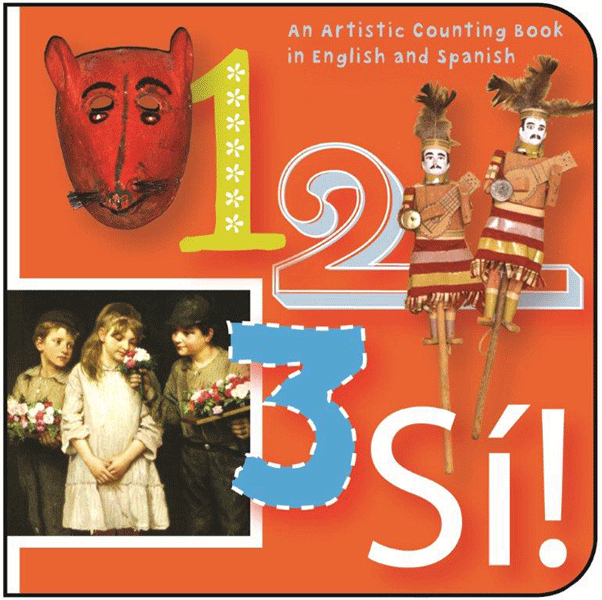
And the hardest part of counting must have been choosing what colorful images to include in 1, 2, 3, Sí! A Numbers Book in English and Spanish. The partners creating this new bilingual board book had to narrow down what to count from the immense holdings of the San Antonio Museum of Art.

Can’t imagine how they managed. And never have Pre-Columbian earthenware babies looked so appealing and downright ticklish, or a combination of images of eight animals from artisans of different centuries from five different countries seemed so logical.

With the assistance of many donors, the San Antonio Public Library Foundation provides the more than 25,000 babies born in Bexar County each year with their first books. Shortly after the newborns arrive, the books are delivered in the hospital to their parents in a Born To Read tote bag that also contains a Library card application and a map of branch locations throughout San Antonio.

Fluffy rabbit from "Pat the Bunny"

A baby’s first books are so important in starting a child off in the direction of a life-long love of learning. If a book is fun and appealing, a baby will want it read again and again. And again and again.

Our daughter wore out her first copy of Dorothy Kunhardt’s Pat the Bunny, but could not bear to be parted from it. We were forced to buy a second copy and perform countless more readings. Alas though, soon “Fuzzy Wuzzy had no hair.” We finally had to alter the words for the second over-petted rabbit to “Love the poor bald bunny,” foreshadowing her impending graduation to The Velveteen Rabbit.

The Library Foundation changes the books in the Born To Read bags every other year so families with more than one child receive different books. The idea to create a book based on the San Antonio Museum of Art’s collection was inspired by My First ABC.  Each letter in this bright board book is illustrated by a work of art drawn from the collection of the Metropolitan Museum of Art, from Paul Cezanne’s “Apples” to an X-shaped painting by Frank Stella.

The expertise of Trinity University Press was tapped to publish 1, 2, 3, Sí! The bright and colorful look of the book was designed by Madeleine Budnick, with photography by Peggy Tenison.

While promoting counting, bilingual literacy and art, 1, 2, 3, Sí! contains smaller-font hints for parents, grandparents, sibling and sitters to use the images for additional interaction. For example, the pages containing ten masks prompts “Which mask would you like to try on?,” with options including a rabbit mask from Mexico, a dog mask from Ecuador and a spirit figure from Papua New Guinea. A mesmerizing pair of eyes from an Egyptian coffin provides an opportunity for playing peek-a-boo.

Other suggestions for stimulating babies’ growing minds will be found in a companion activity booklet being designed by César Proa of Proa Design. Trinity University Press is creating a website – www.123-si.com – with ten related coloring and activity pages for teachers or parents to download and print.

Mayor Julián Castro officially will unveil all of these during a Family Launch on Saturday, September 10, at the Museum of Art. Families need only show their library cards to gain free admission to the museum during the event.

While the publication of 1, 2, 3, Sí! is exciting, there is more to come. The partners promise board books focusing on colors, shapes and animals will soon follow.

For those of us with no babies being born in San Antonio hospitals, 1, 2, 3, Sí! will retail for $7.95. 

Born to Read from SAPLF on Vimeo.

‘Underlooked’ Jesus Moroles Installation

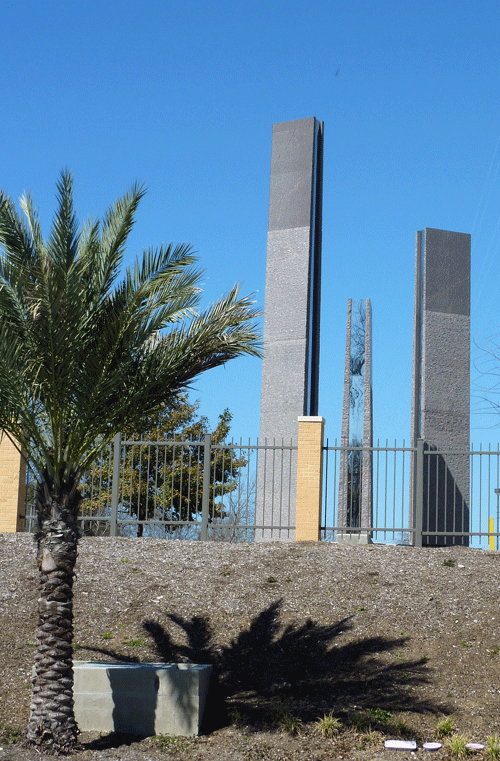
If one is watching where one is walking, they are easy to miss.  But south of Jones Avenue above the west bank of the San Antonio River, a trio of granite sculptures by Rockport-based sculptor Jesus Moroles pierce the sky.  The reflective spaces Moroles inserted between the slender slabs of granite forming River Steles make the sculptures appear to change constantly, depending on the viewer’s angle or the color of the clouds and sky.

River Steles, on loan to the San Antonio Museum of Art from the family of William W. Atwell, stands  on a piece of land created when a bend in the river was eliminated years ago to control flooding.

Jesus Moroles
River Steles by Jesus Moroles are found above the Museum Reach of the river, south of Jones.