Kersey’s pieces like portable public art you can throw in the dishwasher

To get an idea of the sculptural beauty of coffee mugs crafted by potter Diana Kersey, ride across the Mulberry Street Bridge or the Millrace Bridge leading to the Brackenridge Park Golf Course. Each of these bridges is graced with more than 200 square feet of the artist’s figurative tiles.

At first, I felt silly interviewing someone who recently completed these two major public art installations about coffee mugs, but Kersey put me at ease. Yes, she still loves taking a lump of clay and shaping it into a mug as her potter’s wheel turns.

“Small projects allow me to explore design ideas,” Kersey said. “These small works play into the design elements of larger ones.” Plus, she is never bored because: “No two mugs are exactly alike.”

Gayle Brennan Spencer in San Antonio Taste Magazine, December 2011

This slideshow requires JavaScript.

Steve Bennett spotlighted the first bridge Diana Kersey completed on the San Antonio River in a June edition of the San Antonio Express-News:

“The city wanted me to do something on the health of waterways,” Kersey said. “I started thinking about amphibians — you know, if the amphibian life was healthy then the waterway was probably healthy. And in doing my research I learned that the most common toad in this region is the Gulf Coast toad. It’s the one that we all know, that we all run across in our backyards.”

In bas-relief sculptural panels embedded in the bridge’s concrete guardrails above 8-foot sidewalks, Kersey visually tells the story of the life cycle of the toad, from the courting days of Mr. and Mrs. T to strips of frog egg “tape” floating on water to developing tadpoles and “froglets” to the mature toad with the ridges over the eyes and the mouth that turns downward, sort of sadly. The overall effect is a “primordial narrative” like the well-known ape-to-man evolutionary image.

The Millrace Bridge installation was scattered around the tables and floor of her studio when I interviewed Kersey for the story on coffee mugs. The clay since has been glazed and fired to attain striking colors evoking the exuberance of majolica pottery.

Kersey described how she takes clay large-scale in an interview with Gene Elder for Voices of Art Magazine:

I don’t really create ’tiles’ in the traditional sense. I build the panel as one giant piece of clay, and then when it is complete I cut the work up into smaller shapes that can easily be fired, transported and installed. That way the grout lines becomes an important part of the overall design.

Now installed, the panels on the bridge relate to the history of the park and the golf course. Gutzon Borglum, who worked on designs for Mt. Rushmore in his nearby studio, and George Brackenridge, looking a bit dour as one would expect from the man who forbade the consumption of malt beverages on the parkland he donated, are among the relief portraits in clay.

But the story of Queenie the dog stumped me completely? Kersey enlightened me:

Queenie the dog was the beloved dog of Jack O’Brien. Mr. O’Brien was a sportswriter for an early San Antonio paper and a huge fan of golf at Brackenridge. He helped start the Texas Open in the early years. Anyhow, the dog was always by his side and became a bit of a mascot at Old Brack. A portrait of her has hung in the clubhouse for over 60 years and is still there.

Kersey’s mugs are like small slivers of portable public art that you can take home with you – art that can be thrown in the dishwasher. Find Kersey at work in her new studio and showroom downtown in the Atlee Ayers Building at 112 Broadway.

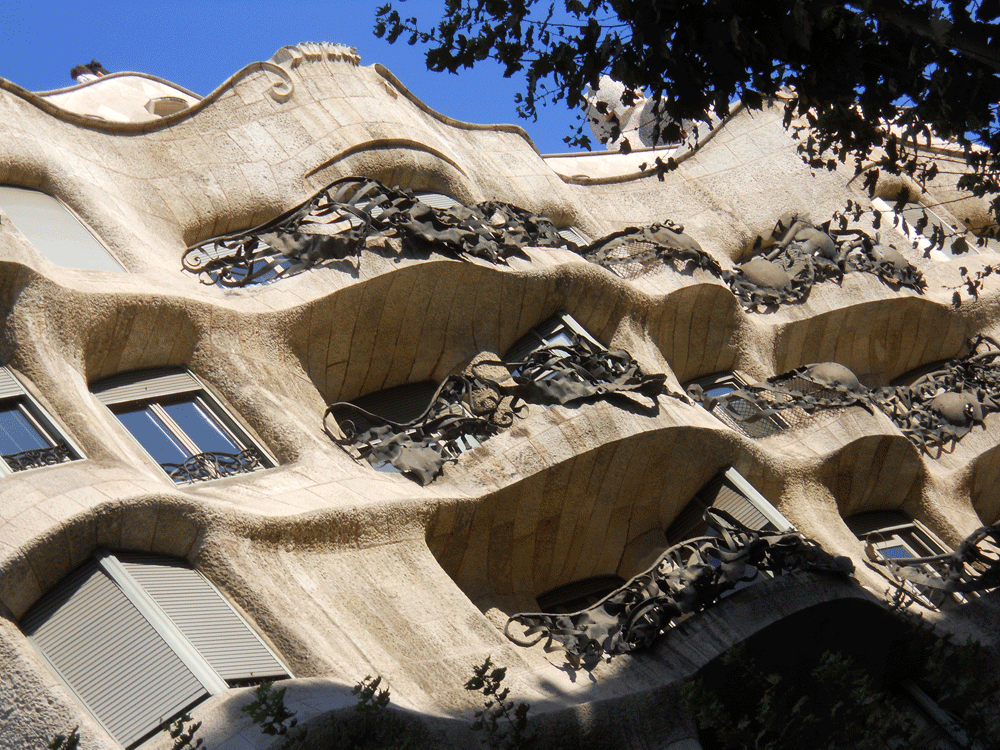
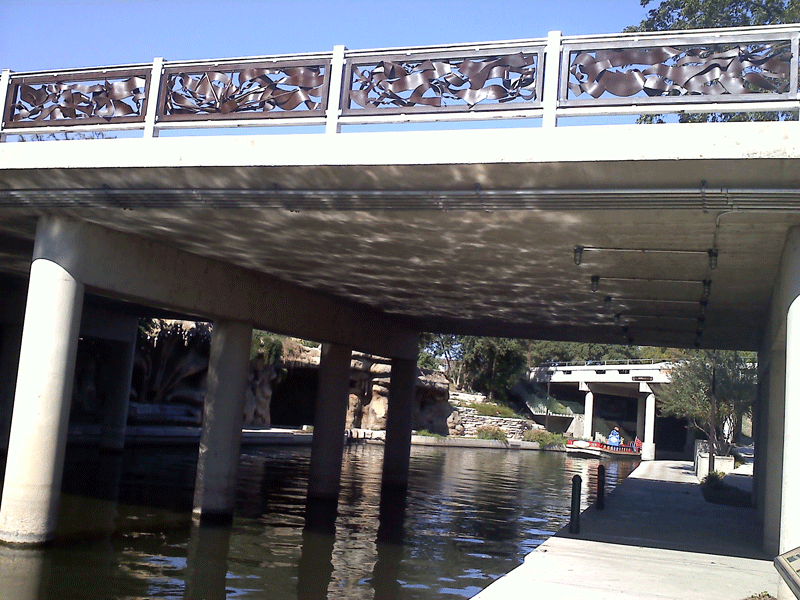
Ribbons of Gaudi-inspired steel ripple above the river

By the time I started this blog, most of the public art projects on the Museum Reach of the river seemed like old-hat. That is not to say the art is stale; I love it. I walked along there only this morning.

But I think the newest addition, a design inspired by balconies on a Gaudi apartment building in Barcelona, is by far the most stunning.

I already was a George Schroeder fan. Even though the stoplight is outrageously prolonged, I find myself driving south down New Braunfels, cutting across Funston and sitting at the intersection on Broadway to admire his entryway to Brackenridge Park. Its lines are so sensual and distracting, the poor car behind me generally is forced to honk.

I’ve become more of a Mission Reach kind of girl, but watching the installation of the railings on the Camden Street Bridge keeps drawing me back to that part of the river. That, and the fact there are no b-share stations south of Blue Star.

Steve Bennett of the Express-News wrote such a great story about the sculpture, I simply will defer to him:

“The whole design is based on the river,” says Schroeder…. Like a lot of Schroeder’s monumental public sculpture, such as “Passage” at the San Antonio Botanical Garden, “River Movement” was inspired partly by wanderlust.

“When I do these projects,” he says, “I try to make something that is drawn from my international travels. I try to bring something from that back to San Antonio.”

A longtime admirer of iconoclastic Spanish architect Antoni Gaudí‘s sinuous 1912 building Casa Milá, also known as La Pedrera (The Quarry) for its undulating limestone walls, Schroeder finally got a chance to see it in person during a trip to Barcelona…..

“The tangled-up metal (on the balustrades) looked very organic, an integral part of the building. So I kept that inspiration and drew on it for this project.”

My favorite part of Steve’s story is his assessment of the importance of this work:

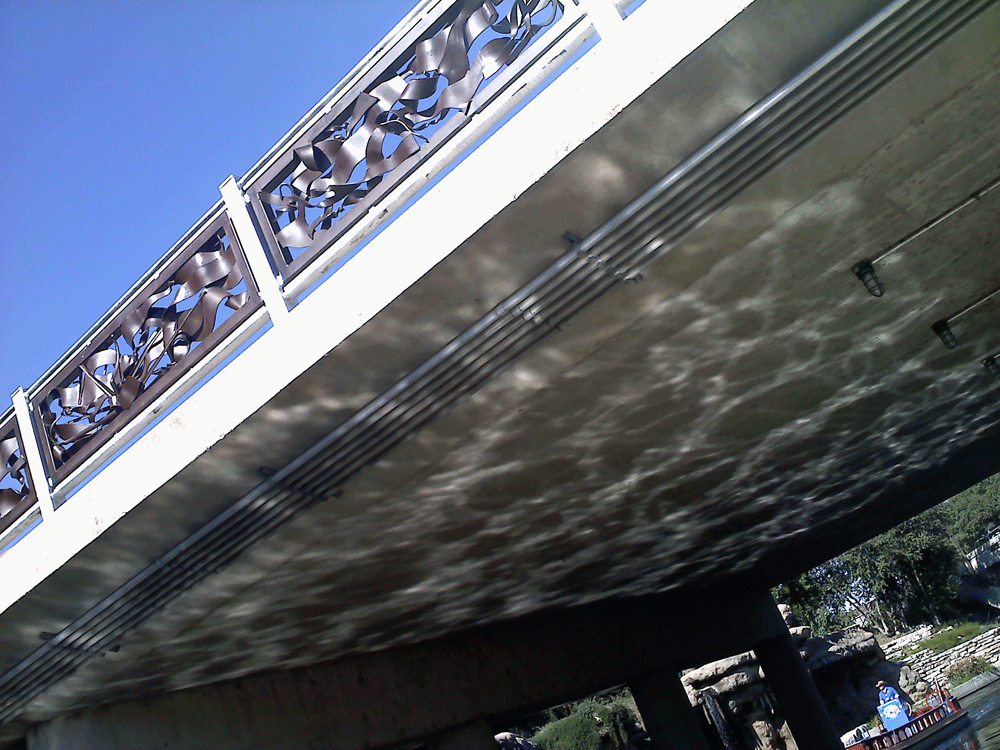
What he’s done is create another San Antonio landmark that will endure for decades, a work that mimics, in an abstract way, the ripples on the water and the breeze blowing through the plants on the banks, even the wakes of the tourist-laden barges that cruise by regularly.

And, my other favorite part: I had not realized there was more to come. The San Antonio River Foundation also is funding more of Schroeder’s work at Newell. 

Thanks.

And while you are in the neighborhood, don’t forget to look upward for the Jesus Moroles stellae….

November 11, 2011, Update: So often when I walk this part of the river, it is barely light. But yesterday morning, I waited for it to warm up a bit. The bright morning sun reflected from the rippling river onto the underside of the bridge makes Schroeder’s design inspiration even more obvious.  


Susan Toomey Frost stimulates a second revival of San Antonio’s traditional tilework

“Benign Obsession” was the moniker she assumed on eBay, but, fortunately for San Antonio, Susan Toomey Frost’s obsession with the products of San Jose Tile Workshops proved anything but benign.

I first “met” “Benign Obsession” online, back when eBay was more fun because you could see the id of those you were bidding against, begin to understand their patterns and learn from an expert willing to warn you of forgeries lurking out there. Susan, in fact, became the leading expert on San Jose Tile Workshops; she literally wrote the book about them. The stunningly beautiful publication, Colors on Clay, was published by Trinity Press in 2009.

I was excitedly telling Sally Buchanan, then president of the San Antonio River Foundation, that I finally succeeded in purchasing a San Jose plate on eBay when she casually mentioned her friend, Susan, was looking for a home for an entire tile mural. I was thrilled to be near one plate, but an entire mural…. With miles of extended riverside trails in the planning stage, surely we could find a home for a Work Projects Administration ((WPA) era mural.

And Susan said, yes, of course, she would donate it to the River Foundation. 

This slideshow requires JavaScript.

Privately commissioned by Mayor Maury Maverick, the 188-tile mural had been rescued by Susan from a home on Huebner Road that was slated for demolition. She flew in a tile preservationist from California to gently pry the mural from concrete and carefully stored the tiles for close to a decade.

“What I do,” Susan explained to me the other day, “is try to save their lives and get them in public view in a safe place.”

Architects from Ford, Powell & Carson came up with the ideal location within the project, directly below El Tropicano Hotel on the river, the point where the original Robert H.H. Hugman designed River Walk began and the new Museum Reach now extends northward. This also is directly below the spot where the mural was born – the Mexican Arts and Crafts shop operated in the old Nat Lewis Barn by Ethel Wilson Harris (1893-1884).

In Colors on Clay, Susan wrote that Harris became the technical supervisor of the Arts and Crafts Division of WPA in San Antonio in 1939. Sixty workers joined her existing crew of craftsmen in the workshop on St. Mary’s Street.

While I had long admired the two existing murals on the river resulting from the WPA program – the “Twin Cypress” mural on the stairway by the flood control gate at the northern end of downtown river bend and “Old Mill Crossing” now at the river level of Hotel Contessa by the Navarro Street Bridge – I had no idea of the quantity and diversification of the products resulting from the WPA program until reading Colors on Clay. In addition to the four spectacular 60-square-foot works – depicting a century of sports in San Antonio from Native American archers on Military Plaza in 1840 to high school football in 1940 – at the entrance to Alamo Stadium, here are other contributions Susan described:

Six weeks after Harris’s appointment, WPA workers were building a kiln to fire 500 sets of dishes for distribution to needy families….

Harris also supervised the wrought iron shop that forged lanterns, railings, table frames and other decorative and useful objects, including window grilles for the Spanish Governor’s Palace, a fountain in the form of lilies of the valley for the San José Burial Park, a wrought iron gate and window frames for the San Pedro Park bandstand, barbecue pits for Olmos Park, and fifty artistic foot scrapers for schools and city parks….

Because federal funding supported the program, charitable and public institutions in and around San Antonio received the products free of charge. City parks and golf courses, for example, received tile drinking fountains and 1,000 concrete and wooden benches carved with a Lone Star….

Susan’s search-rescue-and-return efforts have taken her on virtual and actual adventures throughout the country as she finds new homes in San Antonio and nearby for the tiles made here long ago. Her obsession with the project is only matched by her generosity: Texas State Centennial tables now live at the Witte Museum and the Wittliff Collection at Texas State University; a “Las Sombras” mural graces the cafeteria at St. Mark’s Episcopal Church; and soon works will be installed on the river behind the Witte Museum, at the Ceramics Studio of the Southwest School of Art, at the new theater at SAY Si and at the restored Women’s Pavilion in HemisFair Park.

And there is another mural, this one recovered from Indiana, that Susan has pledged to the Mission Reach of the San Antonio River Improvements Project. It, too, is returning to just below its birthplace. During her lifetime, Ethel Wilson Harris operated San José Potteries next to Mission San José and Mission Crafts within the mission compound itself. The Mexican village scene will be installed at the portal reconnecting the historical ties of Mission San José to the river.

In 1943, the Texas Legislature recognized Ethel Wilson Harris for her role in “the revival and perpetuation of Mexican arts and crafts,” skills Spanish friars taught Native Americans long ago on mission grounds, skills almost lost as Americans rushed pell-mell into an age where machines mass-produced what once had been crafted carefully by hand.

This traditional art form from San Antonio’s past is now entering its second revival due to the efforts of Susan Toomey Frost. Her obsession is bringing the tiles home to roost before they were lost or all ended up hidden away from public view in the homes of wealthy Californians.