
Richard Nitschke: Seeing Agave in a Different Light

When you take a flower in your hand and really look at it, it’s your world for the moment. I want to give that world to someone else. Most people in the city rush around so, they have no time to look at a flower. I want them to see it whether they want to or not….

I decided that if I could paint that flower in a huge scale, you could not ignore its beauty.

Georgia O’Keeffe

The striking beauty of the agave is not as hard to overlook as a petite flower, but four-foot by four-foot photos do command attention.

This slideshow requires JavaScript.

Long-prized in Mexico for both medicinal uses and for producing Tequila, the plant has earned great respect in South Texas for its ability to withstand droughts.

Although not opposed to Tequila consumption, Richard Nitschke views the agave differently. He photographs the ones on his Hill Country ranch over and over under varying conditions, pushing the limits of light by shooting into the sun, overexposing and underexposing in order to release compositions hidden within. His focus on light and design at times makes his images border on the abstract.

Two of his agaves won awards in the Paris International Fine Art Photo Competition, and two of his works are included in the permanent collection of the Bibliotheque Nationale de France.

“Agave” opens for a three-day run at the 110 West Olmos Gallery from 6 to 9 p.m. on Thursday, December 12. The photos also can be viewed from 10 a.m. to 6 p.m. on Friday, December 13, and from 10 a.m. to 3 p.m. on Saturday, December 15.

Prior to making his living in commercial construction during his child-rearing years, Richard studied ceramics with Steve Reynolds at UTSA and worked in the silkscreen studio at the Guadalupe River Ranch. He also is a bluesman, singing lead vocals and playing rhythm guitar and the harp with the Mister in the After Midnight Blues Band.

Catch the art, and then make time the following weekend to catch the band playing at Gustav’s Bier Garten behind Magnolia Pancake Haus on Huebner from 8:30 to 11:30 p.m. on Friday, December 20. The doctor temporarily has grounded Claytie’s warbling, but Ginger Pickett will be filling in with the kind of holiday blues you want to catch.

Rick Hunter lives here. And many other places.

Rick Hunter lives with us.

He is present when our whole family sits down for Thanksgiving dinner.

He greets us “Devine”-ly every time we walk in the door.

We are not special; he lives with many people.

This slideshow requires JavaScript.

The store-window-size tribute by photographer Al Rendon conveys how much respect Rick commanded from his fellow artists.

The walk-by cellphone photo of Rick’s photo in Al’s window should be a throw-away. But the layers quickly enveloped us.

Some of Rick’s last Facebook posts were of Day of the Dead, and particularly poignant was one of an aged woman.

The woman you can barely make out in this photo, the one hovering above my head as though reflecting our inevitable future, is seated by a grave. The Mister noted the death date carved in stone. Our birth year.

And then there are the reflections of the buildings across the street.

No one wandered this neighborhood more than Rick. We rarely set foot in Southtown without bumping into him. He loved his hood.

The streets seemed particularly empty this afternoon.

Sarah’s faces more than a thousand times better…

Summer 2010: St. Mark’s Episcopal Church. Check.

Witte Museum. Check.

Texas Highway Patrol Association. Uh… no.

I put the pen down and asked him why he wanted to send a check to the Texas Highway Patrol Association.

“Because they called several times and told me I owe them money.”

“Owe them money?”

“They said I pledged it.”

“Did you?”

“I don’t know. Probably. I always send them money. A couple of times a year.”

I started explaining to him again how telemarketers generally are wolves in sheep’s clothing. Even the Texas Department of Public Safety posted warnings about this unrelated wart tarnishing its reputation.

“But what about the poor families? The wives and children whose husbands are killed in the line of duty.”

He was but one victim among many who fell prey to an extremely lucrative fundraising scheme. According to a 2012 story by John Tedesco in the San Antonio Express-News:

The operation generated nearly $12 million in revenue from 2004 to 2009. Tax records showed it gave only $65,300 to troopers and their families over the same period, or roughly one-half of 1 percent of its fundraising.

The scam was busted. The Texas Highway Patrol Museum in Southtown, the front for the fake “charity,” was shuttered. The building sitting prominently at the intersection of Alamo and St. Mary’s Streets was sold; although the sale of it was quite contentious.

No one in the neighborhood missed the “museum;” the only thing appealing about it was the outside signage. Soon, though, the storefront windows were covered with plywood. An affront to the ‘hood.

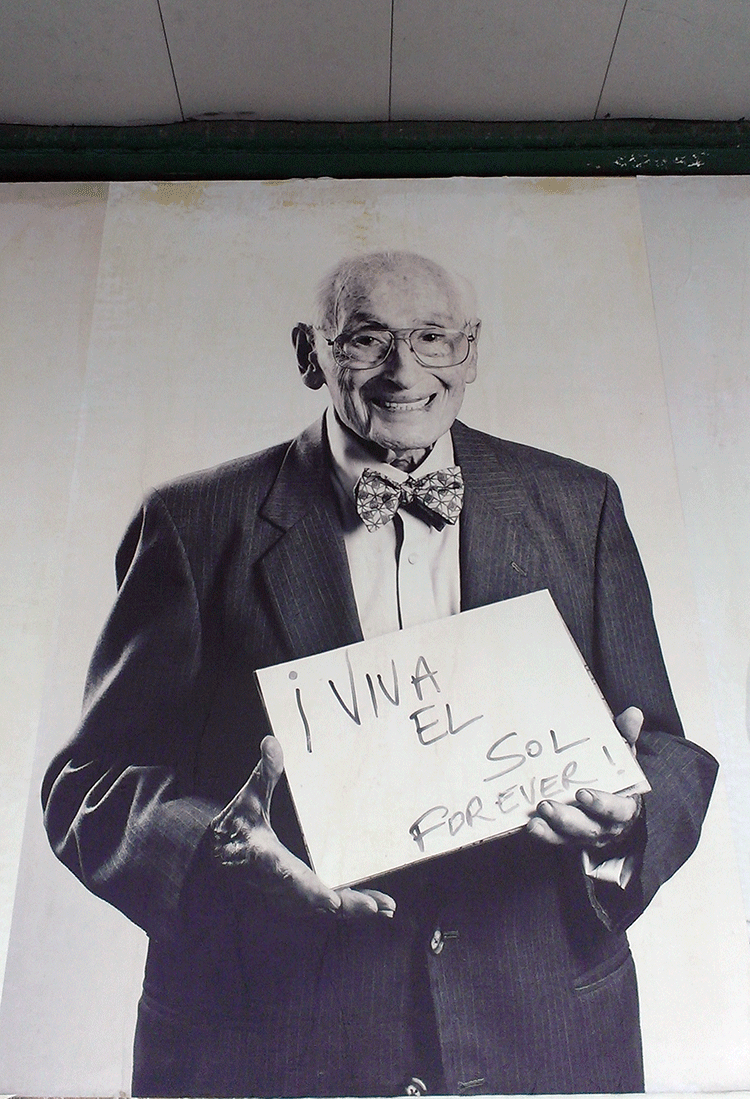
But photographer Sarah Brooke Lyons has helped the building save face by adding faces to disguise the plywood façade.

This slideshow requires JavaScript.

The faces peopling the building represent a small portion of the 1,005 Sarah is capturing as part of her public art project, which received a boost earlier this summer from a $1,000 grant from The Awesome Foundation. Here is her description of the project:

The desire is to showcase the diversity of San Antonio through the faces and thoughts of our community, and in doing so provide a clear image of what our city really looks like. Promoting the movement of DreamWeek San Antonio, and moving away from cliche’s of Riverwalk and margaritas; San Antonio is a cosmopolitan, multicultural epicenter with eclectic people looking to create an awesome place to live and celebrate our talents and interests. 1005 faces is a collaborative art project as it can only be created by the coming together of friends and strangers to create the full scope, and fulfill the goal of photographing 1005 distinct faces.

These faces, particularly that of centenarian Bill Sinkin, make me feel much better than the man sitting at the museum reception desk twiddling his thumbs while telemarketers scammed the elderly to plump his payroll.

Thanks, Sarah.